Every year, more than US$100 million in federal financing programs are allocated to support U.S. aquaculture businesses. But some producers are finding that availability and meaningful access can be two different things – and they are beginning to speak out.
It’s a seeming disconnect between government pronouncements to support the growth of U.S. aquaculture through these funding programs and the difficulties and hurdles business owners say they face when trying to access them.
“ One of the things that’s really making it a lot more difficult is the position of NOAA,” says Robin Pearl, co-founder and president of Florida-based shrimp genetics producer American Penaeid. “And it shouldn’t be this hard and it shouldn’t be this way.”
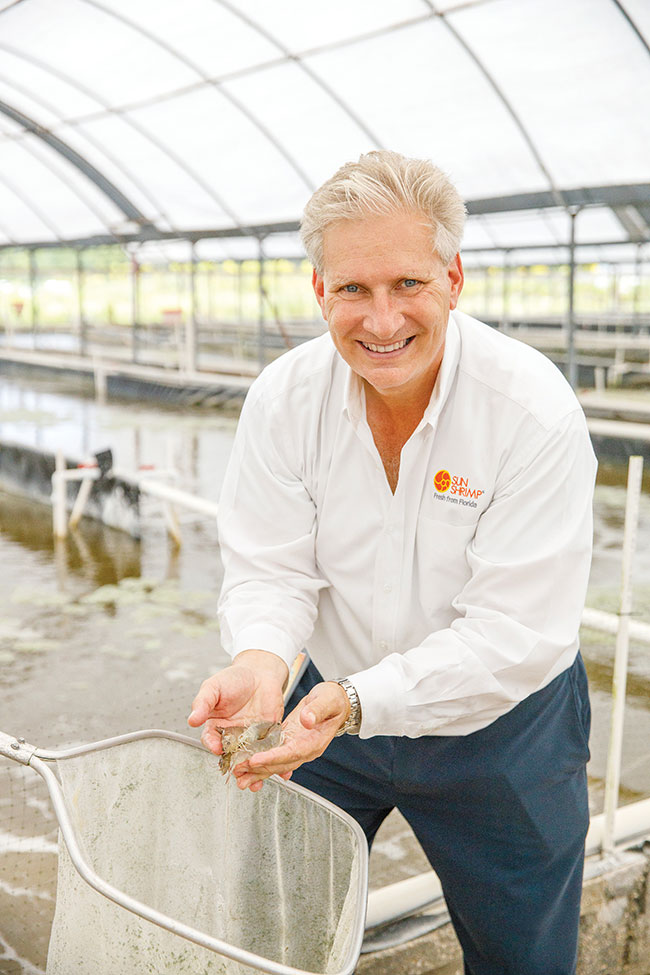
Pearl, who also co-founded American Mariculture (AMI), the company behind Sun Shrimp, maintains the current system governing NOAA-managed financing programs has not been responsive to the needs of seafood farmers, especially after their businesses have had to endure a global pandemic and other natural disasters.
AMI and American Penaeid filed for bankruptcy in January 2025, after taking a significant hit from the global shrimp market downturn following the COVID-19 pandemic.
“ We’ve been in business for 12 years, and we’ve sold over a hundred million dollars worth of shrimp. If one of the better qualified companies in America cannot succeed or cannot find the support that it needs, how does anybody else have a chance?” Pearl says.
As the federal agency that oversees U.S. aquaculture, NOAA offers several funding opportunities for aquaculture research and development, as well as for commercial businesses. In particular, the NOAA Fisheries Finance Program (FFP) provides long-term fixed rate loans for the fishing and aquaculture sectors with an annual allocation of $100 million.
AMI was among the aquaculture companies to have been approved for the FFP. Having gone through the application, approval, and funding processes, Pearl has experienced first-hand the flaws within that system. In a July LinkedIn post, Pearl called it “the worst mistake I ever made.”
There is no publicly available data on how many companies have received loans through the FFP or how much has been extended to aquaculture businesses to date. As of press time, NOAA did not respond to questions from this writer. (Editor’s note: NOAA submitted a reply after press time and we included their perspective in this article.)
Slow growth
Despite a national goal of advancing its domestic aquaculture industry, the U.S. still imports as much as 80 percent of its seafood supply. Domestic aquaculture only accounts for seven percent of the total U.S. seafood supply, according to data from NOAA Fisheries.
“The U.S. isn’t even in the top 10 of the countries in the world for aquaculture production and value,” says Nicole Kirchhoff, founder and CEO of Live Advantage Bait, which produces warmwater marine fish, fingerlings, and eggs for baitfish and foodfish grow-out, research, and restoration.
“Part of this is our lack of governmental support compared to other nations. The top countries support aquaculture through tax incentives, subsidies payment for ecosystem services, and direct-to-business financing and loans.”
While there is no information available pertaining to loans facilitated through the FFP, NOAA’s Sea Grant does provide some data on its federal investments. Sea Grant is a federal-university partnership program supporting coastal marine and Great Lakes communities through research and education. From 2018 to 2023, the program has invested an average of $16.3 million in aquaculture annually, resulting in $69.6 million in economic impact.
Knowledge gap
Kirchhoff, who is also a marine biologist, notes a large chunk of government funding, up to 95 percent, goes to federal facilities, universities, and not-for-profit organizations, leaving very little money for private businesses.
“ Other countries, for example in Australia where I was, they have a model where most of the funding for aquaculture is either directed by the farms themselves – they actually have to sign off on it – or is actually paid to the farms to do the work. And then the academics help either the data collection or the writeup or ways,” Kirchhoff says.
The Live Advantage Bait CEO has travelled around the world exploring global aquaculture industries, and has spent five years in Australia, where she has significantly contributed to tuna conservation, aquatic animal health, and fish welfare.
Aquaculture farmers often find themselves in competition with NGOs and research institutions when it comes to government funding. “Sadly, one of our biggest competitions has too often become the very institutions tax payers are funding to help us.”
Kirchhoff says she hopes for better collaboration between research institutions and commercial farms, with the common goal of advancing the economic benefits of aquaculture. Funding policies that make research institutions more accountable to increase farm productivity – such as knowledge transfer and providing a path to commercial viability – would be most beneficial to the industry. Currently, there are no meaningful incentives for academia to pursue these kinds of industry-focused outcomes; instead the objectives have mostly been for academic publishing and student education.
Kirchhoff says one area of research and industry collaboration would be to use commercial farms for research purposes, instead of universities building their own facilities, which typically lack the economy of scale that a commercial farm might provide.
“We spend a lot of money on aquaculture research but it’s not being spent in the right areas. As you can see from the last 20 years, 30 years, aquaculture really has not grown in the United States,” she says.
Private funding and regulatory hurdles
Beyond government funding, private capital makes up a significant amount of investments into global aquaculture. In 2023, more than $1 billion in venture capital flowed into aquaculture start-ups, globally, with investments focused on sustainable production, a report from AgriTech Insights says.
Securing funding from traditional banks, however, is another story.
“Banks still consider (aquaculture) a high-risk industry,” says Kirchhoff. “Securing loans is nearly impossible and comes with a high cost. Without collateral, most businesses can’t even get started without their own money or investors’ (money). Investors (often) don’t get the returns they want so you are looking at a smaller pool of passionate investors to keep us going.”
Pearl says banks are typically wary of providing loan facilities to aquaculture businesses due to assets that are not easily collateralized. For instance, the land where the aquaculture facility stands can be used as collateral, but not the actual facility.
“Commercial banks are generally not part of the mix because they say it is just too risky,” he says. This is why government funding and loan facilities are crucial, and need to be designed to better serve the industry.
The Fisheries Finance Program was established in the 1970s. Pearl points out some pain points of the loan approval process and the hoops that a business still has to go through even after approval to actually access the money.
For one, he says the requirements that a business applicant must prove 75 percent U.S. ownership could be problematic for start-ups who have had to rely on foreign capital to fund their projects and would automatically disqualify them for the loan.
“When you are an investor in my company, in my shrimp farm, and let’s say you invested $20,000. And then I say, ‘Oh, by the way, can you send me your passport? I need your social security card. I need to make sure that you’re an American.’ That doesn’t go over well with investors,” Pearl says.
The reimbursement model for accessing an approved loan also needs revisiting, he adds. When the loan is approved, the money is placed in escrow from which the company can draw after they have incurred the expense and request for a reimbursement. This means a company which has been approved for the loan still has to come up with hundreds of thousands of dollars upfront, and spend that money before it can get reimbursed.
“So when (NOAA) finally gave us the (loan) money, they didn’t give us the money,” Pearl says. “ They took the $4.8 million they put in an escrow account with Wells Fargo and they said, ‘Now the minute you spend half a million dollars, you could file a draw and then we’ll pay back $400,000.’”
The recognition of the regulatory hurdles faced by aquaculture companies is not new. In 2018, during a Senate hearing held by the committee on commerce, science, and transportation, then senator John Thune of South Dakota stated, “Currently, however, those seeking to expand the domestic farming of seafood often face a confusing regulatory maze. Permits for an aquaculture farm may be required from the U.S. Army Corps of Engineers, the National Oceanic and Atmospheric Administration, the Environmental Protection Agency, the Coast Guard, the Department of Agriculture, and the Food and Drug Administration. This overlapping web of federal jurisdiction and lengthy, sometimes unending, permitting process can take 10 years or more, scaring many investors away.”
Vocal voices
After enduring financial difficulties and a federal regulatory system that he believes does not help the industry thrive, Pearl says he is now becoming more vocal about pushing for a change in the system.
“We are a leading company in our field, but I’ve done very little to actually promote… the whole industry. What we do is hard and I was just trying to figure out how to survive and how to work and how to grow.”
“I realize now that was a mistake on my part. I should have been much more vocal, much more active, even when I was having these issues with NOAA, three years ago, four years ago,” Pearl says.
He acknowledges that it can be difficult for the industry to speak up against the system, but with the current administration’s push towards strengthening domestic production, across all industries, Pearl says this might be a good time to lobby for change.
Kirchhoff says collaboration is key, not just among producers and farmers but also with researchers, NGOs, and the government.
“I work closely with nearly a dozen universities and NGOs – fantastic, smart, driven, and wonderful people. Many see the need for change and want change so they can use limited dollars and their employment and resources to help,” she says.