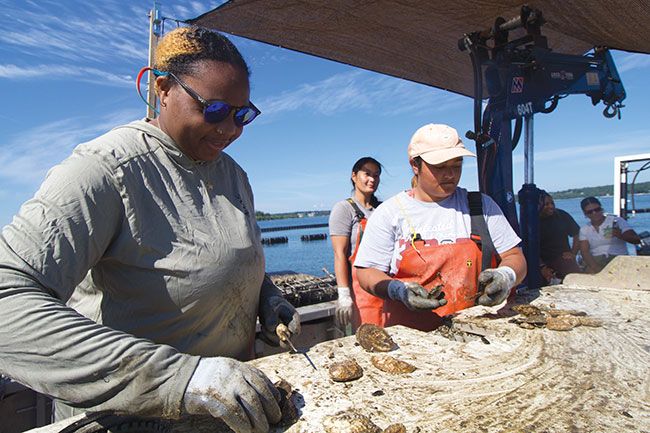
After talking with a few of the international students who were part of the Minorities In Aquaculture (MIA) 2024 internship cohort, I had no idea how hard it truly was for them to become involved in our industry. Of course, these experiences don’t speak for every international student, but for some, it’s a long road of hoping to find a place that will see them not as a short‑term hire, but as a long‑term part of the team.
And when I look at the bigger picture, I can’t help but ask myself: how many amazing people have we passed up on and dropped at the last minute when we find out there’s another step to the process?
The bigger picture
Nationally, the labor gap is striking. There are eight million job openings in the U.S. but only 6.8 million available workers. Projections show this deficit could grow to six million by 2032 (IDP, inSpring & AIRC, 2024).
While headlines focus on nursing or advanced manufacturing, aquaculture and other blue economy fields feel these pressures acutely, especially in regions where specialized talent is already scarce.
Researchers note that “the limited and declining pool of working‑age Americans cannot alone meet the demand for skilled labor; integrating international talent is no longer optional but imperative” (IDP, inSpring & AIRC, 2024).
It’s important to remember that even at the federal level, the topic of international students in the workforce has been shaped by shifting priorities. During the Trump administration, there was significant scrutiny on visa programs like H‑1B and Optional Practical Training (OPT). In 2020, for example, proposed rules aimed to limit the duration of certain student visas and add heightened reviews for work authorizations – policies that, while not fully implemented, created uncertainty for employers and students alike (U.S. Department of Homeland Security, 2020).
At the same time, administration officials publicly emphasized the need to “protect American workers first,” which often left international graduates unsure of their standing in long‑term workforce planning (Redden, 2020).
An untapped solution
International student enrollment in the U.S. reached 1.126 million in 2023-24, with 56 percent pursuing STEM degrees and nearly 73 percent wanting to stay and work after graduation (IDP, inSpring & AIRC, 2024). These students bring cutting‑edge skills in biology, engineering, logistics – precisely what aquaculture operations need to grow sustainably.
The reality, however, is that these students often face steep adaptation challenges. A 21‑year trend analysis found that sociocultural and academic barriers – language issues, cultural isolation, and systemic misunderstanding – remain the most persistent hurdles worldwide (Oduwaye et al., 2023).
“International students face similar challenges regardless of their host country, with no significant improvements over the past two decades,” the study concludes (Oduwaye et al., 2023).
Barriers holding them back
I’ll be honest, until last year, I had never navigated the work visa process, let alone with three interns, all with different needs for support. I didn’t realize how it could feel like a high‑stakes leap for both employer and candidate.
Yes, there’s an upfront investment when it comes to sponsorship, and yes, hiring anyone new is risky. But as I’ve listened – and continue to hear – about the hurdles faced by international students I’ve met or supported as they try to break into this workforce, I’m more curious to know: is it truly the work visa standing in the way of hiring international talent, or is it the systemic lack of understanding of navigating through the process?
What’s striking is that we already have a pathway: Optional Practical Training (OPT). This allows STEM graduates up to three years of work authorization per study level without employer sponsorship. There’s no lottery, no cap, and no direct cost to employers – yet many companies in niche sectors like aquaculture aren’t aware of it (IDP, inSpring & AIRC, 2024).
Even as OPT remained in place under the Trump administration, it came under review multiple times, which the Association of International Enrollment Management noted created “a climate of hesitation among employers unsure of long‑term policy stability” (AIRC, 2020). For international students, those signals added another layer of uncertainty to an already complex process.
The human side of the challenge
Studies reveal that 82.9 percent of international students face sociocultural challenges, like language barriers, homesickness, an discrimination (Oduwaye et al., 2023).
In my conversations with students, I’ve heard echoes of that research – stories of brilliant young scientists struggling to feel seen because of an accent or because their questions about sponsorship felt like a deal‑breaker to potential employers.
One student said plainly, “It’s not about whether I can do the work. It’s about whether someone will take a chance on me long enough to prove it.” That hit me hard.
But change is possible. The Ritedose International Student Engagement (RISE) program pairs a pharmaceutical company with a college to build a talent pipeline. At Case Western Reserve University, targeted employer education and career services have helped international graduates outperform domestic peers in employment outcomes – only one percent still seeking employment compared to 3.5 percent overall (IDP, inSpring & AIRC, 2024).
And of course, what does this mean?
Imagine similar partnerships in aquaculture – hatcheries and universities working hand-in-hand, regional seafood tech incubators teaming up with STEM programs. By breaking down barriers and using models like RISE, we could potentially unlock a steady stream of talent ready to innovate and grow our industry.
I’ve devoted my career to equipping the next generation of the aquaculture workforce with the tools and opportunities they need to thrive, while also working to uncover, address, and solve the very barriers that have slowed the growth of our industry’s career pipeline. Through these conversations – and by witnessing firsthand the untapped brilliance, dedication, and passion international students bring to this field – I see things differently now. We may very well be overlooking some of the most driven, well‑prepared, and resilient future leaders aquaculture could ever hope to have.
As AIRC, IDP, and inSpring put it (2024), “International students represent an underleveraged solution for industries experiencing chronic talent shortages, particularly those requiring STEM expertise.”
In addition to Oduwaye et al. (2023) reminding us that those challenges these students face aren’t going away on their own, we can’t afford not to address it as we improve the viability, accessibility, and global presence of the U.S. seafood industry moving into the future.
So I’ll leave it here with this: In an industry, like aquaculture and the maritime field, that strongly depends on innovation and resilience, how many exceptional international graduates have we quietly overlooked – simply because the path to hiring them felt unfamiliar – and how much longer can we afford to let that untapped talent slip away?
Have a workforce development or industry challenge you’d like me to explore next? I’d love to hear what’s on your mind – email me and share what’s resonating with you right now.
References
- IDP, inSpring, & The Association of International Enrollment Management (AIRC). (2024). “Connecting Industry & Education: International Talent as a Solution to the U.S. Labor Shortage.”
- Oduwaye, O., Kiraz, A., & Sorakin, Y. (2023). “A Trend Analysis of the Challenges of International Students Over 21 Years.” SAGE Open. https://doi.org/10.1177/21582440231210387
- U.S. Department of Homeland Security. (2020). “Establishing a Fixed Time Period of Admission and an Extension of Stay Procedure for Nonimmigrant Academic Students, Exchange Visitors, and Representatives of Foreign Information Media.” Federal Register, 85(189).
- Redden, E. (2020). “Trump administration proposes major changes for international students.” Inside Higher Ed. https://www.insidehighered.com/news/2020/09/25/trump-administration-proposes-major-changes-international-students
Imani Black is an aquaculture professional, advocate, and industry trailblazer with a decade of experience in oyster farming and hatchery management across Maryland and Virginia. As the founder of Minorities In Aquaculture and a graduate with a Master’s degree in Ecological Anthropology from the University of Maryland Center for Environmental Science, she is dedicated to fostering workforce inclusivity and equity through mentorship, education, and advocacy. (imanib@mianpo.org / www.mianpo.org / @imaniiiblackkk)