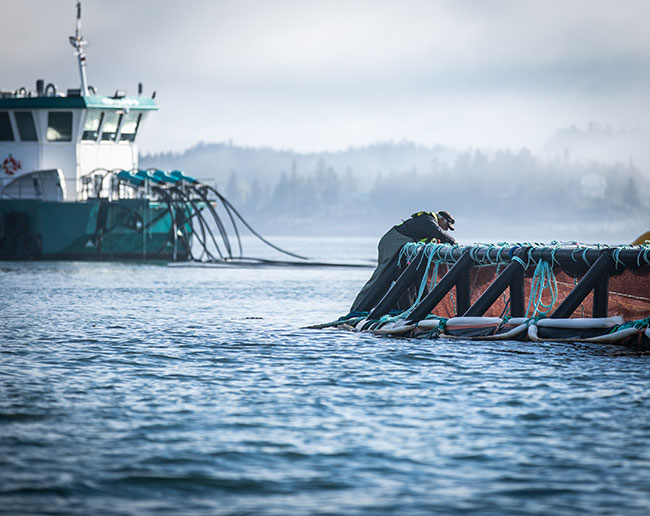
As the changing dynamic in Canada’s salmon farming sector continues to bear down, industry advocates are now looking to Prime Minister Mark Carney’s new Liberal government to provide a clear path forward for salmon farmers.
Banking on the federal government’s ambitious pronouncements for nation-building projects to boost an economy weakened by the ongoing trade war with the United States, Canada’s aquaculture industry has been actively lobbying Ottawa to get lawmakers’ attention. With the looming deadline for B.C. net-pen farms to be banned by 2029 and an entire industry virtually at a stand-still, a lengthening status quo could have significant economic consequences.
“ The decisions and all the indecisions in the last six years has suppressed capital coming into Canada. And it has actually suppressed innovation,” says Tim Kennedy, president and CEO of Ottawa-based Canadian Aquaculture Industry Alliance (CAIA), one of the leading organizations spearheading advocacy efforts on behalf of the industry. “ What we’re really hoping is that the current government can provide very positive signals so that capital and investment can be released to actually work on the innovation that needs to happen to have more efficient and sustainable production in British Columbia.”
And with Carney’s Canada Strong 2025 federal budget narrowly passing the House of Commons in November, the industry is optimistic those clear signals will emerge soon.
Stagnant growth
In the meantime, as the breadth of the socioeconomic impact of the ban becomes increasingly evident, concerns about investability, growth, and innovation in an industry that contributed over a billion dollars to the national economy in 2023 continue to loom.
B.C.’s salmon production has declined 45 percent over the last six years, dropping from an annual output of more than 90,000 tonnes to less than 50,000 tonnes, according to data from the B.C. Salmon Farmers Association (BCSFA). This dramatic reduction was a result of several farm closures across the Broughton Archipelago, Discovery Islands, and the Sunshine Coast.
“ I’m worried about the investability of Canada’s resource economy generally,” says Ken Coates, professor emeritus at the Johnson Shoyama Graduate School of Public Policy, University of Saskatchewan.
“ We’re scaring away billions of dollars, tens of billions of dollars of investment every year from energy, from mining, from forestry, from other things, because our regulations are not seen as being reasonable, and not competitive on an international scale.”
Coates is the author of a report published by public policy think tank Macdonald Laurier Institute that investigated how Canada’s salmon farming industry could benefit coastal communities, foster cooperation with First Nations, drive innovation and protect wild salmon.
In the report titled, “Swimming against the tide: The case for salmon fish farming in British Columbia,” Coates called for the reversal of the ban on net pen farming, “and returning to evidence-based decision-making that relies on government scientists, Indigenous knowledge and academic experts.”
“On the surface, salmon farming seems like a logical place for the Government of Canada to re-evaluate their programs and activities. And we’ve heard signs that (the government) is doing exactly that and they are having those conversations,” Coates says.
He noted, however, that despite those “signs” the industry has yet to see evidence that the government is taking a new or different policy approach from its predecessor. But time is of the essence, says Coates.
If the ban is not resolved soon and net pen farms are allowed to shut down, the federal government could face millions, if not billions, of dollars in compensation claims, he explains.
“The closures will also see very successful coastal communities, including Indigenous communities, suffer egregious changes in their economy, and therefore in their society and their wellbeing. It would be mind-boggling to think our Government of Canada would allow that to happen,” says Coates, adding that he remains cautiously optimistic the government will respond positively.
According to the Indigenous Partnerships Success Showcase, there are currently 17 First Nations that have agreements and business arrangements with finfish aquaculture companies in B.C. It estimates the economic fallout from the salmon farm closures could negatively impact more than 4,700 and C$1.2 billion (US$858.4 million) in economic activity.
Data from the BCSFA indicates the province’s salmon farming sector employed approximately 7,500 people in 2019. Farm closures over the last six years have since resulted in 3,000 jobs lost and C$170 million (US$121.6 million) in lost income for families.
Movers and shakers
Canada’s biggest salmon producers have been making significant moves that signal a changing business dynamic, particularly in B.C.’s salmon farming sector.
In July 2025, global salmon producer Grieg Seafood, which has been operating in Canada for more than 30 years, announced it is divesting its Canadian operations, in a US$1-billion-dollar sale agreement with Cermaq, which also includes Grieg’s Finnmark operations.
The deal, which as of this writing is undergoing review by the Competition Bureau, if approved effectively boosts Cermaq’s salmon production capacity in Canada. Still, Cermaq has earlier expressed concern about the growing uncertainty in international investments in Canada, exacerbated by the B.C. ban.
“While every other salmon producing country has farming licenses of at least 25 years duration or eternal duration, the short license length in British Columbia continues to be a barrier to significant investment, despite our strong willingness to grow the industry,” Cermaq CEO Steven Rafferty said in a statement issued in 2024.
In the same year, salmon giant Mowi announced a strategic review of its Western Canada operations, following the closure of its Discovery Island farms and a processing facility in Surrey, B.C. in 2022.
CAIA, along with industry stakeholders and regional aquaculture associations across Canada were in Ottawa in November meeting with members of parliament.
”We’ve gone through a period of economic stagnation under the previous government,” says Kennedy. “So, Prime Minister Carney focusing on economic opportunity is very welcome. And our deep hope is, of course, that the B.C. situation is looked at very carefully.”
Kennedy notes that industry advocates are not necessarily calling for a return to the 2019 pre-ban era. A lot has changed within the sector over the last six years. Farms and facilities have permanently closed, and new and deeper partnerships have since been forged with local First Nations.
“We need clear signals from the government around performance outcomes. So that it’s clear for the industry where we need to go,” says Kennedy. “ It’s really a pathway towards clarity of outcome, and a longer term pathway so that companies can invest.”
The BCSFA, which represents some 60 businesses and organizations within B.C.’s finfish aquaculture value chain, has maintained that closed containment systems, which the federal policy has favoured as an alternative to net pens, is just not a realistic or achievable option by 2029.
“The technology has not been proven to scale anywhere in the world,” says Michelle Franze, BCSFA manager of communications, partnerships and community. “Under a renewed and responsible policy, investment can reopen, allowing the sector to generate C$2.5 billion (US$1.8 billion) in annual economic output and 9,000 jobs by 2030, and C$4.2 billion (US$3 billion) in annual economic output with over 16,000 jobs by 2040.”
Atlantic Canada
Amid the uncertainties facing its Western counterparts, Atlantic Canada’s salmon farming sector offers a silver lining. Unlike the federally regulated B.C. sector, regulatory jurisdiction of aquaculture in the Eastern region remains in the hands of the provincial governments.
And Atlantic Canada farmers would like to keep it that way.
“ It’s a wonderful storyline to date,” says Tom Taylor, executive director of New Brunswick-based Atlantic Canada Fish Farmers Association (ACFFA).
“ It’s on us to continuously promote, advocate, provide education on what we’re doing. We need to protect these jobs and the socio-economic benefits we’re getting here in Atlanta Canada.”
The region produces around 58,000 metric tonnes of Atlantic salmon annually, directly and indirectly supporting about 8,000 jobs. With B.C. production drastically reduced to less than 50,000 tons a year (~45,000 metric tonnes), Atlantic Canada is now producing more than Western Canada.
Even as Atlantic Canada slowly builds its own salmon production capacity, Taylor says it is in the region’s best interest to stop the shrinking of B.C.’s salmon farming sector.
“We’re going to see the realization of the negative impact [of the ban] beginning heavily this fall (2025) in B.C., and so we need a signal from the federal government very soon,” he says.
Taylor was among the industry stakeholders that lobbied in Ottawa in November and he says they received a “very strong, supportive message” from members of parliament.
The socioeconomic impact of salmon farming can have an extensive ripple effect throughout the value chain, Taylor explains. “When a transport truck travels to a northern community like Klemtu to receive Atlantic salmon that have been raised, processed, packaged and now ready to go to urban city centers, these transport trucks are bringing fresh fruits and vegetables, canned goods and frozen goods and other things that never came to those communities in the past.”
“It’s these benefits that people don’t even see or recognize that are real in everyday lives for people living in rural communities,” Taylor adds.
He, too, expresses optimism that the aquaculture sector would soon gain some traction with Carney, given that Canada’s aquaculture generates about C$5 billion (US$3.6 billion) in economic activity.
“To me, that is very significant to the prime minister. I’m sure it will catch their attention.”