Last June when anti-aquaculture groups appealed a key U.S. Environmental Protection Agency (EPA) permit for Ocean Era’s Velella Epsilon demonstration project in the Gulf of Mexico, CEO Neil Anthony Sims immediately shot back with a press release accusing “a few agenda-driven activist lawyers” of “pushing emotionally charged, anti-science arguments” which robbed the Florida fishing and boating community of the opportunity to form their own opinions on offshore aquaculture.
Undeterred, the Hawaii-based marine biologist expressed determination to move forward on the project, despite seven years of permitting hurdles.
In light of such setbacks, however, industry watchers globally are beginning to ask how aquaculture leaders and young people alike can sustain the commitment to develop the scientific innovations and regulatory reformation necessary to launch a totally new food production system.
Aquaculture North America spoke with Sims, who told us about the experiences that have driven him to become the kind of advocate people often turn to for insights and inspiration. He was as likely to quote Confucius as economic and climate data.
What’s at stake
The imperative to grow finfish in the deep ocean has only strengthened as people have recognized how animal protein production impacts the climate and other limited resources, particularly land and fresh water.
“If you are passionate about personal health, ocean health, and planetary health, then you should be eating more sustainably farmed seafood. It’s one of the least impactful, most readily scalable forms of animal protein production on the planet,” says Sims.
Today, many leading environment organizations – the World Wildlife Fund, Conservation International, Environmental Defense Fund, and The Nature Conservancy – all advocate for increasing the world’s supply of seafood through aquaculture.
And, for both health and environmental reasons, Americans are eating more seafood. In fact, consumption increased 31 percent between 2002 and 2021, according to the National Oceanic and Atmospheric Administration (NOAA).
Yet between 70 and 85 percent of that seafood is imported. For consumers who like to know where their food comes from, it is an uncomfortable fact that 90 percent of shrimp, the most popular seafood in the U.S., is imported.
“When we produce seafood in the U.S., we ensure it’s environmentally and socially sustainable, something not always guaranteed in imports,” noted Danielle Blacklock, director of NOAA Fisheries Office of Aquaculture, in an email.
What’s more, greater seafood production in the U.S. would help reverse the significant trade deficit: the difference between imports and exports has been running at over $20 billion in recent years, according to the U.S. Department of Agriculture.
“To produce seafood at a scale that feeds families, offshore development must be part of the solution,” Blacklock added. So, where does it stand?
Forays offshore
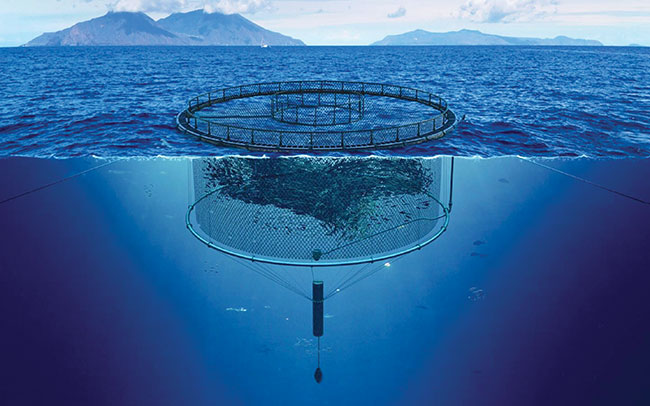
In 2001, Sims and a business partner began developing a fish farm off the coast of Kona, Hawaii. Today that operation, called Blue Ocean Mariculture, produces over 800 tons of sashimi-grade Hawaiian Kanpachi in net pens that can be submerged up to 30 feet (9 meters) below the water’s surface. It is the only commercial farm in the U.S. to raise fish in the open ocean.
”It’s been operating now for over 20 years, and there has been no significant impact on water quality. It is just half a mile from a beautiful stretch of coral reef. On any evening, there will be 15 or 20 boats there with tourists diving among the manta rays. Has the dive community complained?” asks Sims.
“Crickets,” he answers, adding, “Put diving among the manta rays on your bucket list.”
In 2011, Sims’ interests in next-generation technologies led to the launch of the Velella Beta-test Project. In partnership with Lockheed-Martin, the Beta test was an unmoored Aquapod that drifted for eight months off Hawaii Island. The Beta-test kampachi grew twice as fast as expected.
Velella Beta was named one of TIME magazine’s “Best Inventions of the Year 2012.” Through financial support from Illinois Soy Board, Velella Gamma then followed. This moored array demonstrated remote command-and-control technologies.
Now the third iteration, Velella Epsilon, is destined for the Gulf if it can overcome the challenge to the NPDES (National Pollutant Discharge Elimination System) permit, issued by the EPA last May.
With funding from National Sea Grant, this pilot-scale project will feature new technology (a SeaProtean submersible net pen) and a new fish species (red drum).
Goals of this demo project
Through Velella Epsilon, scientists will be able document the performance of the fish, as well as its impact on the marine ecosystem. In addition, they will monitor its effects as a fish aggregating device (FAD), which could benefit commercial, recreational, and charter boat fishermen.
The project was also intended as a demonstration of how to obtain permits for offshore aquaculture in the U.S. As Sims sees it – and the last seven years have demonstrated – “there is clearly deep dysfunction in the current permitting process.”
Offshore aquaculture projects require compliance with the National Environmental Policy Act, the Clean Water Act, the Endangered Species Act, the Magnuson-Stevens Act, and the Marine Mammal Protection Act. The public can weigh in at every stage; groups like Friends of Animals, Don’t Cage Our Oceans Coalition, and the Center for Food Safety all filed appeals or lawsuits to stop the Velella Epsilon project.
“Currently, there’s no clear legislation that tells you what you need to do, what the rules are around submitting for a permit, who oversees it, and how you move the process forward,” adds Dick Jones, whose resume includes CEO of Blue Ocean Mariculture, co-founder of the global nonprofit Ocean Outcomes, and director of seafood buying programs at both HEB and Whole Foods.
Passion for the ocean
If the conservation groups who have opposed the Velella Epsilon project could meet Neil Sims, they might take pause.
After earning a Bachelor’s at James Cook University, he started his career in the Cook Islands Ministry of Marine Resources – the government agency which protects wild fish stocks and marine biodiversity.
The experience frames much of Sims’ philosophy about the relationship between humanity and the oceans.
“I’ve seen islands that supported viable artisanal fisheries, which had been sustainably managed under traditional regimes for decades, and then some bright spark shows up with a vacuum packer and a blast freezer, and in six months it’s all over. The fish are gone,” he says. “And I’ve seen islands where the pearl shell diving industry transformed – in a matter of months – to a pearl farming industry, with tremendous economic, environmental, and work-safety benefits.”
The black pearl farming industry was in its inception in the Cooks during the mid-1980s. Previously, pearl shell diving supplied the jewelry and button trades. Local divers were free-diving these lagoons, ripping pearl oysters out, killing them, and then selling the shell for about US$2 per oyster.
But farming offered a lucrative alternative, Sims says, “if you farmed that same oyster and instead of killing it for the shell, you hung it from a long line, nurtured it, and then had a technician come and implant a black pearl nucleus into that oyster. And then, if you tended that oyster for two more years, you would have a pearl that was worth, at that time, US$85 in the Tahiti auction. And you still had the oyster!”
“ So, very early on, I realized there was a sweet spot: using economic incentives to drive what we saw as the ecological imperatives. And that has been the underlying imperative of my career,” Sims says.
Sims pursued pearl oyster research and development throughout the 1990s, but he also watched as critical wild fisheries in the U.S. collapsed. Atlantic cod; West Coast groundfish like sablefish, flounder, and skate; Pacific albacore; sardines in California – all were overfished. At the same time, increasing affluence and health consciousness were motivating people to eat more seafood.
Sims says he felt the firm hand of fate in his back as he considered his career options: “What are you gonna say when your grandchildren come up and ask, ‘Gee, Grandpa, in the global seafood crisis, what did you do?’”
A team, a network, an alliance
He has now devoted a quarter of a century to offshore aquaculture development.
”Neil has a strong passion for the ocean,” says Jones, who met Sims about 20 years ago. “I think that passion is what drives him to keep going to see open ocean aquaculture in the United States be as strong an industry as it is in other parts of the world.”
The federal and state governments have provided research grant funding for a number of innovative projects. In addition, the U.S. soy industry has supported years of extensive feeds research. Working within the community at Kona’s Natural Energy Laboratory, where both Sims and Jones have their offices, has been an “immense benefit,” Sims says, calling the industrial park “the original aquaculture incubator facility.”
Reflecting on what has sustained him over the years, Sims also gratefully acknowledges his team members and scientific collaborators, who have “not only sipped the Kool-Aid but drunk it in big, thirsty gulps,” he says.
So, he’s ready for the next hurdle. He quotes the I Ching, “Perseverance furthers.”