Bakers are a passionate bunch. Combining that passion with your everyday work, for many, is a dream come true. What if you could further build your values – a deeper purpose – into your business?
We spoke with bakeries and social enterprises that are living their values.
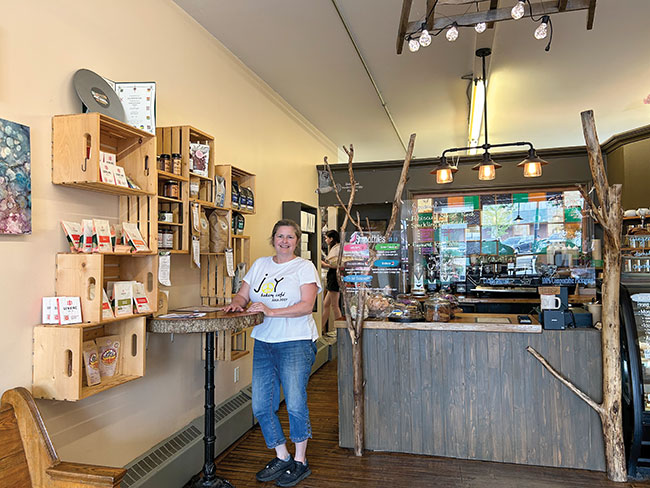
Joy Bakery Café in Simcoe, Ont., has made sustainability a non-negotiable tenet of its operation. Joy Allgood, co-owner with sister Judith Holditch, sees a lot of value in weaving her desire for zero-waste sustainability into the nine-year-old business that serves a bevy of bespoke beverages, unique cookies, bars, muffins, scones, catered cakes and focaccia sandwiches from a peaceful space that features natural décor.
Positions as national sales manager for Brita and Burt’s Bees sparked Allgood’s interest in advocating for environmental responsibility, especially eliminating or drastically reducing the use of plastic in packaging, smallware and other aspects of operation. It’s a complicated proposition and depends on your local standards, Allgood says. Early on, she checked with her recycling authority to make sure what the team are putting in the boxes is actually what the authority accepts and what will actually be recycled. She learned that, in her municipality, fast food packaging is not recyclable. “Certified compostable and reusable is the best we can do right now when it comes to packaging,.” she says.
“Milk bags are the hardest to reduce,” she says. “We use about 200 a week. We wash them as per the instructions and we recycle them.”
Compostable cups are expensive, more so since tariffs were announced and their regular distribution chain was disrupted. “The 50-cent cup became an 80-cent cup,” she says, adding that Holditch now spends hours each week sourcing sustainable products and packaging.
They have never sold plastic water bottles and their bamboo reusable trays with “Please return” written on the back help offset their carbon footprint.
Prioritizing local ingredients is their biggest focus. They work with more than a dozen local farms and producers in Norfolk County, a farming community known as “Ontario’s Garden.” By prioritizing local produce and products, supporting community events and making local residents feels welcome, Allgood says, you are supporting your neighbours, and encouraging them to stay close, use less gas and in turn support your business.
Their environmental commitment is not mere lip service. On their days off, for example, they plant 600 trees per year on participating local farms and properties. Allgood has educated herself and her team and shares that knowledge freely. They have helped extend local woodlands, and, in one of several projects, arranged for local church camp to work with Alternative Land Use Services, or ALUS, which paid for 4,000 trees. The Joy team paid for and helped plant 600 trees as part of the initiative.
They focus on and support a different cause every year. This year they raised money toward the Long Point Biosphere turtle hatchery program, which collects eggs and relocates turtle hatchlings safely. They created themed cupcakes and taught classes about the process to local children during their “Environmental March.”
Walking the talk helps with marketability. “The concept and practices are 100 per cent marketable,” Allgood says without hesitation, citing social media ads shot at local farms as one example. Her marketing background has helped the café draw new customers and convert them to loyal fans. They’re already planning their 10th anniversary post. “We need to show the activities of a full season,” she says.
“Staying focused on your business and not getting pulled aside is important – staying on your path,” Allgood advises bakeries starting out. It’s important to avoid what she calls the Walmart effect of trying to be all things to all people. “If there is something important to you in life, it has to be important in your business. We made local food our focus.”
“Everyone on our team is in the mindset now,” she says proudly.
DO GOOD DONUTS
Do Good Donuts is a non-profit social enterprise that aims to stretch the boundaries of what people with intellectual and developmental disabilities can do, provide workers with meaningful work, confidence and a sense of purpose and challenge other people’s perceptions in the process.
In 2021, Melanie Côté founded the enterprise, which bakes at a community kitchen, caters corporate and community events and sells doughnuts, cookies, cinnamon buns and other goods at Toronto’s Leslieville market.
The idea formed a few years ago, after she and her husband learned their five-month-old daughter, Alma, was born with a rare genetic syndrome. Doctors told them parenting this child would be different and advised adjusting expectations. “It was a lot of statements to make about a person who just born,” Côté said.
Côté hires and trains youth with developmental disabilities to build a world where everyone belongs at work. She has a college pastry diploma and employs a lead and a sous baker to ensure things run smoothly. At the time of writing, they have five trainee employees living with developmental disabilities working on prep and front-of-house duties.
“I thought there could be a way to give kids a ‘job before a job’ – so they could take a sideways move once they gained some skills and confidence and experience.” The goal was to make it easier for employers to say yes to hiring these young people and increase the chances of retaining their new hires.
Offering the kind of product people want to buy, quite apart from their community appeal, is high on the list of Côté’s priorities. “It’s important for us to have an excellent product. For us to succeed as a social enterprise, the “profit” we make is invested back into the business,” she says.
On May 16, 2021, their first day, they sold all of their 100 doughnuts in 20 minutes. These sales, together with merchandise, earned $710. A few weeks later they added cookies. Now, they generally bring about 300 doughnuts on a Sunday, six kinds of cookies, cinnamon buns, scones, lemonade and can take in up to $1,500 on a sunny market day.
They also provide corporate catering and build connections in the community. The goal is to build a brick-and-mortar café and they plan to get there via food truck. They currently rent time in a shared community kitchen, but to grow, need access to production bakery equipment and unlimited access through the week. “A food truck will give us the ability to install a full-size commercial doughnut fryer and commercial oven. It will serve as both commissary kitchen where we can scale up production and mobile retail space,” she says.
“We hire young adults who self-identify as having a developmental disability or autistic youth, aged 18-28, who have a self-determined desire to work at a job in the community but need the opportunity to learn and practise work skills and gain confidence to be prepared to succeed at another job.”
Do Good Donuts hires trainees into three-month contracts at 15 hours a week, with the potential to extend the contract. “Trainees learn in a group setting and work with staff or peers, with a focus on independent skill development. When hiring, the key things for me are emerging math and reading skills. We can adapt the way a recipe is presented to suit a trainee’s learning strengths, but in baking, you need to have some math and reading skills to be successful.”
To get started, they raised $17,000 through a GoFundMe campaign. Since then, they have received a $1,000 community grant from Meridian; then won first prize in the “Small business, big impact” award for Ontario and received other project grants. Their new food truck will funded by a donation from the Doane Grant Thornton Foundation. “We do get funding, but it’s hard to get investment or loans, so it has been challenging to scale up,” she says.
The skills trainees gain are transferable and can translate to independence. One of the people Do Good hired also works at the St. John’s (social enterprise) Bakery as a volunteer. Another works at a local school as part of the kitchen team, preparing the hot lunch program. “We didn’t find them the jobs. They went out and submitted resumés,” she says.
The goal is slow and steady growth with a committed customer base. Côté hopes to have the truck operating by the spring of 2026, and they are launching a long-planned e-commerce site to sell across Canada this fall.
“I think that, especially now, the line between businesses and the everyday customer is becoming blurred. The businesses or brands we interact with can become a reflection of who we are. There’s never been a better time to show your values.”