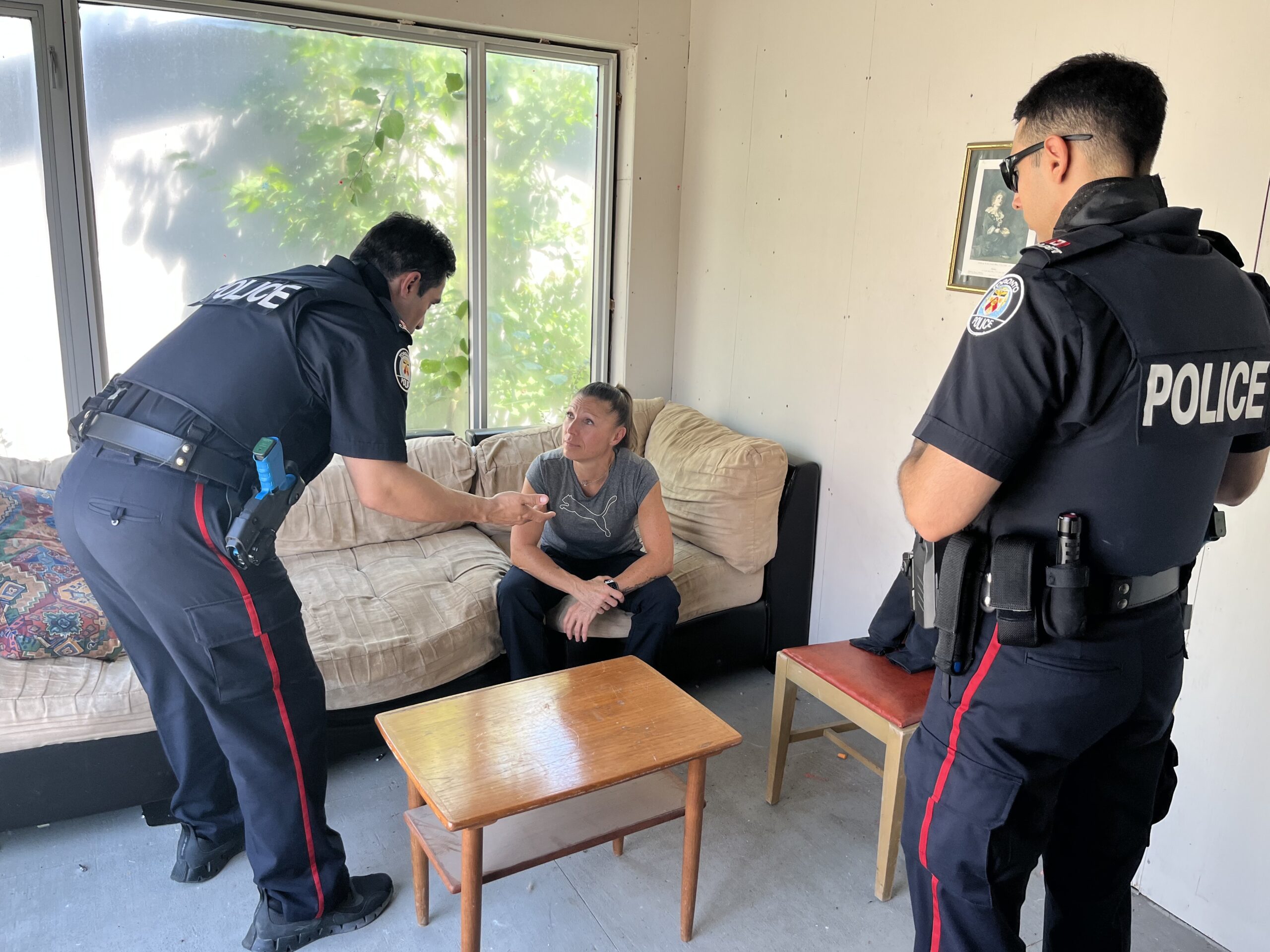
Training officers with scenario-based programs can lead to less use of force without compromising their safety, a UK study found1, and several police training specialists across Canada shared how they’ve seen a maturity in how these scenes are reflecting today’s evolving communities.
A 2024 report, published in Justice Evaluation Journal, wrote how scenario-focused programs led to a 10.9 per cent decrease in the likelihood that police officers used force in a given week, with the biggest reductions seen with “hands-on” force such as restraining someone on the ground.
The study’s training programs focused on scenarios such as booking at custody, attending a domestic event, intervening in a fight in the street, performing a stop and search, and dealing with a vulnerable person.
As the study’s release states, “As they respond to a mock-up of a house in the training environment, officers may find a bickering couple who are responsive to police requests or a highly aggressive individual, armed with a prop knife, who reports they have just assaulted their partner – or anything in between. Officers are assessed on how they manage the role-players in front of them, what they do to de-escalate and what justification they have for using force if they choose to do so.”
Around 1,800 officers were trained during this study, coming from the Avon and Somerset constabularies. Since then, these training modules have rolled out to 43 constabularies across England and Wales.
“This is training that works,” says lead study author Michael Sanders, who is also a public policy professor at King’s College London’s Policy Institute. This type of training program, which stresses de-escalation techniques, “builds on conflict-management techniques and is effective in reducing force, without increasing the likelihood that an officer themselves is harmed,” he adds.
Scenario-based training (SBT), coupled with conflict management strategies, is at the core of what many police training programs in Canada have offered. Their strategies have shifted to identify key goals, mirror the exact incidents officers are most likely to face, and refrain from using aggressive tactics.
Decades ago, words like “de-escalation” never came up in training programs.
Sergeant John Warin of Calgary Police Service’s Skills and Procedures Team says that while scenario-led programs have been taught to Canadian officers since the 1990s, they have matured in vital ways.
“Agencies have focused on specific goals with their training programs, and they’re using scenarios most relevant to the community’s common calls,” he says, “And they are adding mechanisms to ask the questions about what officers are seeing on the ground and where use of force incidents can be improved.”
The programs he’s led have ensured the incidents are generating, according to Warin, “physical responses related to stress, and creating a fear and anxiety the officer will most likely experience. You want them to deal with those fears to allow them to feel confident to control the situation.”
Decades ago, words like “de-escalation” never came up in training programs, remembers Darun Hurdowar, a training constable for Toronto Police Service’s Incident Response Training Section. “But now it’s everywhere, and I’ve seen how scenario-based training helps optimize learning and allows training units to evaluate previous learning and build upon that.”
A 14-year veteran in the training department, Hurdowar says there used to be a reigning “old-school mentality by training officers who were not necessarily trained themselves to instruct scenario-based programs.”
While more aggressive tactics were taught in 1990s-era training programs, Hurdowar says, departments didn’t have the “the less lethal options available to them for events such as crowd control,” he cautions.
Another consideration on why scenario-based training programs have matured is the widespread adoption of body-worn cameras. “That kind of scrutiny, where we can be held accountable for our actions, has evolved expectations by society on policing, and law enforcement has also changed,” Hardowar says.
Hurdowar has also adjusted TPS’s training programs to reflect factors such as the city’s main call types, rather than rare, extremely dangerous situations, which were often included in programs in the 1990s.
“People in crisis have been a major source of focus for us in the past 10 years, whether they’re a threat to themselves or others,” he says.
10.9 per cent decrease in the likelihood that police officers used force in a given week, with the biggest reductions seen with “hands-on” force such as restraining someone on the ground.
A 2024 study2 found that the more realistic these training scenarios are to a department’s actual calls, the more effective this training regimen could be. “When the practice is premised on authentic SBT, it can be an important catalyst for changes to training,” write the authors of a report published in Frontiers in Education.
When considering community members who may be facing a mental health crisis, some experts argue that the focus should be on incorporating the viewpoints of those on the front lines. “There is a well-defined necessity to involve community experts and stakeholders as partners in mental health crisis training design and production to advance training content that serves the needs of citizens as well as police,” according to the authors of this study3 published in the Journal of Police and Criminal Psychology.
Scenario-based training should also be tailored to a city’s cultural make-up. Hurdowar and Warin have guided scenario designs to ensure recognition is given to the shifting demographics in many major cities, such as Calgary’s surging Sikh community. “Bridging the gap is important when it comes to how some people outside of Canada carry fear about policing based on what they experienced in their homeland,” notes Warin.
What Toronto has developed are situations where language barriers cause confusion, Hurdowar says. “That’s where non-verbal de-escalation communication comes in, but it also starts at the top. You need to have officers coming from a range of communities, who can speak the language of those they seek to help.”
As for what’s next for scenario-based training, Sanders would like to see these de-escalation programs targeting jurisdictions where use of force has been problematic and unwarranted. “What we next have to learn is how this training works in a range of contexts, such as areas in the United States where they have a very different pattern of use of force compared to the UK or Canada,” he says.
References
- Sanders, M., Bancroft, K., Hume, S., Chetwynd, O., & Quinton, P. (2024). The Impact of Training on Use of Force by Police in an English Police Force; Evidence from a Pragmatic Stepped Wedge Randomized Controlled Trial. Justice Evaluation Journal, 8(1), 20-39. https://doi.org/10.1080/24751979.2024.2412333.
- Cushion, C. (2024). How to Implement Authentic Scenario-Based Training. Applied Police Briefings, 1(1), 66-68. https://doi.org/10.22215/apb.v1i.4877.
- Lavoie JAA, Alvarez N, Kandil Y. (2022). Developing Community Co-designed Scenario-Based Training for Police Mental Health Crisis Response: A Relational Policing Approach to De-escalation. Journal of Police and Criminal Psychology, 37(3), 587-601. https://pmc.ncbi.nlm.nih.gov/articles/PMC8882363/.
David Silverberg is a freelance journalist who writes for BBC News, the Toronto Star, The Globe & Mail and MIT Technology Review. He also coaches journalists and creative writers.