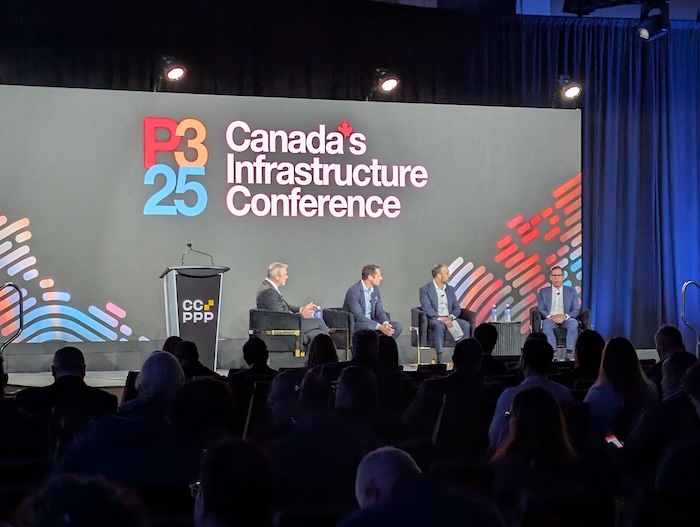
“As engineers, we tend to be great at technical skills and terrible at people skills,” said Kiewit’s Tim Shepherd at the Canadian Council for Public-Private Partnerships’ (CCPPP’s) annual conference earlier this week, “but the people side is very important in managing a project.”
Shepherd represents his firm in OnTrack Alliance, the public/private team delivering the Union Station Enhancement Project (USEP) for Infrastructure Ontario (IO) and provincial transit agency Metrolinx to expand GO train service in downtown Toronto. Speaking in a panel discussion on Oct. 27, he explained that beyond the construction work by his firm and Alberici, design work by WSP and signalling work by Mass. Electric Construction (MEC), OnTrack engaged a collaborative behavioural consultant to help ensure everyone worked well together.
“More than 400 people touch the project on a daily basis,” he explained. “That’s a lot to pull into one culture.”
Collaboration, indeed, was the overarching theme for ‘P3: Canada’s Infrastructure Conference.’ In previous years, CCPPP was front-and-centre in the event’s branding, but as public-private partnerships (P3s) have matured in the Canadian market, new collaborative contract models have also become relevant to all partners—including consulting engineering firms—in infrastructure project teams. And finding the right model can be key in reducing risks and cost overruns.
By way of (related) example, another panel addressed best practices in infrastructure delivery, moderated by Mott MacDonald senior vice-president (SVP) and North America infrastructure advisory lead Joshua Ogier. Marcia Medrano, Metrolinx’s executive vice-president (EVP) of the Union Station+ portfolio, explained the appeal of alliance contracts in transit.
“We have two alliance jobs,” she said, “where we spend a lot of time in the planning phase and on collaboration. We want to know what we’re getting. We don’t want to sign a blank cheque. So, some projects can’t be P3s.”
Fellow panelist Shak Chowdhury, vice-president (VP) of partnering and new projects for Amico Affiliates, pointed out some project schemes have been “converted to P3s after all parties agreed on principles and terms.”
“That sounds like progressive design-build!” replied Medrano.
And while she vouched for P3s’ success in delivering Canadian health-care projects on time and on budget, her fellow panelist Jeff Jerome—director of capital planning for Toronto’s North York General Hospital (NYGH)—explained his team is embarking on Ontario’s first health-care alliance project with a new patient-care tower, now at the procurement phase.
“P3s swung the pendulum in one direction for risk allocation,” he said. “Now the alliance model is swinging it the other way. We have to be involved in the process, but there are benefits to the change.”
So, it is to CCPPP’s credit that the topics at its conference—which has been held in downtown Toronto since 1992—have expanded over time to keep up with changes and to include other models for project success.
This evolution is also clearly important as Canada’s new federal government strives to make headway on ‘nation-building’ projects. Conference sessions responded to the government’s agenda by exploring how the private and public sectors might collaborate to ensure the right megaprojects are prioritized and achieved.
And speaking of nation-building, Associated Engineering project leader David Nagy was part of a panel discussion about the First Nations Infrastructure Institute’s (FNII’s) collaborative model for success with Indigenous-owned and -controlled projects, which involves partnerships with designers, builders and financiers across the private sector.
Consulting engineering firms clearly see value in CCPPP’s conference and the connections it can foster. This year’s sponsors included WSP and Arup, which presented sessions on AI, big data and digital twins, along with Kiewit, Mott MacDonald, Arcadis, AECOM, Exp, Parsons and Egis.