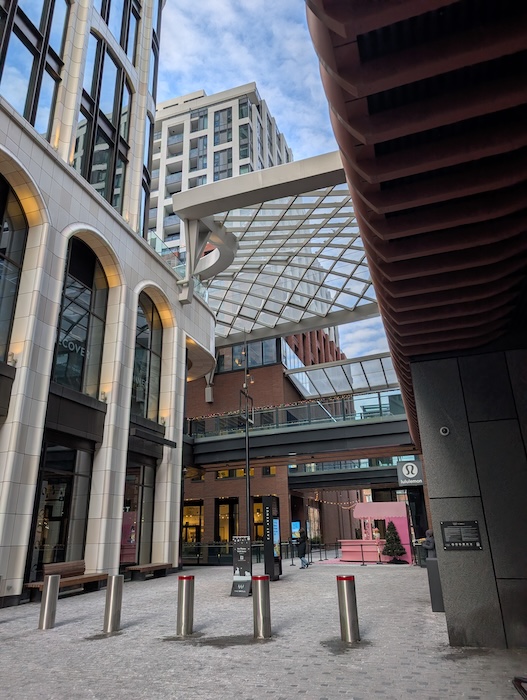
The Buildings Show, held annually at the Metro Toronto Convention Centre (MTCC), had apparently never offered a local building tour before. On Dec. 5, 2025, I was fortunate enough to join the first one, which involved a short walk west to the Well, a 7.7-acre development that runs west from Spadina Avenue to Draper Street and north from Front Street West to Wellington Street West.
Officially completed in 2024, the Well has added nearly 500,000 sf of retail, more than 1 million sf of commercial office space and more than 1.5 million sf of residential units, across seven mixed-use buildings, interconnected by pedestrian walkways and a concourse. The ‘gateway’ to this new neighbourhood is a 36-storey office building at 8 Spadina.
The Building Show’s tour was led by Michael Conway, associate partner at Hariri Pontarini Architects, who has nearly 20 years’ experience designing large, urban mixed-use projects—but as he put it, he had never worked on anything quite like the Well before and he doesn’t think such a project could happen again today.
Spadina used to mark a boundary between Toronto’s downtown financial district and a more industrial district to the west. As the city densified, however, this was no longer the case when Hariri Pontarini created the master plan for the Well and designed the aforementioned office building for the site. Condominium towers had already risen along and near Spadina.
While the Well was also envisioned as a place to live, it would be much more than that. In fact, Conway and his colleagues looked for inspiration from examples of retail-and-office downtown rejuvenation developments in the U.K., where residential is not part of the mix at all.
They planned a variety of floorplates, an off-centre core, brick and masonry podiums and staggered façades, all to help the massive undertaking resemble more of a human-scale neighbourhood. They also reused materials from the demolished buildings the Well replaced, ensuring some level of connection to the past even while reinventing the site.
(Among the more daunting artifacts to remove from the previous buildings were the massive newspaper printing presses that used to produce The Globe And Mail. Ironically, one of the new tenants at 8 Spadina is its largest competitor, the Toronto Star.)
Hidden below the development is one of its most distinctive features: a thermal energy storage (TES) facility, where a tank equivalent to three Olympic swimming pools stores 2 million gallons of temperature-controlled water, fed by Enwave’s Deep Lake Water Cooling system and a new, high-efficiency hot-water loop. Built in 2020, this installation—which serves not just the Well itself, but also neighbouring buildings—offers the first low-carbon heating and cooling option for in Toronto’s downtown west district.
The project team for the Well included such consulting engineering firms as RJC (structural); Jablonsky, Ast and Partners (structural); Mulvey & Banani (electrical); TMP, now BPA (mechanical); Novatrend (mechanical and electrical); EQ Building Performance (sustainability); LRI Engineering (fire code and life safety); and Odan/Detech Group (civil).
RJC recently had more to say about high-rise projects, including the Well; check out their article in our Winter 2026 issue.