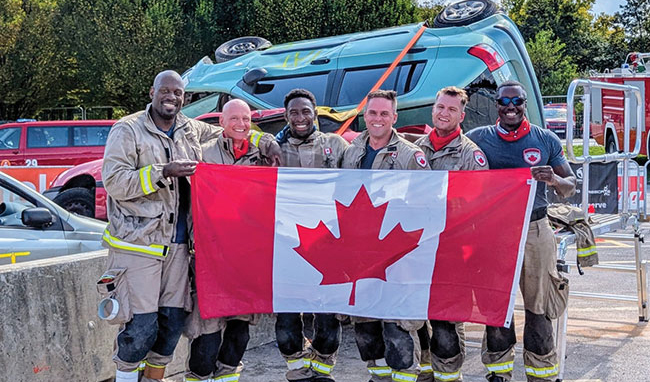
A group of Markham firefighters have been breaking windows, cutting through steel and pushing their limits at Standard Auto Wreckers, dedicating their time at the parts yard to refining their extrication skills, all on a volunteer basis. This year, the Markham Extrication Team (MXT) was the only Canadian team competing on the global stage and participating in the annual World Rescue Challenge in Croatia in September – an international competition that brought together 36 extrication crews from 28 countries.
“It’s a dream come true,” remarked Captain Brad Sterling from Markham Fire and Emergency Services (MFES), who is the incident commander (IC) of the MXT. As IC, Sterling takes charge of the rescue scenarios and leads the team through the extrication process.
The MXT journey began just a few years ago, in 2021, when Sterling and former-IC Captain Howie Tse, who is now the team manager, co-founded and launched the team. Initially, the goal of the MXT wasn’t to earn awards or international recognition. “We started as a training team and had a facility just to get better at the job,” Tse recalled.
Both firefighters admitted that the early days were far from glamorous. As the MXT operates separately from the fire department, the crew had limited access to modern rescue equipment and practiced with hand tools rather than battery-powered gear. Finding a place to train was also challenging. Those limitations often put them at a disadvantage when competing against teams with extensive experience operating newer equipment. However, the team’s persistence and growing sponsorship support helped them catch up quickly. “The whole team should be proud of themselves,” said Tse on the team’s rapid growth in such a short time.
Now, in 2025, with the support of Standard Auto Wreckers owner David Gold in Scarborough, the team has access to a training site and an almost endless supply of cars to practice on. Sponsors like HexArmor and AMKUS provide safety gear and rescue equipment, including gloves, cutters and spreaders. With a training sandbox so close to home, MXT has a unique advantage in refining its extrication procedures.
Meet the team
Comprised of seven firefighters serving in four roles, MXT is made up of the following team structure: Sterling as IC; Jesse Joseph, Amanie McLaren and Daniel Cresswell as technicians; Daniel Seck and Horatiu Pantea as medics; and Tse as team manager.
Five team members—Sterling, Joseph, McLaren, Cresswell and Seck—serve at Station 91, strengthening the close-knit brotherhood and chemistry within the team that translates into effective responses to real-world rescue scenarios.
Starting as a volunteer firefighter, Sterling developed a passion for the service and eventually found his place at MFES As IC, he can only observe and direct the team to be in the right place at the right time, a shift from his previous position as a technician. “Having to sit back and watch is very difficult,” he added.
Cresswell, the MXT’s lead technician, joined MFES as an on-shift instructor. Determined to deepen his knowledge of auto-extrication, he attended MXT training sessions to learn more from the crew firsthand and gain practical experience with tools that might have been overlooked during general training. “Before I knew it, I was on the team,” he said. Cresswell often encourages other firefighters to broaden their skill sets as well. “The pursuit of knowledge is part of our trade; you’re constantly learning, you’ve never learned it all, you always have to get better. There are so many skills to refine.”
Once the technicians have identified and established entry points, medics Daniel Seck and Horatiu Pantea step in to assess patient injuries and provide basic life support (BLS). Seck and Pantea joined the MXT within weeks of each other, which allowed them to forge a unique camaraderie and shorthand, ultimately leading to smooth communication during a rescue scenario.
Pantea was initially brought on in the role of a patient during the team’s training sessions. After demonstrating his skills with the tools, he was officially asked if he wanted to join the MXT as a technician. Now he serves as the secondary medic, helping with gear and creating entry points while communicating potential hazards to the primary medic. “I’m trying to comfort the patient, but I don’t want to be another victim,” Seck explained.
The team is always evolving, and roles are regularly swapped to enhance the team dynamic. “It’s good to switch roles so you know what each role needs and you’re not left guessing,” noted Pantea.
On Tse’s journey to become the team manager, he held both medic and IC roles before Sterling took command. He initially had his sights on a career as a paramedic, but after a friend’s suggestion, he decided to pursue fire fighting. “I wouldn’t change it for the world,” he said. As manager, Tse wears many hats on the team and fills in if any members are unavailable.
While the IC, medics and technicians perform the extrication, Tse observes the crew and provides critical feedback on their performance. Since team managers are not allowed to participate in the rescue challenges at competitions, Tse is uniquely positioned to offer an independent perspective on the extrication after it’s finished, in addition to monitoring other teams and noticing strategies that the MXT may have overlooked in the moment.
The World Rescue Challenge
The World Rescue Challenge is run by the World Rescue Organisation, which describes itself as a global platform for extrication and trauma care that aims to advance rescue operations, strengthen practices and foster growth through learning from one another. The event brings teams together from around the world not only to compete in extrication and trauma challenges but also to learn from the strategies of other departments.
“There’s no information gatekeeping at these competitions,” said Pantea. “It’s all about serving our communities and potentially saving a life, so why hide anything or keep it to yourself?”
Tse agreed. “With 36 teams from 20 countries, you’re going to have different ways of thinking and techniques. You learn from every single one.”
To qualify for the worlds, rescue teams must finish in the top two at either the Transportation Emergency Rescue Committee USA (TERC USA) or the North American Vehicle Rescue Association (NAVRA) events. Although the MXT placed fourth overall in the 2024 NAVRA challenge, Sterling explained that they qualified because the second-place team was unavailable to attend, and the third-place team had already won the NAVRA qualifier. This bumped the MXT to second place and secured their spot at the World Rescue Challenge.
Leading up to the event, team members reviewed challenge guidelines to prepare for a wide range of extrication scenarios they might face at the competition. On the day of the event, before their turn, the team was provided with their specific extrication scenario along with the patient’s vitals. Each scenario requires a tailored approach, and time is critical. Throughout the challenge, teams are judged on three categories: command, technical and medical.
“There’s really nothing I haven’t seen now. My confidence level has gone through the roof,” said Sterling, who believed the work put into training translates effortlessly into real emergencies.
Better competitors, better firefighters
The MXT encourages other fire departments to get involved and establish their own extrication teams. In the meantime, they also invite any firefighters to train with them at Standard Auto Wreckers in Scarborough, as it ultimately strengthens Canada’s fire fighting capabilities.
“We offer free training weekly, and it’s open to anyone,” said Cresswell. “Anyone who wants additional time on tools could come and cut a whole side off a car.” He and other MXT members recall the days when Ontario hosted regional competitions with over 30 teams in attendance. Today, that number has reduced to three or four.
At the 2025 World Rescue Challenge, MXT put up a strong showing from Canada, finishing 18th overall out of 36 teams, and 12th place in the technical category. Despite the competitive nature of the event, MXT members received unwavering support, day and night, that reinforced a strong sense of international brotherhood among firefighters. “Even though we compete, we’re still very much a firefighting family,” Seck added. “My medical skills grew fast under pressure, and I got to step up as an interpreter to help a French team during two trauma scenarios—a true example of what this community is all about.”
The MXT connected with global departments and shared valuable fire fighting advice, forging friendships and a community beyond international borders. “We look forward to crossing paths again at future World Rescue Challenges,” said Cresswell. “We also hope to inspire firefighters from other departments across Canada to start their own extrication teams, raise their vehicle rescue skills and experience the same camaraderie that makes this competition circuit such an invigorating part of the fire service.”
The MXT plans to maintain its current team structure and individual roles, while also welcoming new members to ensure a dynamic roster, as it sets its sights once again on the world stage. The team is eager to apply everything they’ve learned to serve their communities and prepare for the upcoming NAVRA qualifier in December, aiming to repeat their success at the 2026 World Rescue Challenge in Brazil.
“Our gaze is fixed on the goal of qualifying once again to represent Canada—stronger, better and more prepared than ever,” assured McLaren.
Take a look below at some photos of the MXT training session in Scarborough that Canadian Firefighter attended and pictures from the World Rescue Challenge.