There are certain milestones that stand out as markers of a company’s longevity and success: silver at 25 years, gold at 50, and diamond at 60. Gilbert Smith Forest Products has not only reached but surpassed each of these, proudly celebrating 70 years in operation as the largest employer in Barriere, B.C.
Founded in 1955 by Gilbert Smith as a cedar pole plant, this family-run company has grown through three generations, evolving into a leader in specialty cedar products. From its earliest days, the business was shaped by hard work and vision—qualities that allowed it to embrace innovation and adapt to shifting markets. With the help of his four sons, Gilbert grew his operation over time to include a specialty cedar products sawmill, installed in 1967.
“The turning point was when we started our headrig, and then the evolution of the sawmill with different machines—growing with what we needed to do,” reflects Greg Smith, current president and third-generation leader of the company.
In the years that followed, Gilbert’s sons Ted and Carman spearheaded ongoing investments in the mill. A resaw was added shortly after the headrig, followed by a planer. By the mid-1990s, the company had acquired a used bin sorter. But the most transformative upgrade came in 2004 with the installation of the mill’s first small log line. That same year, Carman’s son Greg began management training, stepping into the next generation of leadership.
The company’s momentum was briefly slowed by the U.S. housing crash, but over the past decade, Gilbert Smith Forest Products has renewed its focus on innovation. Roughly $25 million has been invested in modernizing the plant. More recent upgrades include an in-house designed cut-to-length bucking system, a profiling HewSaw R200SE, and a controls network enhancement.
“We did a lot of foundational work to get the mill production up to where we wanted it,” Greg says.
One of the most impactful additions was a customized grade sort line, which allows the mill to process rough green, rough dry, and finished dry products through one line efficiently.
“It’s giving us the flexibility we need to set us up for a diverse product offering,” Greg says.
Before the installation of the grade sort line, green lumber was traditionally stacked, transported manually across the site via forklift, and batch run through the planer for grading and sorting.
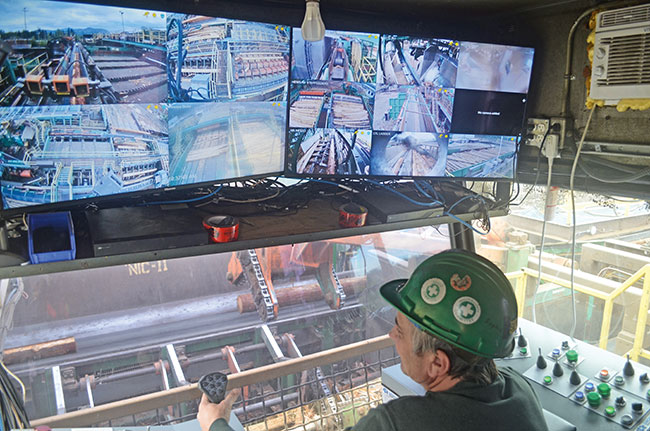
“Now, the mill is fully connected via three conveyors to the grading and sorting length (GSL) finishing lines,” Greg says, underscoring a shift toward seamless integration and streamlined operations.
The most recent advancement at Gilbert Smith Forest Products is the installation of an AI Vision BSQ grading system this past fall by Raptor Integration based in Salmon Arm, B.C.
“This scanner is the heart of our grade sort line,” Greg says. “Both our finished and rough products go through it—it’s definitely getting a workout.”
This isn’t the first collaboration between Gilbert Smith and Raptor Integration. Eight years ago, the company served as a beta site for one of Raptor’s earlier systems.
“It started as a geometric scanner, and we’ve now transitioned to a vision-based system,” Greg explains. “We run Raptor’s technology on our optimized board edger and our small log line as well.”
The upgrade to the mill’s board scanning system is expected to improve grade recovery, overall lumber recovery, and improve flexibility for different products.
“As we expand into other niche species, this system makes that process much more efficient,” Greg notes, adding there are also operational and training efficiencies. “With the addition of the AI system, our graders can now apply their knowledge elsewhere in the mill.”
Drying upgrades
Another major recent investment is an 80,000-board-foot capacity package kiln from Nyle Dry Kilns, equipped with Nyle’s largest dehumidifier, the HT162. The kiln runs on renewable electricity and is supported by an energy monitoring system that optimizes usage during peak demand hours.
“It’s 192 kilowatts of segmented electric heat,” says Adam Duplisea, vice-president of sales for North America for Nyle Dry Kilns. “They’re able to reduce their demand charges and qualify for BC Hydro incentives, without sacrificing drying performance. Even when the kiln is running at partial electrical load during the day, drying times remain consistent.”
The inclusion of an electric hydronic heated floor helps to stabilize the thermal mass in the winter and reduces the energy required during kiln charges.
The system automatically adjusts its output throughout the day: when the sawmill is running, the kiln operates at 50 to 60 per cent electric heat input to reduce demand charges. Once the mill powers down for the night, the kiln ramps up to full electric input.
What sets Gilbert Smith Forest Products apart is its targeted drying process.
“We don’t dry everything,” Greg explains. “We target-sort and grade our wood. Many of our cedar products are sold in the green, and for the products we do dry, we can choose specific items. Our stacker is versatile—we can stack with lath for finished products or stick them for drying in the kiln.”
The kiln was also designed with the future in mind. It’s fully prepped for expansion with all electrical, fire system, and framing infrastructure in place to support a second chamber—a key consideration as the company looks to process slower-drying species like white pine or hemlock.
“We’ll need that second chamber when we start drying longer-cycle species,” Greg says.
So far, customer response has been overwhelmingly positive.
“Everyone’s been really happy. The consistency has been excellent, and the kiln has performed very well,” Greg says. “The transition to electric drying has also supported the company’s carbon reduction goals. We’re working toward offering a truly low-carbon product by using renewable electricity. We’re even exploring the opportunity to sell carbon credits once we’ve finalized the monitoring and reporting.”
Maximizing fibre
Like most B.C. sawmills, Gilbert Smith Forest Products faces ongoing challenges in sourcing fibre.
“To get supply, we often have to go farther afield. Everything takes more time, more planning,” Greg says. “You really have to make sure you have a multitude of channels being developed at the same time. We are very fortunate to have developed long-term supply relationships with a variety of licensees including Simpcw Resources Group.”
The company has strategically adapted by focusing on small-log utilization.
“Smaller logs are more difficult to process efficiently, so we’ve had to find value-added markets and enhance our processes to support the economics of it,” Greg says.
The mill produces a wide range of dimensional lumber in sizes from 1’x3’ to 2’x12’, tailored to meet market demand.
Hiring and retention
Operating with around 85 employees on a single sawmilling shift and a single remanufacturing shift, the company hasn’t had trouble finding general labour lately—but skilled trades are a different story. Finding millwrights, electricians, and saw filers is a growing challenge. To help address this, Gilbert Smith Forest Products has developed a robust apprenticeship program aimed at building talent from within.
“You want to attract people who can see a career path here,” Greg says.
The community of Barriere has grown over the years along with its support services offered to residents. This could help bring skilled labour back to the community that may have left to work on more profitable oil and gas projects but are looking to enjoy the lifestyle that the area offers for raising a family, Greg notes.
The need to adapt
With the constant changes in duties, tariffs, fibre availability, and all of the other instabilities that come with running a sawmill in B.C. these days, Greg says they’re used to never getting too comfortable.
“The only thing we know for certain is that we’ll always need to adapt,” Greg says.
While having a culture of safety is a top priority at Gilbert Smith Forest Products, so is fostering a culture of innovative thinking. That mindset has helped the mill remain competitive—through bold investments and a willingness to innovate.
“As a small operator, staying relevant takes effort and creativity,” Greg says. “We make investments not just for now, but so the next generation can keep moving forward.”
Those investments are often phased—leveraging during lean times and then building new foundations when the opportunity is right.
“When times are tight, you rely heavily on your earlier investments,” Greg explains. “Then when things turn around, that’s when you make a step change—like we did with our grade sort line. That was the biggest project we’ve ever taken on, and it gave us the platform to pursue a series of smaller but equally impactful improvements. Each step builds on the last.”