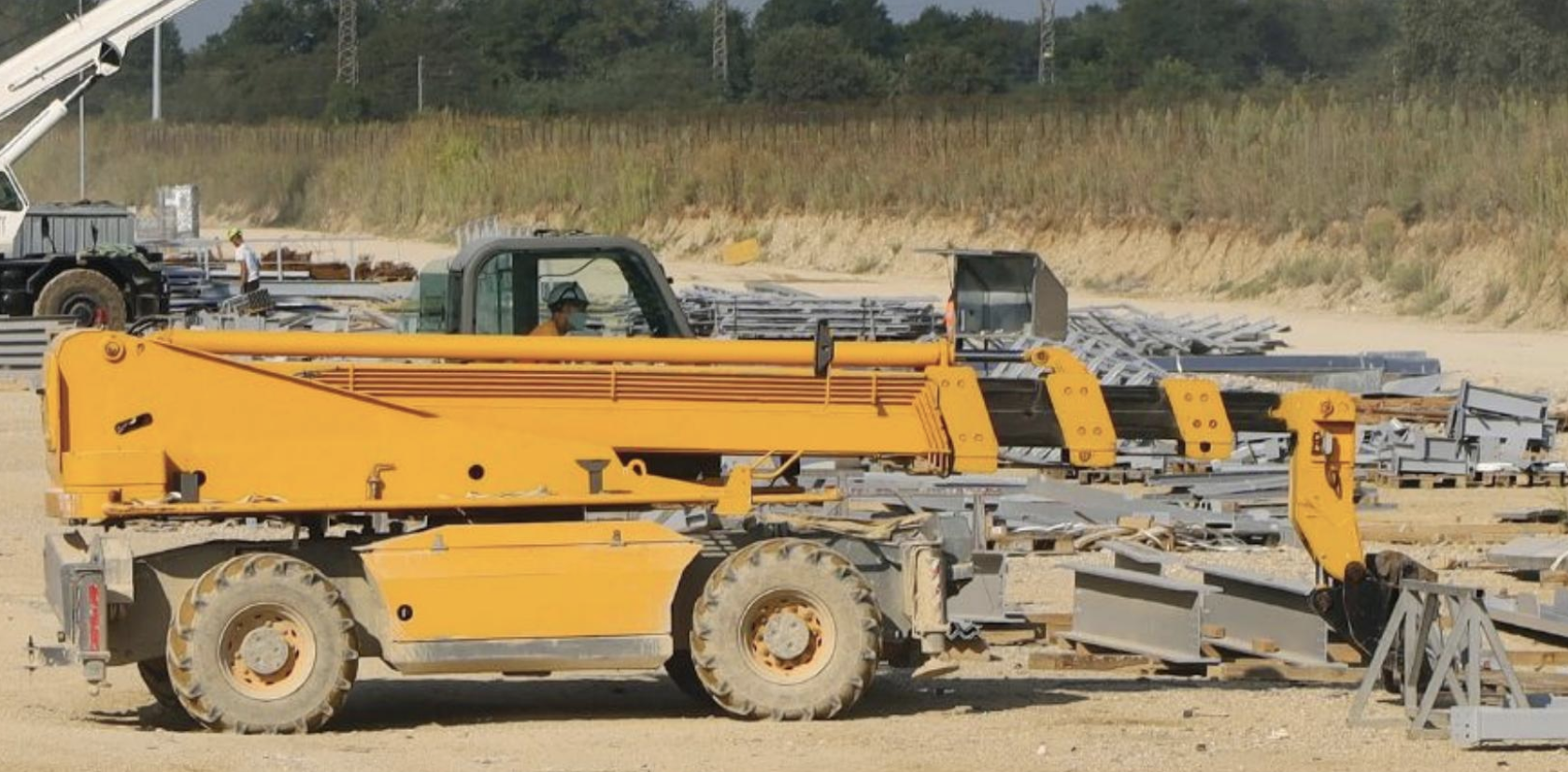
Rotating telehandlers are unique within the construction world: while most heavy equipment has a defined purpose on a jobsite, rotating telehandlers act almost like a Swiss Army Knife, being used for a wide variety of applications replacing the use of forklifts, personnel lifts, loaders, and often, cranes.
It’s their replacement of cranes on jobsites that is of major concern to many in the heavy lifting industry, as these machines do not fall under a set of standards similar to what cranes are required to meet.
To help solve this issue, VIM Technical Services Ltd.’s Dennis Domenichini has authored the Overview of Rotating Telehandlers in Canada publication for the Canadian Standards Association (CSA), which offers three different recommendations for rotating telehandler standards.
Domenichini’s research was completed with the assistance of a project advisory panel consisting of André Chénier (international representative, Canadian Region, International Union of Operating Engineers); Benjamin Lowe (WorkSafeBC); Elizabeth Huckson (J.J. McGuire General Contractors); Guy Taillon (Ministry of Labour, Immigration, Training and Skills Development); Rocio Morales Rayas (CSA Group); and Andrea Holbeche (CSA Group project manager).
Option one
The first option was expanding the scope of CSA B335-15, which addresses forklifts. This option doesn’t make sense to Chénier.
“That standard does not cover crane issues,” Chénier said. “When these rotating telehandlers have a winch and a suspended load, a great deal of other factors come in play.”
In addition to CSA B335-15 not covering any operational requirements related to suspended loads, the standard also does not cover manufacturer design specifications.
“The standards aren’t the same. These manufacturers don’t build these rotating telehandlers to the same specs as mobile cranes,” Chénier said. “To expand B335-15 to incorporate rotating telehandlers into that standard would be almost mission impossible.”
A third-generation crane operator, Chénier is baffled by the fact that rotating telehandlers are not required to adhere to the same standards as mobile cranes.
“I travel all over Canada and I see these pieces of equipment hoisting loads, suspended loads, with no qualifications needed to operate this piece of machinery, no licensing whatsoever. In most cases, regulators usually just require proof of training, which may consist of a very brief crash course facilitated by the manufacturer, or dealer renting the equipment – these are cranes. Once you have a suspended load by a hook, a hoist line and winch attachment, and it rotates 360 degrees, can boom up and down, extend, retract – it’s a crane,” he said.
Option two
The second option presented was to incorporate rotating telehandlers into the CSA Z150, but the technical advisory committee found this option problematic.
“Rotating telehandlers do not align well with standards that many manufacturers are using to design these pieces of equipment, that’s the root of the problem,” Chénier said. “We want to add these telehandlers into the Z150, but right out of the gate at the manufacturing plant, they’re not designed the same way. They’re not designed to the same standards.”
Manufacturers’ stability requirements for rotating telehandlers are different from the Z150 standard for mobile cranes, which complicates incorporating it into the existing standard.
“Another problem is that telehandlers can be used for earth moving. They can have bucket attachments when they’re on a jobsite moving dirt. You can’t do that with a mobile crane, so it would be tricky to incorporate that into the Z150,” Chénier explained.
Option three
To Chénier, the third option presented by the advisory committee makes the most sense: developing an entirely new standard.
“The only way to go is to develop a new standard for rotating telehandlers,” he said.
The creation of a single standard addressing all design and operational considerations would require the creation of a large standard, which would be a big project to undertake.
For this reason, the advisory committee recommended that standards for rotating telehandler design be separated from any standards that address operational requirements.
“Operational requirements would not be any different than a mobile crane when you’re dealing with suspended loads, centre of gravity, the environmental factors, ground condition, wind, or dynamic loads – that’s all stuff that’s currently covered by the Z150 when it comes to operational requirements,” Chénier said.
For Chénier, additional issues stem from telehandler manufacturing and design, with their distinct differences from cranes creating a degree of degree of nuance to developing a proper, all-encompassing standard for these machines.
“The design factor is the problem,” he said, caused by regional differences between Canada and where they are manufactured.
“Most are designed in Europe, and are not designed to the same specs as a crane. It’s not black and white, it’s complex.”