Agriculture may be undergoing a transformation that puts automation at the forefront, but the human element remains essential. It’s impossible to separate poultry health and wellness from the key roles that farm team members play.
Both on-farm and behind the scenes, daily decisions make a difference to bird health and, correspondingly, the bottom line. Training is an important tool, but top-down culture and communication are foundational elements as well.
Guiding principles for team members
Shawn Harman is the director of business development with the Harman Group of Companies, which has multiple flocks throughout Saskatchewan and Manitoba. He is also the CEO of Star Egg Company. He believes that when the culture of the companies is emulated through team members, it creates a foundation for success.
“Healthy hens, healthy business is our guiding principle,” he says. “Everyone knows that bird welfare overrides production targets and we encourage staff to flag issues immediately. No blame. Just solutions.”
But it’s certainly more than a motto or something staff are told. That guiding principle of hen health ripples through daily activities, onboarding, hiring, audits, communication and more. Plus, these standards are expected from every producer who ships eggs to Star Egg.
“We look for people who demonstrate respect for livestock and have a ‘birds-first’ mindset,” he says. “Previous livestock experience is an asset, but not mandatory. Attitude is.”
The company also looks for people who have good observation skills and attention to detail, are comfortable with automation in hen houses and prove their reliability and willingness to work within the organization’s strict standard operating procedures (SOPs) and audit frameworks.
“Standards are covered during onboarding, reinforced through posted SOPs in each barn, reviewed in weekly toolbox talks and tracked using our digital compliance checklists,” Harman says. “KPI dashboards (mortality, condemnations, feed conversion) are shared with staff so everyone sees the link between welfare and performance.”
Bringing the data to team members gives them insight into how their actions make a difference in the barn on a day-to-day basis. While some individuals are naturally attuned to animal welfare practices, those who come from different livestock or non-livestock backgrounds may not always appreciate the subtleties of their actions on poultry health and welfare outcomes.
Training is part of the culture
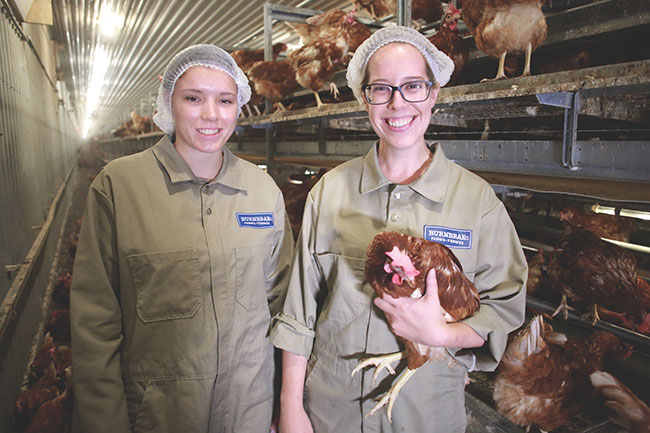
Team members at Burnbrae Farms are trained annually through a multi-module program that enables poultry technicians to observe and take action as needed. These individuals watch the birds and their environment on a daily basis.
“All our poultry team members are trained annually in animal care practices as part of our standard training procedures,” says a Burnbrae spokesperson. “There are several modules included in the training, such as poultry behaviour and health, biosecurity, handling and transportation.”
The hiring process Burnbrae has created looks for individuals with interest, education and experience in caring for animals or other relevant roles that illustrate that commitment to animal welfare.
“Animal welfare is a fundamental commitment for us at Burnbrae Farms,” the spokesperson says. “We are committed to treating all poultry under our care in a safe and humane manner and to continuously improving our animal care practices as more scientific research and other evidence becomes available. We have zero tolerance towards the unacceptable treatment of our animals.”
The organization also employs a full-time animal care specialist who ensures standards of hen care are considered as essential practices for birds in the company’s care across Canada. While animal welfare training is an essential part of team protocols, it would lose its benefits without day-to-day oversight, so managers constantly monitor and enforce standards. Burnbrae also meets the Egg Farmers of Canada Animal Care Program requirements based on the Code of Practice for the Care and Handling of Pullets and Laying Hens.
Care for birds, care for farmers
At McDermott Farms in Abbotsford, B.C., Erv Wiens and his son Jordan know that bird care is the key element of their operation, where they have turkeys, broilers and layers.
“The comfort of the bird, the health of the bird, I would say it’s number one,” says Erv. “And it might be for selfish reasons. I mean if the bird does well, if you take care of its welfare, it’ll take care of our welfare.”
The Wiens lead by example with daily record keeping, in-person checks of the birds, inspecting inputs like water meters and feed monitors, and having cameras in place to aid with watching at any time.
Regardless of the type of poultry, the focus on the birds remains constant.
Conversations are the starting point to make sure staff and new hires are always aware of what is expected. With a new hire coming on board, Erv was in the middle of sharing the farm’s practices.
“We’re doing it right now, so it’s very relevant for us. I just met with a fellow that’s going to work for us,” he says. “I had an almost two-hour meeting with him … a conversation along the way, the importance of how we treat the birds, how we take care of the birds.”
As the new hire comes on board, the conversation continues with about a month of job shadowing. Doing things together, like picking up and handling birds, helps bring the talking points to life and into practice. Training also continues beyond that first month.
“It’s not just a one-off,” Erv says. “It involves a training program. It’s a lot that needs to go into this.”
Tech makes the job easier with some of the tools currently available, and this is where Jordan shines.
“There’s always something to look at on the computers or cameras,” he says. “We can see what’s going on and help learn together.”
Because the whole team is in the production process together, monetary incentives apply based on the performance of a flock.
Bird welfare is reliant on the knowledge and practices of team members. When organizational culture focuses on bird welfare, not only do birds fare better, but so does the farm as a whole.
Key takeaways
Strong welfare culture benefits both birds and farm success.
- Training matters: Burnbrae Farms trains all poultry staff annually on behaviour, health, biosecurity, handling and transport.
- Culture counts: Star Egg reinforces welfare through SOPs, toolbox talks, compliance checklists and KPI dashboards.
- Hands-on leadership: At McDermott Farms, new hires receive job shadowing, mentoring and continuous training.
- Technology assists: Cameras, computers and dashboards give staff real-time insight into flock welfare.
- Expanding education: COOP training (see sidebar on page 11), developed with IPWA, has logged 950+ completions since 2024, with over 100 XR module users.