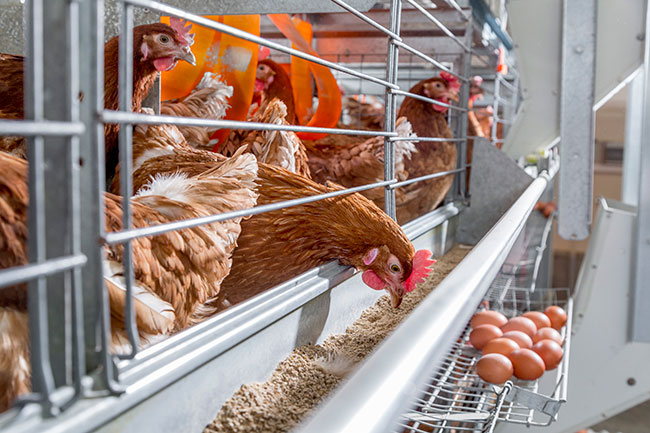
Advances in poultry genetics make it possible for hens to continue laying for up to 100 weeks of age. The prospect for upping lifetime egg production does come with downsides to bird health and performance – something researchers in Canada are working vigilantly to address.
Extending egg production by about 28 weeks could return up to 500 eggs per bird, boosting productivity and profitability for producers. But egg production is a complex process with many factors impacting a longer, productive life for laying hens, and there is little information available for what layers need beyond 72 weeks.
“If we can get more eggs per bird then we have a way to increase food security and profitability for producers,” says Elijah Kiarie, who holds the McIntosh Family Professorship in Poultry Nutrition at the University of Guelph. His research explores nutritional strategies to support longer egg production without compromising egg quality and liveability for layers.
“We are trying to understand what the hen needs for an extended lay and think ahead with practical applications that producers may be able to use in the future,” says Kiarie.
The risks with getting older
While genetic progress may make a productive life possible for layers beyond 72 weeks, the risks to older hens include the challenge to control egg weight, a decline eggshell quality and the ability to absorb calcium, and an increased risk of fatty liver hemorrhagic syndrome and osteoporosis.
Controlling egg weight is key to keeping hens longer and often involves reducing protein in the diet, that can in turn increase the diet’s energy concentration and consumption. The source of energy in a hen’s diet has enormous implications on the accumulation of fat in the liver.
“The liver is an important organ when it comes to keeping hens longer, so we need to understand it better and how to manage it for bird health, longevity and productivity,” says Kiarie. His PhD student Lonita Manoa is looking at a few different additives in the hen’s diet that could support a healthier, longer lay period.
Adding fibre and enzymes
As a nutritionist, Manoa is interested in taking care of all the organs, hormones and tissues involved in egg production, so birds can produce more, high quality eggs. “My research is looking at changing the source of energy in the diet by reducing the amount of starch from cereal grains and replacing it with fibre,” says Manoa. “Fibre is a source of energy that’s available when fed with an enzyme to help make the fibre more accessible to the bird.”
One of her research trials involves adding fibre and exogenous enzyme to layer diets from 72 weeks to 100 weeks of age, and measuring key performance indicators including egg production, egg quality and liver condition through scoring.
She’s still evaluating the results, but the early findings look positive for these ingredients that are already approved for use in Canada.
Evaluating fruit pomace
Manoa’s second trial is with fruit pomace – a waste product of the food processing industry that includes seeds and skins with natural antioxidants. Pomace is bulky and has to be refined to produce a very small quantity that contains the bioactive portion. There are commercially available pomace-based feed ingredients in Canada, but most are sourced from outside Canada, according to Kiarie.
In older hens, pomace may help improve the hen’s total antioxidant capacity and be able to control hemorrhages that come with fatty liver syndrome.
Manoa is sourcing local pomace from cranberry, grape, apple and blueberries with an eye to the practicality needed down the road if these ingredients could nutritionally support a longer lay period. This feeding trial will get underway within the year and will add varying levels of pomace to layer diets at about 18 weeks of age, to measure key production factors as well as incidence of fatty liver.
“I am hoping to see that the antioxidants will help older hens maintain egg production and quality, and prolong livability without impacting their welfare,” says Manoa. “We are looking for a boost to flock productivity by supporting older hens, and also the ability to waste (pomace) into a sustainable food ingredient.”
Boosting mineral support
At Laval University, Marie-Pierre Létourneau-Montminy has been focusing on the role of minerals in supporting a longer laying period. “If we are able to extend the lay period and ensure birds remain healthy and maintain egg quality, we can use fewer birds to produce more eggs. And as dietary protein is reduced with age, there will be less nitrogen excretion,” says Létourneau-Montminy, who holds the Canada Research Chair in Sustainable Animal Protein Production.
Calcium and phosphorus are deposited together in bone – calcium goes to the eggshell and excess phosphorus is excreted in urine. But with little information available for inclusion levels in diets for older hens, Létourneau-Montminy’s feeding trials used recommended dietary levels of both minerals with hens from 70 to 100 weeks. The project is still underway but there are some surprising results that are adding to the knowledge being built around a sustainable longer lay period.
Hens maintained a laying rate of more than 85 per cent at 100 weeks of age. “These birds are very resilient,” says Létourneau-Montminy.
Bone mineral content was not lost from the bones of the laying hens before 100 weeks of age. “We expected mineral levels in the bone to be depleted during an extended lay period, but surprisingly, that didn’t happen,” she says. These results suggest the recommended calcium and phosphorus levels through the normal lay period are adequate to support an extended lay.
Phosphorus levels can be reduced during the normal lay period with no impact on bird performance or health, but maintaining full levels during an extended lay period may be important. “It’s possible to reduce phosphorus by about 25 per cent without affecting hen performance up to about 75 weeks,” says Létourneau-Montminy. “But during an extended lay period, we are seeing that it may be best to not decrease phosphorus because of the role it may play in helping hens manage stress.”
An exciting shift
For egg producers, production goals focus on lay persistency, egg size and shell quality. But the prospect of extending the lay period – and the environmental and profitability benefits – will require the development of a broader life-cycle approach, and integrating the nutrition and management of breeder-pullet-hen will be critical.
“Our work is a bit hypothetical at this point because producers have to deflock at 72 weeks,” says Kiarie. “But a bird built on longevity and production would represent an exciting new shift and opportunity for Canadian poultry producers, and we want to figure out what it would take for this potential game changer to take hold.”