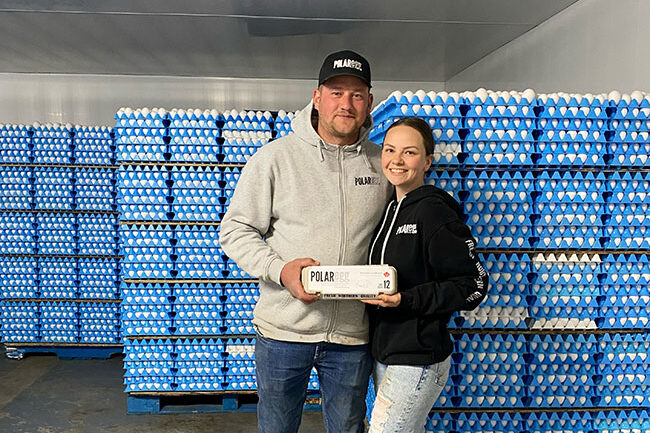
For more than 12 years, Polar Egg has supplied the Northwest Territories (NWT) with locally produced and graded eggs from its base in Hay River. Since 2023, under the new ownership of Matt Vane and Jeff Bisschop of B.C.-based Knutsford Ventures, the brand has expanded its reach, with cartons now stocked in more than two dozen stores across the Territories.
Egg production has been going on in the NWT since the 1990s. At their peak, two larger operations called Hay River Poultry Farms and Choice North Farms reportedly produced about 37 million eggs per year. Before 2012, without a local grading station in the territory, all eggs were shipped south for grading and distribution. But at that point, the owners of those farms added a grading station and launched Polar Egg for NWT consumers.
This was welcomed by all – the public, municipal and territorial leaders, and Egg Farmers of Canada. The NWT and federal governments contributed $150,000 to the grading station, helping with the purchase of equipment, employee training and so on. In 2023, Vane, who farms in B.C., was approached to take over the operations. “We got on a flight to see the operation and discuss details,” he says. “I thought it could be a good opportunity and decided to proceed.”
Prior to purchasing the operation, Vane recalls that the first thing on his list was to hire an excellent operations manager. “I needed someone with solid experience with both equipment and bird management,” he explains. “We were very pleased that Melvin accepted the position.” He’s referring to Melvin Schellenberg, who has moved with his wife Sydney and their three kids to Hay River from Chilliwack, B.C.
Vane describes Schellenberg’s experience in the poultry industry as “extensive.” Open to new opportunities, the move to a small town was appealing, and the family is really enjoying their new community.
Four other staff members round out the operation, carrying out a variety of duties from egg collection to grading operations.
Expanding the market
There are three other commercial egg producers in the territory, all of which produce eggs for Polar Egg. The eggs are white, primarily produced by Babcock and Lohmann hen breeds.
As mentioned, Polar Egg eggs are currently carried in over 25 grocery and retail locations, and Vane is continuing to work on expansion of the market, and not just in the NWT. “The Polar Egg brand is well-recognized here, so we have that solid foundation to build on,” he reports. “We intend to distribute our eggs all across the North.”
The new barn
After hiring an operations manager, the next thing on the list was to build a new barn. A larger facility would add production capacity and allow Polar Egg to use all its quota. Construction started in the summer of 2023 and ended just recently in May 2025. Everything went smoothly for the most part, says Vane, “but the challenges of building in the north are real, and things certainly take longer than expected. There was a nearby forest fire in August 2023 which set the build back six weeks and of course, during the extreme-cold days of the winter, it’s not possible to do construction. But we finished on schedule.”
The new barn features enriched colony housing, which Vane says is a first for the NWT and the first enriched system he’s built. The producer researched various housing firms and settled on Hellmann, as they presented a good price and quality and were also good to work with.
The other Polar Egg barn has conventional housing, and Vane says he’ll replace that with alternative housing in the years to come. Both barns are heated with propane and have tunnel ventilation. And though the new barn build is complete, Polar Egg is currently in the midst of building a new grading station.
Bird health and management
The pullets for the new barn arrived in May from Alberta (as does feed on a continual basis) and Vane says the new flock is looking great. “We’ve had no disease in the new barn or in our other barn since we took ownership,” he explains. “We want to keep it that way. It is a plus of farming in the north that disease risk is very low. We still worry about avian influenza, but there’s diminished risk. At the same time, we keep biosecurity tight.”
Overall, Vane notes that egg farming is both very different in the north but still the same in many ways. There are no poultry veterinarians in the NWT, but they can contact vets in B.C. or Alberta for remote services as needed. “There are weather issues in the north that I don’t have in B.C., for example, and managing feed inventory and egg pick up is a little different,” he says. “But egg production is the same.”
Food in the north
Vane is very pleased at his decision to join northern food production. “We are incredibly grateful for the support we receive from the local community here in Hay River,” the farmer says. “Also, our working relationship with the territorial government and its Agriculture Products Marketing Council is very productive. All the support is much appreciated, and I think leaders in government and beyond absolutely recognize the significance of egg production as a big part of northern agriculture.”
Schellenberg is a member of the Council and believes having protein production in the form of eggs is an important part of the food security mix. “I believe egg production in the north is a huge source of pride, not only for the local community here in Hay River but for NWT as a whole,” he says. “The amount of support for what we do here has been immense, and locally produced products in the north are becoming increasingly sought after.”
Council chair Janet Dean, who is also executive director, Territorial Agrifood Association, notes that the NWT’s agriculture sector is still in its infancy. The cost of production is high because the north sits at the end of a very long supply chain. In addition, distribution within the territory can be challenging. At the same time, she notes that “we are also a place of great opportunity and ease of entry.” Dean also points out that besides food production, Polar Egg also contributes to the economy by creating jobs and fostering regional investment.
In terms of government investment in local food production, in February 2025 at the Territorial Agrifood Conference, the NWT Canadian Northern Economic Development Agency announced federal investments totalling over $4 million towards five local food initiatives. They will enhance infrastructure to produce, harvest, process and distribute local and country foods.
The agency stated that these initiatives include “projects like production facilities and country food processing plants, ensuring greater access to food for communities and the entire territory…to help create more diverse, resilient northern economies and reduce dependence on southern food systems.”
Indigenous country foods (e.g., meat from hunting and fish) are the focus of research into their integration in NWT pre-school and school food programs.
Drs. Kelly Skinner, Sonia Wesche, Sonja Ostertag, and Tiff-Annie Kenny led this work through a CanNor Northern Food Innovation Challenge Grant, conducting a scan of existing programs and engaging daycares, schools, children, parents, and Elders. In schools, students have even created cookbooks that celebrate country food.
Together, these efforts highlight both the challenges and the promise of food production in the North.
For Vane, Schellenberg, and their team, Polar Egg is more than just an egg operation – it represents resilience, partnership, and community pride. With a new barn built and more cartons reaching store shelves across the Territories, the company is carving out a lasting role in strengthening food security and shaping the future of agriculture in the region.