Mental health has come a long way from heavily medicating people with lithium and leaving them in a back bedroom, institutionalizing them or telling them to “just be happier.” But there’s still a heck of a long way to go to normalize what is, ironically, an incredibly common human experience.
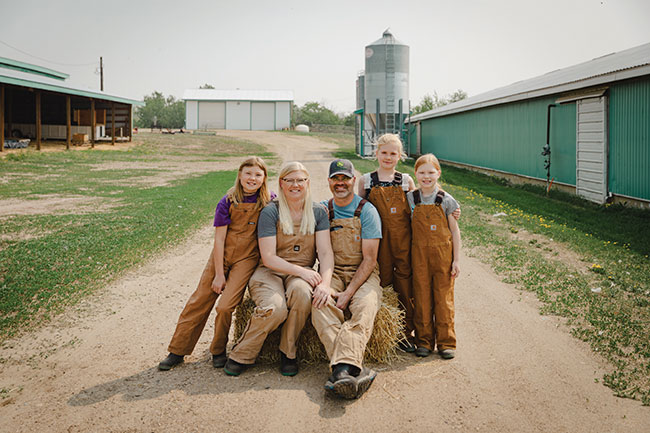
Farmers like Hinke Therrien of Alberta-based Ment-2B Agribusiness, a broiler and turkey operation near Edmonton in Sturgeon County, are familiar with the anxiety of wondering if HPAI will hit, despair at the confirmation, uncertainty of the process toward rebuilding, then the disbelief and anger as it comes around again. She and her husband Marc had a HPAI positive on September 3, 2022 and again on October 29, 2025.
It’s easier the second time around, but…
Whether it’s having been through the process before, knowing to ask for help, having access to supports or (most likely) a combination of all three, the producer is feeling more grounded going through this latest depopulation.
“The first time around it was sad, overwhelming. You don’t know what you’re getting yourself into,” she says. “Now, I know what to do. Get out of my way, let me get to it. Let’s get to it quickly and let’s get ‘er done. I could channel that anger into work.”
Fortunately, despite not seeing the doctor often, she found help before the first cull at the women’s clinic where she’s a patient and took the support she got from within the industry.
“There was a network they started within that first year and it’s just gotten better,” she says of Alberta’s support programs. “I think we just need to keep talking about it. The stigmas are still there. Just talking about it is good.”
Proposed additions to existing frameworks
Good isn’t good enough says a report by Rebecca J. Purc-Stephenson from the Department of Social Science at the University of Alberta about the mental health impact to farmers from culling livestock due to disease. In the report, she notes that the Canadian government’s emergency management framework doesn’t fully address the mental health needs of farmers and sought to identify the impacts as well as the strategies that could help farmers build more resilience.
“The existing emergency management framework follows a continuous four-phase cycle: prevention, preparation, response and recovery,” the report notes. “We adapted this framework based on our findings to specifically address the mental health needs of farmers dealing with livestock diseases and depopulation.”
Among the 12 activities suggested were education and communication opportunities as well as items more directly correlated to mental health like “identify crisis counselors and therapists in the region who can support farmers” and “ensure farmers have access to mental health counselors to process the event and learn strategies for healthy coping.”
This could help with the themes that came up in the study: emotional distress, threats to identity, economic burden, distrust and frustration with authorities and resilience and adaptation.
Challenge the blame game
“If I were to talk to anybody that has [a disease outbreak], I’d say ‘you can’t blame yourself,” says Therrien. “You start questioning every aspect. Everything. It’s not your fault; you will get through this.”
But that sense of blame and fault are common says Gerry Friesen, The Recovering Farmer, a speaker, coach and advocate for prioritizing good mental health. Friesen wrote a book about his journey from farmer, to not-a-farmer and the accompanying mental health challenges along the way. His book, The Recovering Farmer, explores that transition.
“There’s threats to their identity, there’s stigma involved, there’s internal conflict,” he says. “Very often folks think they are alone… that causes people to isolate themselves.”
Friesen says when being a competent farmer and a steward of animals makes up someone’s identity, a cull can be devastating in multiple ways. Those who identify as a farmer are left wondering who they are if they decide to discontinue farming; or they may be left with fear and anxiety of another outbreak if they restart.
“If I’m not who I am, then who am I?” he asks. “You wake up one morning and you need to build a new identity and that can be a real challenge.”
His advice, in brief, is similar to Therrien’s. “Talk about it, talk about it, talk about it,” he says. “That may be to a family member, that may be to a neighbour, that may be to a friend and for goodness sake, that could be to a professional.”
He wants to see reaching out to professionals become a normal response, just as one would for a broken limb.
Identify when it’s no longer working
Therrien walked around “like a zombie” for a few days and recognized she needed help when she took the couple’s three daughters to school but left their lunches behind. While some wouldn’t see that as a flag, Therrien did and took action to get support.
At the Alberta Chicken Producers, Rob Renema, producer programs and research manager, says the industry has improved at providing help as case counts have risen. The team has gained experience and now has point people who specialize in different aspects of a disease outbreak. Stress levels, he says, were dramatically higher a few years ago, and mental health is now included in regular HPAI training.
“We are multidisciplinary in our office. We’re essentially advocating for the producer,” he says. “We’ve gone the route of having a producer liaison role… someone they can trust and talk to.”
The organization is training farmers to support one another, and that liaison can assist with any aspect of an outbreak. But some may need help before an outbreak, given the anxiety and hypervigilance noted in Purc-Stephenson’s report.
Friesen says farmers need to ask for help before they think they need it. Many hide their need by putting on a brave face or denying their internal pain.
“Yesterday. That’s the short answer,” he says of when to ask for help. “There are producers who may not have gone through this but are worried sick. If I’m waking up with my gut tied up in anxiety, it’s a good time to see someone who can help.”
Therrien was more public about the outbreak the second time because she felt more confident and supported, despite some negative reactions.
“I don’t have any shame anymore because I think I’m doing everything I possibly can to avoid it,” she says. “The industry is so much better.”
The Alberta approach to support
The need for mental health support is high in livestock production and it isn’t always about disease. Animal activism, climbing input prices, lack of labour and other factors are driving a push for more resources. The Alberta Poultry Industry Emergency Management Team (APIEMT) is taking a proactive approach.
The organization is recruiting farmers with lived experiences of the stressors of farming to be mentors to others going through challenges that may impact their mental health. The Do More Agriculture Foundation will be providing a virtual training workshop for these mentors.
Alberta Chicken Producers, a member of APIEMT, also provides resources to support farmers on its website through articles, access to the Alberta Mental Health Hotline and a detailed list of mental health resources in the Emergency Response Plan.
There are free counselling programs for farmers in all provinces and territories across Canada as well as the Canadian Centre for Agricultural Wellbeing and the Do More Agriculture Foundation.