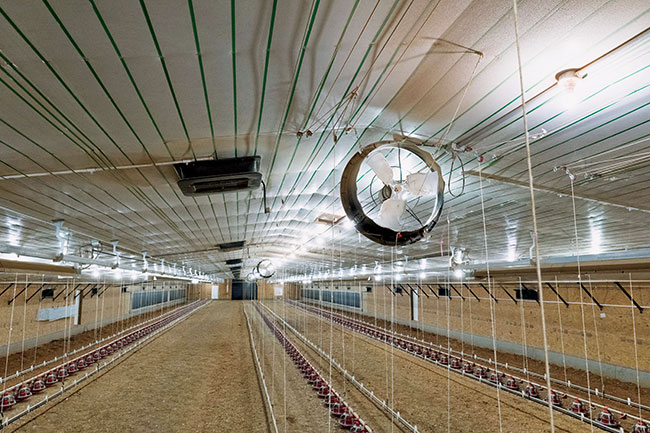
Whether you are upgrading an older barn or planning a new one, ventilation, heating and cooling is key for excellent bird health and welfare. It’s also a huge energy cost consideration. But a one-size-fits-all approach to barn air management is impractical, given the range of barn designs, sizes and locations across Canada. Rather, Canadian poultry producers should look closely at the basics in their barns and ensure they are all addressed properly. Here are five practical strategies to consider.
1. Check your negative pressure system
Michael Czarick, with the University of Georgia Department of Poultry Science, notes that negative pressure ventilation systems – whether in new or old barns – work very well. However, they must be supported by a properly sealed, tight barn. (We all know how much the sucking power of a vacuum is affected if the hose has holes!)
“For negative ventilation systems to be effective, you must maximize air entering the inlets and minimize the amount entering through cracks,” Czarick says. “Only the air that enters through inlets will benefit the birds because it’s the only air brought into the house by exhaust fans that will be heated and dried before it moves down to bird level. Air that enters through cracks tends to quickly fall to the floor, resulting in wet litter, ammonia and chilled birds. Furthermore, under typical wintertime conditions, air leaks cost a lot per day in heating fuel.”
To determine the degree of air leakage, close the barn, turn on a couple of fans and measure the resulting negative pressure. Enter that information into Poultry411’s Poultry House Tightness Calculator at poultryventilation.com/resources to calculate the precise leakage area; the tool also estimates potential heating cost impacts and evaluates minimum ventilation system performance.
Czarick cautions, however, that to obtain accurate results, ensure fans used in the pressure test are properly maintained and their air-moving capacity at 0.10” static pressure is known.
Here’s an example of a 50’ X 500’ barn. If a static pressure of 0.10” were measured when a single tunnel fan (rated at 25,000 cfm @ 0.10”) is turned on, the calculator would indicate about 19.4 square feet of leakage area. The leakage area calculator would also show the relative leakage area (square feet of leakage per 1,000 ft2 of floor space), thus standardizing tightness test results, Czarick says.
A relative leakage of 0.4 or lower is viewed as excellent (a house capable of providing a high level of environmental control and energy efficiency during cold weather) and anything above one is viewed as very poor.
2. Seal air leaks
While this strategy may seem obvious, Dr. Jesse Campbell, associate extension professor of biosystems engineering at Auburn University, says he and his colleagues still often find significant air leaks in poultry barns.
These leaks are particularly common around concrete foundations. He also says it’s common to find some leakage in tunnel, end wall and man doors.
To ensure all leaks are dealt with, Campbell advises examining all vents. Tighten, adjust and lubricate hinges as needed, and if any vents are not functional, repair or replace them. “They all need to open evenly and seal shut when closed,” he explains. “Similarly, clean, adjust, repair or replace damaged fan shutters. In breeding barns, tape any holes in tunnel curtains or sidewall curtains.”
3. Right-size your fan choice
Whether you are planning a retrofit or a new build, Jerry Emmanuel of Cargill’s Poultry Team in Edmonton, advises the strategy of being sure you are employing the right-sized fan.
“For example, one 36-inch fan can provide [better performance] compared to two 24-inch fans,” he notes. “The 36-inch will simply provide more air exchange, and the producer will be able to run it longer. That way producers are using less power while also gaining better air exchange in the barn.”
4. Service all minimum ventilation fans
Staying with fans, Campbell notes that any minimum ventilation fan (each being key in keeping the barn environment dry and comfortable for birds) can operate 288 times over just one day. “These fans are under the stress of constant start and stop every few minutes,” he explains. “They also operate under the increased static pressure of 0.10” to 0.15”. This is why it’s critical to service them properly, especially in situations of wet litter during cold weather. We need as close to 100 per cent fan performance as possible to keep air fresh and litter dry.”
Campbell also advises examining shutters for proper open-close, and cleaning and repairing (or replacing) as needed. “Likewise, the tensioners should be inspected, greased or replaced to keep the belt tight,” he notes. “Bearings should be inspected for wear (noise), and greased or replaced as need. Belts should be in excellent condition, with a tight fit and all pulleys aligned.”
5. Service all ventilation motors
Campell notes that if minimum ventilation fans cycle 288 times per day, inlets can operate over 576 times (open then close) per day, in addition to constant adjustment to maintain static pressure. He says flawless functioning of the inlet motor/system (typically only one per barn) is paramount from both an energy efficiency and bird comfort standpoint.
Therefore, clean, inspect and service (lubricate, repair or replace any damaged parts) this system often. Inspect, grease and replace pulleys, sprockets, rods and cables as needed.
ROI on strategy implementation
Which strategies will save the most money depends largely on the barn’s current condition. Producers will see larger improvements if many fans, vents, brooders and heaters need servicing and cleaning. Likewise, producers with multiple air leaks – rather than just one – will see bigger gains in system efficiency.
“When you go over everything, it’s typically a little of this, a little of that, and it all adds up,” Campbell says. “Servicing doesn’t generally cost a lot. It’s more a time investment. It’s the same with sealing leaks, it doesn’t cost much, it just takes time and must be done correctly. We have to avoid the thinking where we install something and expect it to work without checking on it regularly. That is a strategy that never pays.”
Bonus strategy for brooding: Service every brooder and heater
Campbell notes that while there may be enough appliances in barns, they may not be producing enough heat. “Example: if existing brooder produces 70 per cent of the heat it was designed for when new, then you might not have enough heat to preheat and brood during cold weather,” he says. “The heaters will have to run overtime to achieve and maintain target temperatures and sometimes that is not even possible. If heaters seem never shut off, then it is time to revisit maintenance. Our birds need like-new brooder and heater performance.”
He notes also that while it’s important to make sure the outside of the heaters are clean, it’s the inside that really matters. “Just note that brooders and heaters will not work if there is not enough fresh air delivery into the combustion chamber, so check fresh air delivery for restrictions,” he says. “Also, if there is no pressure, low pressure or and even too-high fuel pressure, this will cause a brooder or heater to malfunction. Make sure you have the right pressure and get professional help if you do not know how to achieve this. Orifices need to be cleaned too.”
Also check that the brooders and heaters are sparking properly. Pilot lights, ignitors, etc. all must be in like-new condition, says Campbell, to allow the brooders and heaters to start and burn efficiently every time they are started.