Maintaining proper ventilation in poultry barns is among the most important management practices to promote bird health and performance. In my role working with poultry producers across Canada, I often see how small changes in barn conditions can have a major impact on flock performance. Understanding the fundamentals of ventilation is key to achieving and maintaining an optimal poultry barn environment.
Environmental swings
Even small changes in temperature, wind speed or humidity can have drastic effects on flock performance. Under-ventilating by just a few thousand cubic feet can negatively affect birds by causing increased ammonia levels, damp floors and high humidity. All of these conditions are very detrimental to bird performance.
Maintaining fans so they operate at maximum performance is essential. It’s also important to minimize air leaks through vent and tunnel doors. Maintaining a tight building and adequate static pressure helps achieve a stable and optimal barn environment.
Young to older birds
For young birds, providing an adequate seal around vent and tunnel doors and fan louvers helps force air to the centre of the poultry barn. This is a fundamental principle of ventilation. It’s critical to get birds off to a good start and maintain barn conditions that encourage optimal performance throughout the life of the flock.
As birds grow older, increasing wind speed becomes more important as a cooling mechanism. That means ensuring belts are tight, shutters are clean and fans are running efficiently so that air movement through the building remains consistent.
Barn hot spots
Air leaks are one of the most common causes of cold spots in poultry barns. Temperature probe placement for the environmental controller can also create problems if probes are located too close to heaters. In that situation, the controller may think the barn is warmer than it actually is.
If one or two probes are too close to the heater, the heating system may not run as often as needed, leaving parts of the barn too cool. It’s important to understand where temperature probes should be placed and to conduct periodic maintenance to confirm that probes remain accurate.
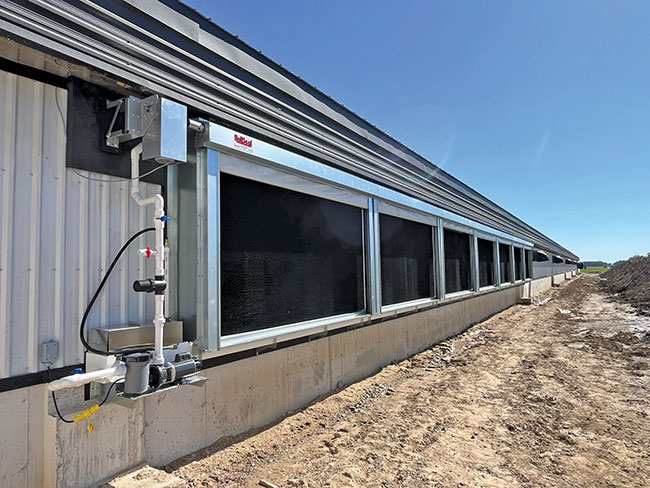
During the summer months, air often enters the barn through the evaporative cooling system and is then removed by fans at the opposite end. Typically, hot spots are less common, but temperature gain can occur if wind speed is not high enough to move air quickly through the building. In that case, the barn can warm up as the air moves through it.
Improving the performance of existing fans can often help solve this problem. Installing new belts, cleaning fan shutters and checking whether evaporative cooling pads need replacing can make a noticeable difference. If pads accumulate dust or mineral buildup, they can clog and slow wind speed, forcing fans to work harder to pull air through the system.
Another good practice is to have the total maximum tunnel fan CFM checked by a professional. In many cases, tunnel barns are under-ventilated, which can also cause temperature gain because there is not enough wind speed to move air quickly through the building.
For cold weather issues, useful steps include recalibrating or replacing temperature probes, cleaning dust off heat reflectors on heaters so radiant heat is directed where it is needed and checking gas pressure to determine whether an older heater should be replaced.
Reading the birds
One of the most important management practices is simply reading the birds. If they are huddled in the middle of the barn, it is probably too cool. If they are pushed toward the walls, it is likely too hot.
Producers can also monitor the previous day’s water consumption. A reduction may indicate illness or signal that something else in the barn environment is not right.
Wet or caked litter is another warning sign. Damp floors usually indicate under-ventilation and the need to run fans to bring more fresh air into the barn. Adequate ventilation removes carbon monoxide, humidity and ammonia while also moving large volumes of air over birds to provide cooling.
Proper ventilation is probably the single biggest factor in maximizing bird performance. Producers understand that, but every day brings different weather conditions and challenges. The goal remains the same – maintaining a stable environment for the flock – but achieving it often requires making small adjustments from day to day.
Doug Martin is the Canadian sales manager for Cumberland, a global provider of poultry production equipment and systems.