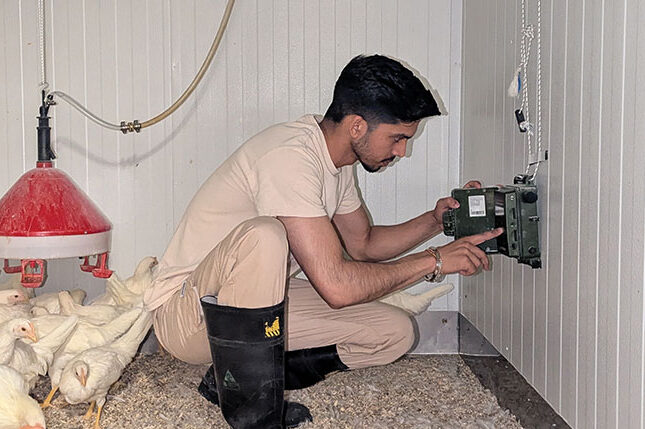
What young layers experience in the first 19 weeks shapes every aspect of their long-term health, performance and behaviour. But it’s tough to keep tabs on all the factors at play. Researchers are working on ways to simultaneously monitor how birds are acting, sounding and moving through brooding and rearing stages as an early detection system that could alert producers to potential problems before they develop.
“Early life is where everything is set for laying hens,” says Dalhousie University researcher Dr. Suresh Neethirajan. “It’s where they develop the ability to quickly recover from challenges. You may not see obvious issues, but it shows up in how uniform the flock is, how they handle stress and how they perform.”
Basic bird development hasn’t changed, but Neethirajan is looking for new ways to integrate the different signals birds may be sending that, when taken together, could indicate what the bird is experiencing and what adjustments may be needed in the barn. Those signals include the sounds birds make, the way they move and react, their body temperature and the environmental conditions of the barn.
Neethirajan is monitoring all these signals and with the help of artificial intelligence (AI) hopes to ultimately give producers earlier awareness about any potential issues in a flock. It’s an area of research called digital livestock farming and Neethirajan leads AI-driven precision livestock systems as a Dalhousie University Research Chair.
“Digital farming is about being able to read the barn – the environment and the birds – to help see patterns and support what producers instinctively know about their flocks,” says Neethirajan. “It remembers patterns from last week or the last flock and can give you a nudge when something starts to drift off course.”
Creating more consistency
Researchers know that if early experiences for young layers are unstable, laying hens are often more aggressive and can take longer to recover if they are sick. That’s why Neethirajan is interested in studying the behaviour, social interactions and physical environment of young layers to better understand how birds respond to stressors – and how to catch problems earlier.
He’s seen firsthand how producers can walk into a barn and just know when something is off. And it’s never one thing – how quickly birds settle, the feel of the air or how birds sound. He wanted to apply digital farming principles to support a farmer’s innate instinct about their own birds with a new tool to gather and interpret all the aspects of bird development and behaviour in a more consistent way.
“Producers already do this so well,” he says. “They listen, watch and adjust. The work we’re doing is intended to support their instincts, make it continuous and reduce the chances of missing subtle changes in bird development.”
Studying the senses
Neethirajan’s latest research followed 150 Lohmann LSL-Lite chicks from hatch to 20 weeks, recording thermal imaging of birds, acoustic recordings of their sounds, video monitoring for bird behaviour and environmental monitoring.
The goal was to look for patterns as birds developed that might show the feasibility of using multimodal monitoring to support precision poultry farming in the future. In other words, would this approach translate into measurable improvements in the long-term health and performance of layers.
Each of the areas monitored provides useful information on its own – but when AI can help pull it all together, a much clearer, fuller picture emerges.
“We are trying to develop a tool that would help farmers catch issues earlier – a small change in sound or behaviour – before it becomes visible and costly,” says Neethirajan. “By the time something looks clearly wrong in a flock, the biological signal has already been present for days. Our goal is to detect that signal early and shift decision making from reactive to predictive.”
Early weeks are critical
Neethirajan and his team found a clear pattern as the young hens developed. Perhaps not surprisingly, birds are noisy and reactive at a young age, and settle as they age to become less jumpy, more predictable and their thermal patterns stabilize as they are better able to regulate themselves.
“What stood out for me is that these changes don’t happen in an organized pattern,” he says. “The sound, movement and thermal signals of the birds evolve on different timelines.”
The encouraging news is that the AI element of the research helped make sense out of that chaos. The research demonstrated that it’s possible to capture all these aspects of laying hen development at the same time – and that a multimodal approach could be a viable, commercial system to monitor the health and welfare in poultry operations.
“The biggest, immediate takeaway for producers is to pay close attention in the early weeks to young layer flocks,” says Neethirajan. “Not just visually but how the barn sounds, how the birds move and how quickly they return to normal after a disturbance. Small inconsistencies that happen early tend to grow into bigger issues later in their life.”
While the path to full commercial integration is still evolving, early applications of this sensing approach are already demonstrating value in research and pilot farm settings. Being able to alert producers earlier on issues in the barn could help spot uneven flocks, support less experienced staff and lead to flock management decisions being made more consistently.
Beyond layers, Neethirajan says the same monitoring approach could apply to breeders, turkeys or broilers – any sector where early development matters.