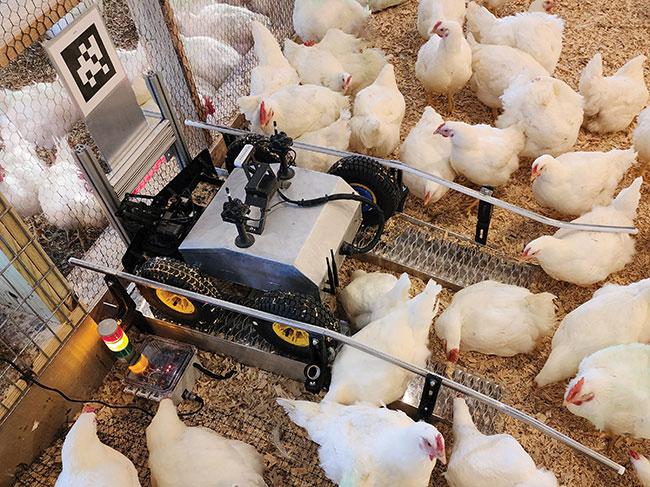
Poultry producers have been hearing about the arrival of barn robots for years. While uptake has taken longer than expected, robots are making their way into barns. At the Poultry Industry Council’s Innovations Conference in Niagara Falls last November, Cargill Canada veterinarian Chanelle Taylor offered a detailed look at where poultry robotics stands today, including what’s working, what’s still being figured out and what Canadian producers should be paying attention to. The picture she painted was one of an industry in transition. There are more tools available than ever before, and even more reason to use them.
The case for change
Pressure and challenges drive change, and the most immediate driver on Canadian farms is labour. Every segment of agriculture is dealing with shortages, Taylor told conference participants, but poultry producers are particularly exposed. The work is physically demanding, the hours are long, and the conditions – dust, ammonia and disease risk – are hard on workers. Turnover is high; the bigger the operation, the bigger the problem.
Mortality removal tops the list of tasks poultry workers don’t want to do. Walking barns daily to collect dead birds is time-consuming and ergonomically challenging, particularly as birds approach catch weight in larger programs. Leave a bird too long, and the consequences go beyond labour. Decomposing birds introduce pathogens, degrade air quality and attract pests. Arguably, mortality removal is the kind of task robots are made for.
Biosecurity adds another layer of urgency, as people moving in and out of barns are among the primary vectors for disease transmission. With avian influenza now endemic in many parts of the world, reducing unnecessary barn entries has taken on new significance. A robot that can monitor a flock through the day without anyone setting foot inside is no longer just a labour-saving device. It’s another tool in the biosecurity toolbox.
What robots can do
As Taylor outlined the range of applications robots can perform at the conference, it revealed just how much the field has grown. Robotic systems are now being developed for environmental monitoring, mortality detection, gait scoring, floor egg collection, litter management, barn sanitation, automated catching and processing plant operations.
Some robots move on the barn floor with the birds. They’re large enough to encourage flocks to get up and move as they pass through. Others are mounted on ceiling rails, travelling a fixed route while scanning the barn from above. Many come equipped with a combination of cameras and audio sensors, as well as environmental sensors that measure ammonia, temperature, humidity and carbon dioxide. Many feed data into AI software that tracks trends over time in order to alert producers when something is off.
The monitoring capability is where Taylor sees some of the most immediate value. A robot moving through a barn can detect respiratory sounds, identify birds with foot pad issues, flag unusual flock behaviour and spot mortality. That kind of continuous surveillance, she said, has the potential to improve animal welfare outcomes by 10 to 20 per cent.
“Being able to have something monitoring the barn and the flock 24/7 is incredibly valuable in detecting those diseases and animal welfare issues,” Taylor said. “It allows us to be proactive, to prevent, instead of reactive, and needing to treat.”
Early disease detection could also help lower antibiotic use. Getting ahead of an illness by identifying clinical signs before disease spreads through a flock makes intervention possible before it becomes entrenched.
The floor egg problem
Nowhere is the robotic opportunity more tangible than in floor egg collection, especially as the egg industry continues to move from caged to cage-free production. Driven by commitments from major retailers and fast-food chains, cage-free egg production has expanded widely in recent years. While cage-free eggs represented less than 24.5 per cent of the market in 2020, Taylor said that share had risen to 72 per cent by 2025.
While the welfare benefits of cage-free systems are real, the system also presents operational challenges. Floor eggs – eggs laid outside nesting boxes – can account for 10 to 15 per cent of production in cage-free barns. Collecting them is a daily, labour-intensive task that also carries food safety risks, as floor eggs come in direct contact with litter and manure, raising the risk of contamination.
Robotic floor egg collection is not new, but it has improved significantly. Researchers at Mississippi State University recently developed vision software that, when integrated with an existing robotic platform, lifted the system’s egg detection and collection success rate. University of Georgia poultry science researchers found that integrating AI technology increased the robot’s capability from 46 per cent to 80 per cent in laboratory testing on 300 eggs. The improvement matters for more than efficiency. A robot that cannot reliably see an egg will run over it.
“Those are eggs that won’t be profitable, won’t be collected,” Taylor said.
Colin Usher, senior research scientist at the Georgia Tech Research Institute, has been working on robotic egg collection since 2013. His team’s most recent field testing in commercial houses puts their system’s detection-to-picking success rate at 91 per cent. In cases where the robot misses an egg on a first pass, it typically returns from a different direction and retrieves it. The system can now self-dock and recharge, work on a set schedule, and recognize when its egg crate is full, navigating autonomously to a drop-off point before resuming its search.
“I still firmly believe they will become indispensable assets for farmers, as more of these systems are deployed and farmers are able to quantify payback and benefit,” Usher said.
Barriers and the road ahead
Some Canadian producers aren’t waiting. In a follow-up interview, Taylor confirmed that a handful of broiler operations are already trialling floor robots that circulate through barns and get birds up and moving. On the layer side, she said several producers are testing ‘Roomba-style’ robots that run beneath aviary systems to discourage floor-laying behaviour. Early results, she said, are promising.
Overall, however, adoption has been slow. The technology takes time to develop, test and refine, Taylor said, and not every robot is the right fit. Before committing, producers also need to see a clear return on investment. For smaller family operations with one or two barns, Taylor said a barn robot is likely still a luxury. For larger operations running three or more barns with minimal staff, however, the math might pencil out. The labour-sharing alone justifies the investment, she said, before factoring in the early-detection advantage.
User-friendliness may be the biggest barrier to uptake. For robotics to gain real traction on-farm, the technology must be approachable and easy to use. Producers should not need a technician to run a robot or an analyst to decode its data. Taylor said plug-and-play was the way to go.
Ease of use has been a consideration in robotic design since the early stages of development. Usher was already building his platform around the principle that a farmer should never need a specialist to operate it. That goal hasn’t changed, and Taylor echoed it at the conference as one of the main conditions for broader adoption. Systems need to be robust, self-maintaining and as close to plug-and-play as possible.
Generational renewal will likely be a driver of change too. Taylor noted that succession is already reshaping how farms approach technology. As younger producers take over farm operations, she believes they are more likely to seek tools that give them better flock oversight and will be more open to welcoming robots onto their labour force.
Cargill Canada is already putting that to the test. Taylor confirmed the company has several technologies running in barns right now.
“We are learning that a lot of these systems take time,” Taylor said. “But I have learned that a vast majority of our growers are excited to learn and utilize tech where they can.”