Product quality and innovation go hand-in-hand in any line of work, often with spectacular payoffs and rewards for companies that get it right.
Founded in 1918, Anjou, Que.-headquartered fresh-produce distribution powerhouse Courchesne Larose has been getting it right for 108 years on its continuous long upwardly journey to establish itself among Canadian fresh produce industry’s elite.
Starting out as a small fruit importer in downtown Montreal, the company now ranks as the second-largest privately owned distributor of fresh fruit and vegetables in Canada—servicing customers in the retail, food-service, processing and institutional sectors with exemplary service and reliability.
With a vast market reach from Ontario though Quebec and all of Atlantic Canada, the tightly-integrated Groupe Courchesne Larose company employs over 1,000 people across several operating divisions that include:
- KROPS, in charge of overseeing the import and distribution of top-quality products from abroad.
- Les Aliments Bercy inc., specializing in the distribution of organic fruit and vegetables, along with the processing and packing of value-added products.
- Founded in 1998, La Paysanne is a fruit and vegetable wholesaler, specializing in emergency supplies for grocery stores.
- Founded in 2003, Dynapro Transport is the parent company’s transportation and logistics arm offering professional, efficient and dynamic capabilities in the transport of fruits, vegetables and dry goods with a fleet of about 175 trailer trucks outfitted with advanced temperature-control technologies to maintain optimal product freshness and shelf life during transport.
- Marcan Packaging, specializing in the subcontracting of packaging, sorting, warehousing and value-added handling of food products.
- Founded in 1983, Veg-Pak Produce is a leading Ontario-based value-added wholesaler and processor of fresh produce.
Distributing well over 30 different fruit, vegetable and berry varieties throughout they year—from root and green vegetable to apples, strawberries and citrus products—Courchesne Larose first gained true national fame as an industry pioneer back in the early 1970s by introducing Morocco-grown clementines into the Canadian market.
“There was actually no such thing as clementines in North American market back then; it was a brand new fruit grown exclusively in the Morocco kingdom’s Maghreb region,” the company’s executive vice-president Guy Milette told Canadian Packaging in a recent interview.
“The clementines remained pretty much exclusive to Morocco for nearly 20 years,” Milette recalls, “and we secured an exclusive distribution deal with the royal family to be their representative for clementines in Canada.
“That exclusivity lasted about 25 years,” Milette says, citing the product’s fast-growing popularity with Canadian consumers right from the outset.
“Today, of course, there are more than 80 varieties of clementines grown across Morocco, Spain and other Mediterranean countries, South Africa, and South American nations like Chile, Peru, Argentina and Brazil,” Milette relates.
“Interestingly, clementines were not even grown in the U.S. until about 15 years ago, in California,” notes Milette, who began his career in the produce business with Courchesne Larose back in 2001.
In addition to working his way up to the company’s senior management ranks, Milette also became a well-known ambassador for the Canadian produce industry through his volunteer work for the Ottawa-based Canadian Produce Marketing Association (CPMA), where he served as the group’s chair of the board during the 2021-2022 term.
Today, Milette continues his active involvement by serving as chairman of CPMA’s Member Services committee.
“Having been involved with the association for more than 20 years, a better part of my working life, has been an invaluable experience both personally and being the ambassador Courchesne Larose as well,” Milette says, “insofar as expanding our circle of influence to the highest levels of governmental policy-making on national level.
“For some smaller companies, it may be hard to see what’s going on behind the scenes in the industry if they are not participating in the CPMA,” Milette points out. “But being a national organization covering all provinces makes it an invaluable resource for industry contacts, networking and uncovering new business opportunities.”
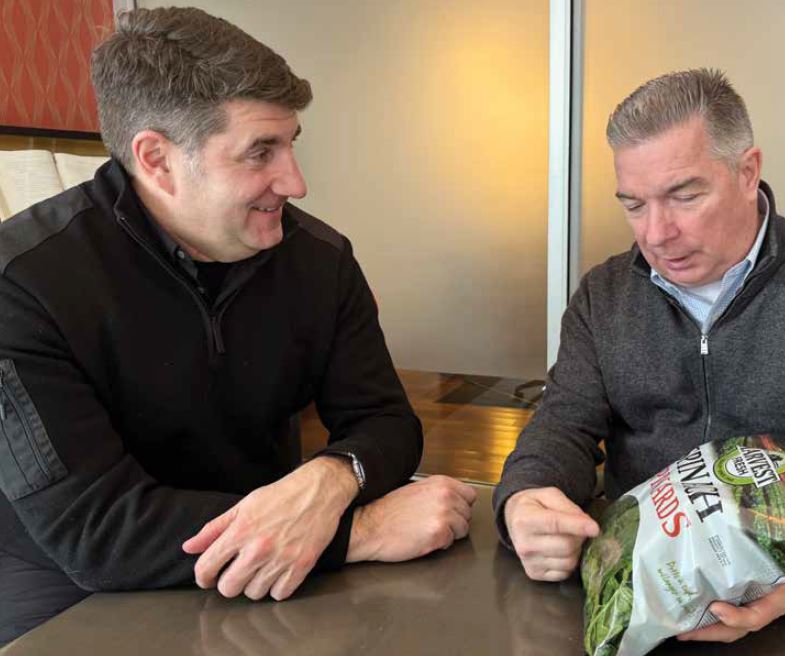
Michel Aucoin, who joined Courchesne Larose two years ago as the company’s new chief executive officer, fully concurs, saying CPMA’s high-level contacts and solid relationships with its counterpart U.S. industry groups will become critically important assets in coming months, as the industry grapples with the punishing new tariffs on Canadian imports to the U.S. With no specific exemptions for fresh produce announced yet, the troubling development is a profound industry-wide threat.
“While we do have one of our divisions selling directly to a couple of U.S. customers, we are primarily a Canadian business, with about 97 to 98 per cent of our output distributed in Canada,” Aucoin relates.
“The retaliatory U.S. tariffs will undoubtedly impact some of the product that we import from there,” Aucoin acknowledges, “but because out imports are sourced from about 100 countries around the world, we have more flexibility, agility and the scale to minimize those impacts, compared to some of our large competitors.
“Because we are dealing primarily with pure commodities with no fixed price, since it fluctuates on almost daily basis, we should be able to come up with some nimble response strategies to minimize the tariffs’ impact on our own business,” Aucoin continues.
“Nevertheless, because we pay for all out imported commodities in U.S. dollars, the prospect of a Canadian dollar weakening further is bound to have a macroeconomic impact on the Canadian food industry in general in terms of further exacerbating the lingering food inflation.”
Even if the Canadian economy slides into a recession due to the looming trade war with the U.S., Aucoin thinks Courchesne Larose has enough “recession resiliency” built into its business model to overcome whatever challenges come its way because of the tariffs.
“People will still need to eat, recession or not,” he says, “so what usually happens during the economic downturns is the consumers start spending less going out to restaurants and making more trips to the grocery stores.
“Because this trend works in reverse in stronger economic times, having a large customer base in both retail and food-service industries enables us to adjust to whatever demand fluctuations we need to address to remain a competitive and reliable business partner to all our customers,” Aucoin asserts.
As Aucoin relates, Courchesne Larose has made intensive efforts in recent years to diversify its offerings to create a “more balanced” product portfolio.
Whereas the company used to be primarily associated with imported fruit products, more than 40 per cent of its output is now accounted for by vegetables, according to Aucoin.
“We go through an average of about 500 trailer loads of produce per week,” Aucoin relates.
“This is quite a large, high-volume number,” Aucoin says, “and it covers pretty much just about every major produce variety in the world that Canadian consumers want to buy: the full produce basket, if you will.”
To keep up with growing volumes, Courchesne Larose has carried out a number of significant, capital-intensive facility and equipment upgrades at many of its operations—particularly at the company’s state-of-the-art central distribution facility in the Montreal suburb of Anjou, which also serves as the company’s headquarters.
Built in two phases (2012 and 2017), the 174,000-square-foot facility houses 17 climate-controlled storage rooms and 33 other separate enclosed rooms for ripening bananas, avocados and pears.
The company also operates another 92,000-square-foot Marché Central facility—located within Montreal’s city limits—housing 18 refrigerated rooms and 26 banana rooms, primarily operating as a hub for the retail sale of fruits and vegetable by local food merchants.
All the products stored at the two facilities are kept under optimal storage conditions that are meticulously maintained by a state-of-the-art refrigeration system, with the temperature and humidity levels constantly computer-calibrated to ensure an ideal environment for the products inside.
Employing advanced sophisticated temperature, moisture and other critical climate control and monitoring technologies for optimal product protection and shelf-life, both facilities boast three critically important global certifications, including:
- The SQF Level 2 food-safety certification from Global Food Safety Initiative (GFSI);
- The Ecoresponsible Level 2Performance certification for sustainable development;
- The Fairtrade certification for sustainable and ethical sourcing practices worldwide, with provisions for ensuring fair prices for the farmers, as well as decent working conditions.
“We are the only produce distributor in Quebec to have obtained the SQF Level 2 certification,” says Aucoin, citing significant expenses involved in maintaining it.
“With each climate-controlled room subjected to its own periodic third-party certification auditing process each year, it all adds up to a considerable financial outlay.
“The SQF Level is a very strong certification,” Aucoin comments, “but it is also a very expensive one to maintain.
“The banana room alone costs as about $200,000 per year to carry out three audits annually,” Aucoin reveals, “and there are many other specialty storage rooms requiring multiple audits throughout the years, each costing anywhere from $2,000 to $2,500 per audit.
“But that’s just the reality of ensuring food safety these days,” says Aucoin, “and we are happy to be an active part of it.”
Despite the extra costs, the certifications serve as valuable marketing tools for expanding the company’s business reach and customer base, Aucoin points out.
“Our banana rooms, for example, feature advanced forced air circulation systems that provide the bananas here with two to three extra days of shelf-life at the retailer’s end,” he says, “and that’s a huge competitive advantage for this particular product.”
Other notable technology investment carried out by Courchesne Larose in recent years include:
- The AiroCide air-purification system.
Developed by NASA (National Aeronautics and Space Administration) specifically to eliminate mold, fungus, airborne bacteria and volatile organic matter such as ethylene, AiroCide technology provides the required levels of protection to ensure the stored fruits and vegetables do not ripen prematurely and enjoy a longer life-span.
- State-of-the-art Roadnet delivery tracking system that enables the distributor to optimize its transportation routes.
- Custom-designed loading docks that allow for the truck doors to be opened inside the warehouse, thereby ensuring that the cold chain is never interrupted, and that the products are consistently stored at their ideal temperatures.
Aucoin adds that Courchesne Larose has also made considerable investments into automated packaging equipment for its Anjou facility—including optical sorters, flow-wrappers, baggers, top-sealing equipment, etc.—to carry out some rudimentary packaging tasks for some raw products onsite.
“So if a customer asks for his red peppers to be shipped in packs of three, for example, we can easily run that on our flow-wrapper to the specified quantity,” Aucoin explains.
“We do some value-added “transformation” work here at Anjou,” Aucoin notes, “but only for the smaller, short-run jobs typically.
“We have our other sister-companies, like VegPak and Bercy, to look after the large-volume transformation stuff for the bulk of the product shipped to Anjou,” says Aucoin, adding the Anjou center operates on 24/7 basis throughout the year, closing only for the Christmas Day and Saint-Jean-Baptiste Day holidays.
“It is the biggest distribution center in Canada dedicated exclusively to fresh fruits and vegetables,” Aucoin proclaims, adding the company’s industry-wide reputation for customer service, product quality and innovation that perfectly position it to continue on its solid growth projectory well into the future.
“We really work hard to make sure our customers get the product they need, when they need it, and in the condition they need it to be,” Aucoin asserts.
“Quality is always a huge issue in the produce business, so we continually invest in the latest inspection and track-and-trace capabilities to ensure optimal quality levels throughout the value chain,” he adds.
“And we tailor all our services to meet our customers’ exact needs,” Aucoin states.
“We deal with the largest retailers in Canada, who are some of the best, most sophisticated retailers in the world,” Aucoin point out, “but we also cater to the small retailers, as well as the smaller distributors who don’t have the scale to procure on a global basis like we can.”
“It all comes down to carrying out or duty of care to increase the value of our produce throughout the supply chain,” Aucoin concludes, “to deliver the best value proposition to the consumers, our customers and our vendors on a daily basis.”