It’s hard to find good help these days. This concern can be heard throughout almost every industry across Canada today as the labour pool continues to shrink. The meat-processing industry can be especially challenging for finding skilled workers.
This has been the case for Boucherie B. Poirier, a small, vertically integrated butcher shop, slaughterhouse and meat-processing facility located in Saint-Louis-de-Gonzague, Que., about a 40-minute drive from Montreal.
The company has long held its roots in this rural community, opening as a butcher shop and slaughterhouse in 1939 when Omer Poirier purchased the business for his son, Bernard.
The Poirier family had owned and operated the business for several decades, serving the local farming community, before being purchased about two years ago by Michael Zeppetelli, a former commodity trader, investment banker and CFO, who identified opportunities for growth within the family-run business.
“Our investment thesis was that there’s an opportunity in the market for portions,” Zeppetelli says.
When speaking with potential clients within the hotel, restaurant, and institutional (HRI) sector, the owners and operators explained that they were having a difficult time finding qualified people to work as chefs and sous chefs.
To solve this issue, Zeppetelli decided to create turnkey solutions for the sector.
“We’re still doing the slaughtering and the custom butchering for farmers that sell direct to consumers, and we still have our retail market, but we’ve gone hard over the last two years into the portion market—selling into restaurants, daycares, other resellers with private label, or custom packaging for them,” he says, adding that Boucherie B. Poirier is also developing an e-commerce website to expand its reach.
The company’s current 10,000-square-foot facility currently employs 40 people working across two shifts seven days a week. Currently, the abattoir slaughters about 2,000 cattle a year, along with another 1,000 sheep and goats.
While the number animals slaughtered is not huge, Zeppetelli says what sets his company apart is its vertical integration.
“We’ll buy the live animal, or we’ll bring it in for a farmer and do their custom butchery. The animal will arrive here in a stock trailer alive, but they’ll leave as finished cuts, all retail cuts,” he explains, noting that his company has no interest in competing in the boxed beef market as a wholesaler.
Boucherie B. Poirier’s production area is broken up into one carcass line, and an order preparation area.
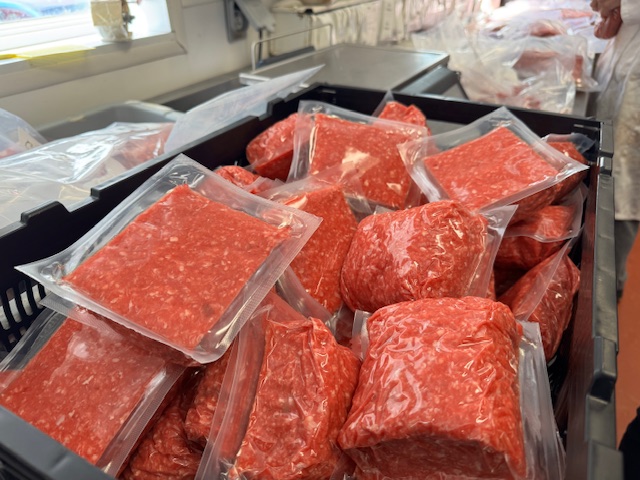
The carcass line typically has eight butchers breaking down the animals, which are then transferred over to another two butchers who take all the trim, grind it, place it into the company’s Reiser Vemag Robot500 vacuum filler, and then onto the company’s Reiser Variovac Optimus thermoformer, with both machines purchased about 12 months ago as part of the meat processor’s expansion plans.
When researching the company’s options for investing in automation for its processing and packing operations, Reiser’s reputation for quality equipment was part of the reason for the purchase.
“They’re known to be workhorses,” Zeppetelli states. “We talked to a lot of other people in the industry that have lots of experience in meat processing, and there was nothing but good words about Reiser as an organization and their equipment.”
Zeppetelli adds that the company and its staff have found Reiser’s Variovac Optimus thermoformer especially impressive, particularly the ease and speed at which dies can be changed out.
“Within 15 minutes, those are changed,” he says. “So if we’re packaging one-pound ground beef packages, and we need to switch to a larger format for another cut, it’s all done within 15 minutes.
“By the time the guys get back from their coffee break, the entire production line is ready to go again,” Zeppetelli says, noting that the control panel is remarkably intuitive and simple to operate.
He was also impressed by how he was treated by Reiser despite being a smaller customer.
“We’re not a big account for them,” he says. “The reality is I bought just two machines. I’m sure there are companies that buy two or three machines a year, but they treated us like we were one of those companies.
“They helped us with the financing, and they helped us with getting a small government subsidy for investments in automation. They were there every step of the way,” Zeppetelli says.
“The first time we met, for an hour-and-a-half we talked about everything except Reiser,” recalls Jean-Yves Belisle, sales representative for Reiser.
“We talked about everything—ambitions, goals, investors, and where he wanted to bring the business in his first five years.
“And I don’t think we really talked about what Reiser was bringing to the table, because I really wanted to understand the goals and the objectives of the business,” Belisle continues.
“I think that made a big difference: not trying to sell anything right away, but trying to understand the business to provide good solutions down the line.”
The ability and willingness of Reiser to custom build and design its products to accommodate the tight production and packaging spaces within the Boucherie B. Poirier facility were another reason they were chosen for the project.
“We have 10,000 square feet, which is a very small facility considering the volumes that we’re doing,” says Zeppetelli.
“They were able to get us a custom-made, shorter packaging machine with only one tray.
“A lot of other companies’ machines wouldn’t even fit in our space,” he notes, “but Reiser was able to make a modification and deliver us the machine.”
He has also been impressed by the level of service that Reiser offers.
“They’ll FaceTime with the staff to help them if ever there’s an issue,” Zeppetelli says, “and they’ll be here within 24 hours if required.
“I’ve been in other industries where you give someone a big six-figure sale and two months later you don’t hear from them,” Zeppetelli says, adding that Reiser is keen on offering solutions and service that help companies succeed in the long term.
Over the first 12 months of operation, the Reiser Variovac Optimus thermoformer and the Vemag Robot500 have both performed as advertised and the company’s production has doubled, with plenty of spare capacity to produce even more products.
“Packaging is no longer our bottleneck, storage is,” Zeppetelli says. “The machines don’t even run eight hours a day.
“We make a bit of a backlog and package everything in one swoop, and then we shut the machine off until the next batch of production is ready.”
To maintain its growth, Boucherie B. Poirier is currently in the process of planning out a 6,000-square-foot expansion to increase its storage and production space over the next three years. Once completed, the company would have the ability to double its production again.
Zeppetelli says there is a growing demand right now from smaller resellers, including convenience stores, grocery stores, retirement residences, schools and daycares that the company wants to capitalize on.
“As we’re serving more and more restaurants and institutional clients in the greater Montreal region, we’re attracting that urban retail customer out here, and within 30 to 45 minutes, they can talk to an artisanal butcher who can prepare the cut fresh right in front of them,” he says.
While the investment in automation with the Variovac Optimus and the Vemag Robot500 machines can be partially traced to managing labour shortages, it’s also about optimizing efficiencies to maximize profits and to cope with market volatilities.
“Automation is no longer a luxury:it’s a necessity,” Zeppetelli states. “Automation allows us to have more consistent products, with high quality standards that can be respected every single day.”
Both units have been production powerhouses for Boucherie B. Poirier’s operations. While the Variovac Optimus thermoformer is currently being used for simple vacuum packaging, the units are also available with the ability to do modified atmospheric pressure (MAP) packaging —increasing the potential number of applications for the machine.
For its part, the Vemag Robot500 has been expertly calibrated to ensure accurate portions for all their products, such as the popular 500-gram ground-beef packages.
“With a growing number of our customers serving the online market, consistency, accuracy and portioning has become increasingly important online,” Zeppetelli explains.
“A lot of times it’ll be sold at a fixed weight or fixed price, which means you can’t afford giveaways.
“If you’re selling a 500-gram portion, it needs to be 500 grams, not 502 grams, and this is where these units really shine,” he says. “Once they’re calibrated, this machine will run all day, and it’ll hit that 500-gram target on the nose.
Adds Belisle: “It’s designed to make consistent sausages in terms of weight, length and diameters, and very accurate portioning as well for ground beef and in multiple other applications.”
The ability of the Vemag Robot500 to be able to make a variety of products has been an invaluable production tool.
“We’ll do ground meat, and we can also do the more liquid products like meat pies with all the fillings, with everything being portion-controlled,” Zeppetelli remarks. “Our sausages, our kaftas, our burger patties … all those things that used to be done by hand are now done by the machine, so that’s huge.”
Between the company’s investment in the Reiser Variovac Optimus thermoformer and Vemag Robot500, the company has saved a great deal in labour costs, according to Zeppetelli.
“To do the work that these two machines do would take an extra five or six staff,” he says.
As Belisle points out, “Instead of having an operator actually getting the meat, putting it on the scale, removing some, adding some, and then putting it in the packaging machine, you can rest assured that the accuracy of the vacuum stuffer is going to be high.
“You don’t have to measure it, and you don’t have to put it on the scale,” he continues. “It’s directly in the thermal forming machine and you know it’s going to be consistent in terms of weight and size—fitting perfectly in the designated pocket of the packaging machine.”
All in all, Boucherie B. Poirier views Reiser as its own automation department, and Zeppetelli and believes they will be working together well into the future as his company continues to grow.
“They were here for the first solutions that we’ve put in place, and the goal is that they’ll be there for the next ones,” Zeppetelli says. “They’re not just a supplier of equipment.
“They bring a lot of expertise, and this is expertise that we didn’t have internally,” he points out. “The team we have here: they’re amazing butchers who really understand carcasses, while I understand spreadsheets.
“However, none of us had operated these machines before, and so having a team from Reiser come in and take us from A to Z on how this equipment works has been invaluable for our operation.”