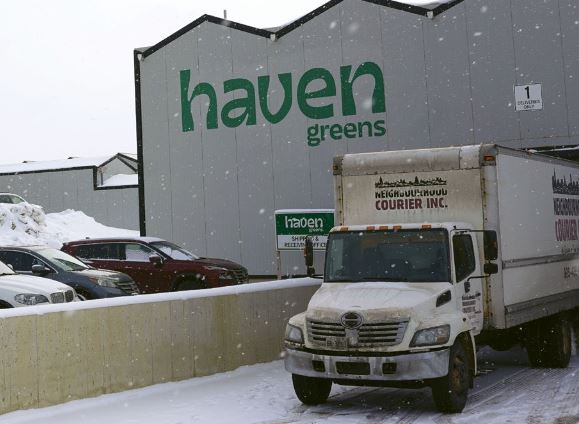
Every day is a fresh new harvest day at the Haven Greens greenhouse operation in King City, Ont., where automation and AI (artificial intelligence) technologies play a central role in the production of high-quality baby lettuce in a fully climate-controlled indoor environment set up to ensure maximum product freshness and crunchy texture for its leafy creations, with minimal human intervention.
A brain-child of the company’s founder and chief executive officer, Jay Willmot, the five-acre greenhouse is already producing about 10,500 pounds of fresh lettuce per day, barely a year since launching the first batches of its Haven Greens brand of green and red baby lettuce leaf into the Canadian retail markets.
For Willmot, a third-generation farmer who has masterminded the recent transformation of the family’s legacy thoroughbred horse farming enterprise into an agri-tech start-up, the company’s early success is a strong validation of his long-held belief that modern technology and traditional farming practices can not only co-exist, but in fact improve the Canadians’ quality of life through greater home-grown produce availability and self-sufficiency.
“Well over 90 per cent of the leafy greens consumed in Canada are imported from the U.S.,” Willmot says, “so there is a real need to grow Canadian production volumes to ensure better food security and food sovereignty for Canadian consumers, with an opportunity to ‘Buy Canadian’ by giving them a choice that is both fresh and affordable.
“Food security and food sovereignty are big issues for Canada,” Willmot asserts, “and obviously we can’t solve this problem for Canada ourselves because we’re just not big enough.
“But if we can inspire other people to pick up that food sovereignty mantle, we’ll be happy to be leading the charge towards serving the Canadian market with more Canadian-grown produce,” he states.
“The market has really evolved in the last 10 years in terms of consumer education and knowledge about greenhouse lettuce versus field lettuce,” Willmot notes, “but being able to offer pesticide-free, non-GMO lettuce that does not need washing before eating really creates a whole new category with a fresh, crunchy and tasty product that is a real game-changer in this market.
“It has taken a lot of hard work and up-front investment to build Canada’s first fully-automated greenhouse for lettuce,” he points out, “but we believe it’s an important first step towards building this critical infrastructure to supply the Canadian domestic market with local product.”
As Willmot relates, “We are the first greenhouse in Canada where not a single human touches the crop, from sowing and seeding all the way out to harvest and going into the package.
“It’s a totally hand-free process where everything is mechanized, with conveyors and mobile gullies (gutters) automatically transporting the product throughout the greenhouse to our harvesting area and on to the pack house,” Willmot explains.
The Mobile Gully System (MGS) at the Haven Greens greenhouse consists of multiple conveyor belts and robotic arms that guide gutters through each stage of cultivation—from soil filling to seeding.
After seeding, the gutters spend two days in a dark germination chamber for the seeds to sprout, before being rotated back into the greenhouse to mature under tightly controlled and monitored temperature, humidity, light and moisture conditions.
Each gutter uses RFID (radio frequency identification) technology to track plant health and maximize yield by adjusting the indoor environment as dictated by the AI-enabled central computer system throughout the growing process—about 24 days for green and red baby lettuce, and 14 days for flavour varietals such as mustard and arugula.
“We control every aspect of the environment here in our greenhouse, including things like lighting, irrigation and fertigation, the climate, humidity, temperatures, and air pressure inside the greenhouse,” Willmot relates, “and we integrate that with what’s happening outside of the greenhouse.
“So we’re even constantly measuring the weather outdoors,” he points out, “to make sure that what we’re doing inside is as efficient and as sustainable as possible.
As Willmot relates, “We collect data on everything we do, using multiple different sensors, advanced smart machine-learning algorithms, and narrow-band AI to drive a lot of the processes and make calculations to determine the most efficient path to achieving our goals.
“So there is a constant interplay between our computing equipment, our growers and our production staff to adjust to any trends and to see how well our strategies are being implemented.”
As Willmot points out, “There’s a lot of life science that goes into ensuring good growing conditions 365 days a year.
“You need really precise nutrient balancing to make sure you’re giving the plants exactly what they need throughout the growing cycle,” Willmot elaborates.
“You also need to make sure that you’re fighting the proliferation of any root pathogens or other issues that could be causing the plant not to transport those nutrients effectively.
“And of course, you need to get this product out to consumers in the shortest amount of time so that they can experience the freshness of the product,” says Willmot, citing a 48-hour order-to-delivery turnaround for customers in both retail and food-service sectors.
“The biggest thing for us is our proximity to our consumers, so that our lettuce is fresher than others when it gets to the consumers’ table,” Willmot states.
“Freshness is really, really important when it comes to the eating experience,” he proclaims, “and we deliver that freshness by growing nice healthy, crisp and crunchy plants without using any pesticides, delivered to consumers ready-to-eat, straight from the package.”
This promise of a better, fresher and more satisfying salad experience is quickly resonating among leading Canadian retailers, now accounting for about 45 per cent of Haven Greens’ business, as well as its food-service clients.
Since delivering its first shipments of the Haven Greens retail packs to Toronto-based boutique grocery chain Summerhill Market last spring, the company has also added leading grocers such as Metro, Sobeys and Costco to its client list, along with a growing number of independent grocers.
At the moment, the company’s flagship Haven Greens brand—packed in 113- and 226-gram top-sealed, recyclable plastic trays with built-in resealable tabs incorporated in the top film layer—is available in Baby Green Leaf, Baby Red+Green Leaf and Baby Spring Mix blends. In addition, the company has also developed a one-off 283-gram top-sealed tray package used exclusively for the Trillium Blend salad mix it ships to Costco.
All the filling and packaging of these trays unfolds in the company’s busy Pack Hall department, where inflowing rows of lettuce are processed into loose leaves and transferred onto a multi-head automatic weigh scale, which dispenses precisely measured portions of the fresh, crunchy greens into the awaiting trays on the conveyor belt below.
Again, the entire primary packaging process is automated for hands-free product handling, with packhouse personnel not touching any product until the perfectly top-sealed finished trays come out of the packhouse’s state-of-the-art, fully automatic tray-sealing machine, manufactured in Germany by the renowned global packaging machinery builder MULTIVAC Group.
Installed by MULTIVAC Canada experts a little over a year ago, the MULTIVAC TX815 is a high-performance, automatic, dual-track tray sealer designed for maximum output for tray-packed food products.
Part of MULTIVAC’s renowned TX series tray-sealing machines, the dual-track TX815 plays an integral, vital role in helping Haven Greens run a highly automated process.
Loaded with cutting-edge features and performance attributes, the TX815 makes light work of churning out about 100 finished trays per minute at Haven Greens in continuous operation when running both lanes, while ensuring swift, smooth transfer flow for the light, delicate product.
Optimized for large tray sizes, the high-speed machine utilizes advanced X-Tools die technology to evenly distribute sealing forces across every tray, ensuring uniform and reliable package integrity.
According to MULTIVAC, RFID (radio frequency identification)-coded dies are particularly beneficial for companies running many different tray formats that require frequent die changes.
Moreover, the MULTIVAC TX815 provides seamless digital integration with smart service features, including Multi Sensor Control, Flow Manager, Smart Production Dashboard, Smart OEE Analyzer, Smart Log Analyzer, Smart Data Backup, and Smart Machine Report.
Featuring fully hygienic design to comply with Haven Greens’ strict sanitation regime—involving a nightly sanitation shift to keep the entire greenhouse spanking clean—the MULTIVAC TX815 produces airtight, attractive top-sealed tray packs that can be easily stacked on the retail shelf with side panels on the bottom, allowing the pre-printed cozy graphics and branding elements on top of the top-seal film layer catch the shoppers’ attention in the produce aisles.
Currently processing more than 40,000 trays per day with minimal human intervention, the machine also facilitates remarkably quick product changeovers to help keep production running, according to Haven Green’s chief agriculture officer, Eric Highfield.
“We are able to switch between a four-ounce and an eight-ounce tray in less than 30 minutes,” says Highfield, a lifelong produce industry veteran and now also a big fan of MULTIVAC’s tray-sealing technology.
“It’s been a reliable piece of equipment that enables us to process 10-to-11 pounds of lettuce every 20 seconds,” Highfield says, “so the time it takes for the lettuce entering the Pack Hall to the time that it’s put into a retail tray is less than two minutes.
Says Highfield: “Being able to run dual lanes gives us an opportunity to achieve at least 100 trays per minute, if not higher, which is pretty much the ‘Gold Standard’ when it comes to this specific type of automatically-cut baby leaf lettuce.”
As Highfield recalls, “We were looking for speed, and we were also looking for a company that was able to provide service in a very timely manner, while being able to stand behind the product that they delivered.”
According to Highfield, the MULTIVAC TX815 delivered on each key selection criterion from the outset, helping the company hit the market running with an attractive, high-impact retail package boasting an 18-day shelf life without any gas-flushing, along with the highly convenient resealable pull-up windows in the front panels for easy opening and reclosing of any leftovers.
“It allows consumers to have a fresh experience each and every time they go into the refrigerator to pull product from this package,” Highfield extols.
For his part, Willmot cites MULTIVAC’s vast experience in the global produce industry, along with its renowned technological prowess and local technical support, as key factors for choosing aMULTIVAC solution for the company’s packaging line.
“We wanted to make sure that a light crop like leafy greens was understood by the integrator that came in to install their technology in our Pack Hall,” Willmot recalls.
“We look for experience in every aspect of everything that we do here at Haven Greens,” Willmot says, “so it was very important for us to work with somebody who had done this before.
“And with the MULTIVAC Canada warehouse being located only 30 minutes away from us [in Brampton], it was a great opportunity to have an OEM service partner that we could trust.”
Says Willmot: “The integrated MULTIVAC system allows us to truly live up to what we say in terms of offering Canadians a no-hands, pesticide-free product, available 365 days a year in diverse packaging formats at our retail customers, with plenty of opportunity to scale up.
“We take innovation very seriously here at Haven Greens,” Willmot concludes, “and MULTIVAC has been incredibly important in allowing us to deliver our vision to Canadians everywhere across the country.”