Ganong Bros. has been producing chocolates and candies for almost as long as Canada has been a country.
Based in St. Stephen, N.B., the fifth-generation family-run business started up operations in 1873, making it Canada’s longest-standing family-owned and operated chocolate company.
The venerable candy maker produces some of the most classic and longest-running chocolates and sweets in North America, including Chicken Bones cinnamon-flavoured candy (since 1885); Delecto boxed chocolates (1917); and the Pal-o-Mine candy bar (1920).
Moreover, Ganong Bros. was also the first Canadian company to purchase a lozenge machine from Europe (1889); first in the country to make lollipops); and the first to introduce heart-shaped chocolate boxes.
Growing in leaps and bounds since its inception, Ganong Bros. is now an industry leader in candy manufacturing and co-packing services for some of the biggest brands in North America.
It’s hard to believe that with such a rich history Ganong Bros. didn’t start out in the sweets business, but as a general store.
“St. Stephen was a big shipbuilding town. We’re right on the St. Croix River, on the border of Maine, and there was a lot of industry at the time,” explains Nick Ganong, chief operating officer at Ganong Bros. and one of the fifth-generation of the Ganong family running the business, along with his sister, president and chief executive officer Bryana Ganong.
The general store wanted to differentiate itself from competitors, so the Ganong family hired a candy maker to work in the back of the store.
The idea was so successful that in 1873 the store was converted from a general store into a full-time candy manufacturing factory.
Ganong Bros. remained in its original factory until 1990, when they constructed a new production facility in St. Stephen, housing with 130,000 square feet of operating space and 45,000 square feet of warehouse space.
The company currently employs more than 300 people, making it one of the largest employers in the region.
As the company grew its own brands, it also started taking on co-manufacturing services for other candy companies—a trend that has taken off in the world of food production.
The company nowadays produces approximately 15 million pounds of chocolates and candies annually at the St. Stephen facility using 20 different manufacturing lines and 22 different packaging lines.
While many of its production processes have been automated over time, there are still some tried-and-true processes in place, Nick Ganong relates.
“Walking through our factory is a bit like a walk through confectionery history,” Ganong remarks. “Some of our processes maintain elements of our original methods in order to keep the product quality and attributes our customers know and love.
“Then there are some areas in the plant that are heavily automated with robotics,” he points out.
“There’s a pretty big split, but we’re constantly on a journey to find ways to automate and reduce some of our more labour-intensive operations.”
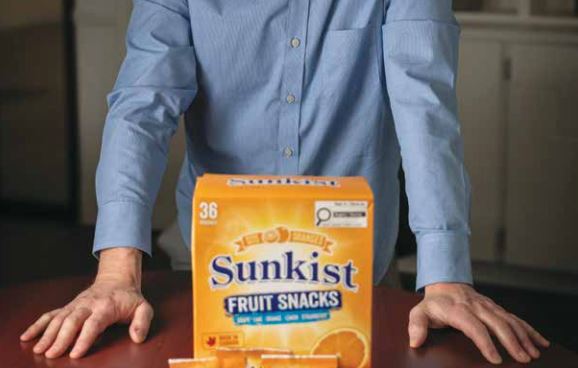
In 1997, the company became the official Canadian Licensee of the Sunkist brand. Since that time, Ganong Bros. has continued to produce Sunkist fruit-snack products, in addition to its own branded candies and chocolates.
The demand for Sunkist fruit-snack products has grown significantly over the past 29 years, while also attracting other potential co-manufacturing clients in the U.S. looking to offer more variety to their own products offerings. So much so, in fact, that the candy maker recently invested in a new packaging line to keep pace with production demands.
“We manufacture faster than we package for this product type, and we had a new opportunity to improve our unit costs and our productivity, and also a new opportunity to work with a co-manufacturing partner in the U.S.,” Ganong explains.
“But while we had the manufacturing capacity to make the candy, but we didn’t have the packaging capacity to be able to convert it into finished goods,” Ganong recounts.
To meet those packaging demands, Ganong recently purchased and installed four Mars Rapid vertical form-fill-seal (VFFS) baggers, along with four ELITEWEIGH 24H multihead weighers from PLAN IT Packaging Systems, based in Mississauga, Ont., and Tampa, Fla.
“This allowed us to be able to make improvements to our existing product lines and allowed for enough capacity to take on new business by adding the four new baggers,” says Ganong.
Plan IT Packaging Systems is one of Canada’s fastest-growing packaging-automation companies, delivering advanced solutions in weighing, bagging, flow-wrapping, case-packing, and end-of-line robotics and palletizing.
With a major U.S. facility in Tampa and a new 40,000-square-foot Canadian operation in Mississauga being readied to come online on July 1, the company is rapidly expanding to meet rising demand across North America.
“Known for its robust systems, engineering aptitude, and fully integrated turnkey approach, PLAN IT continues to position itself as a leading partner for manufacturers seeking modern, efficient, and highly reliable packaging automation and robotics,” says Mark Evangelista, sales director for PLAN IT Packaging.
This first project collaboration between Ganong Bros. and PLAN IT Packaging was initiated when Ganong Bros. reached out looking for a multihead weigher to marry into a third-party bagger they were considering buying at the time.
“We had an initial conversation, and I educated them on some of our offerings,” recalls Sal Choudhary, sales manager for PLAN IT Packaging.
“With PLAN IT being a turnkey packaging solutions provider, taking your product all the way through to a finished pallet, I wanted to make sure the Ganong Bros. team were familiar with our capabilities,” Choudhary states.
Originally, Ganong Bros. was considering purchasing two multihead weighers to integrate into one bagging line, but Choudhary says they recommended an alternative route to improve redundancies.
“Instead of relying 100 per cent on one bagger, we suggested to divvy it up into different units,” he relates.
“That way they have repeatability, and the versatility, to be able to run different products,” Choudhary explains. “They liked that idea.”
Ganong Bros. was also interested in purchasing a single bagging line that had two baggers welded together on one frame, but once again, Choudhary suggested another option to improve redundancies.
“If that bagger goes down, you no longer have a bagging operation that’s live,” he says.
“So I suggested to them that maybe we could break that process into completely independent bagging lines.”
As Choudhary relates, Ganong Bros.’ minimum throughput requirement was 400 bags a minute, while the bagger they were considering was only rated to makes going to 350 to 400 bags per minute maximum.
So, Choudhary suggested four completely independent bagging lines that package 150 bags per minute, which would also give the operation plenty of redundancy to run continuously.
“If one line does go down for any reason, at least you still have other lines up and running,” he explains.
“They liked that idea too,” he says. “Their concern was pricing at that point, but we came in very competitive.”
By installing four new bagging lines, Ganong has expanded their capacity for pouching in order to accommodate new demand through the factory.
“Not only does it give a better output than what we had initially forecasted with a single system or two systems, but it also gives them the chance to minimize downtime with the redundancy of multiple lines,” Choudhary says.
According to PLAN IT, the Mars Rapid VFFS baggers with four ELITEWEIGH 24H mutlihead weighers installed at the St. Stephen plant feature:
- Stainless steel framing;
- Four incline in-feed conveyors to carry product from ground level up to the top of the systems;
- Four exit conveyors to carry finished pouches from under the vertical bagger and bring them up to working height.
- An incline infeed conveyor boasting a modular belt with cleats for easy sanitation.
- The ELITEWEIGH 24H mutlihead weigher is equipped with:
- A 24-head weigher with dimpled contact parts to reduce contact surface with the product;
- Tool-less removable contact parts for easy sanitation;
- A third layer of memory buckets to use as a temporary holding bucket that stores product when the weigh bucket’s contents don’t fit into an optimal combination;
- A triple timing bucket to store three complete target weights at any given moment to maintain higher speeds without sacrificing accuracy;
- High-precision digital strain-gauge load cells for high accuracy, reliability and high speed dynamic weighing;
- Angled contact parts for better product flow.
For its part, the Mars Rapid VFFS bagger features a servo-driven vertical bagger with six servo motors powered by Omron controls, while the unit’s open-frame design delivers great accessibility, fast changeovers and superior sanitation.
“With full visibility and easy access from all sides, the operators can clean, service and adjust the system in a fraction of the time—boosting uptime and overall line efficiency,” Choudhary says.
Moreover, the Mars Rapid bagger is designed with continuous-motion sealing jaws that act as a pulley for the film, while adding seal dwell time for higher speeds—running the 22-gram Sunkist pouches at up to 185 packages per minute.
Other key features include an automatic film centering and unwinding system; tear notch seal jaws for tear notch cutouts; tool-less removable forming tube for easy changeovers; and an overhead pan to prevent contamination of product.
“It allowed us to get around 2.5 times the output of what we were having on that packaging process on the existing line,” Nick Ganong says.
“Hence it allowed us to shift some volume around, so there’ll be more people on these lines, operating them to get more output.
“It didn’t displace people,” Ganong asserts. “It just enabled those people to be able to accomplish more in the run of a shift.”
Ganong also compliments the ELITEWEIGH 24H multihead weighers for allowing Ganong Bros. the flexibility for packaging a lot of different combinations, while operating at a higher speeds.
Ganong says his company talked to 30 different vendors that provided similar types of packaging equipment, but he was ultimately sold on PLAN IT Packaging’s combination of a short lead times (only three months from purchase to commissioning), competitive pricing, and being able to deliver the promised throughput.
“Overall, the business case was sound to move forward with them,” he says.
Having PLAN IT Packaging technical experts located relatively close by in Mississauga for any servicing or maintenance was also a bonus.
“We were able to travel to them and do the testing onsite without having to cross international borders,” Ganong points out.
“And if you go back 10 or 11 months, there was a lot of dialogue and concerns around potential tariffs, so buying from a Canadian supplier helped us to reduce the risk around potential impact to tariffs.”
While many Canadian workers often worry that automation will replace them, Ganong says that is not the case at his plant.
“We are growing, and want to grow faster than we will be able to grow the number of people,” he says.
“So we are confident that we’ll continue to find opportunities to employ as many people as we can find,” he says.
“It’s not about reduction of jobs: it’s about up-skilling our staff,” Ganong states. “We have found that some of the manual, repetitive tasks are not as engaging, and retaining staff in those roles is difficult.”
Ganong says the company is always looking for ways to automate less popular tasks such as product inspection.
“We’re asking humans to do things that are difficult for human to accomplish, like looking at 350 packages a minute as they go by to pick out any defective packages.
“That’s a tough job and difficult to do as a manual process,” Ganong says. “In a lot of cases we’ve already implemented, or will be implementing, vision systems to do those tasks with technology.”
Case packing and preparation is another area Ganong is always looking to automate.
“There are tasks, like getting cases ready, where we can do with a machine,” he comments, “but it would still require someone to operate that machine.
“Incorporating technology in this way is more engaging for the staff overseeing it,” Ganong says, adding that it would create some value for the employees while improving completeness for the company.
As Ganong relates, in 2018 the company Ganong achieved the vaunted, globally recognized Safe Quality Foods (SQF) Level III certification, which is the highest standard that can be achieved for food safety and food quality systems.
From a competitive standpoint, having the highest certifications in food safety, along with the technologies to reduce production bottlenecks, are keys to a successful food production operation, according to Ganong.
“Our goal is to be as turnkey as we can be for our own brands and our co-manufacturing partners,” says Ganong.
“We want our customers to be able to order a finished product, and then we create it from start to finish and get it into the format that they want it delivered to the retailer,” Ganong sums up.
“That way they don’t have to go through all the intermediate steps involved in sending product to a co-packer,” he concludes, “while we get the opportunity to add as much value as we can while the product is here.”