| |
 |
|
|
 |
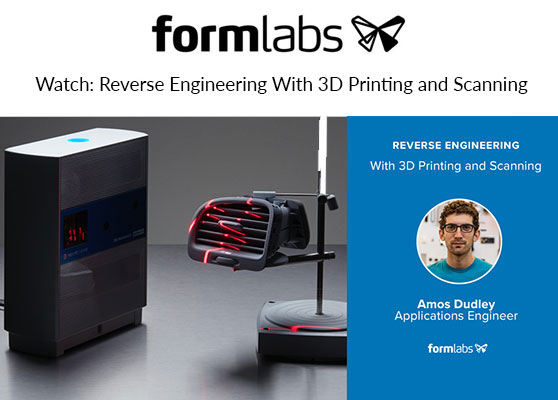
 Due to advances in 3D printing and 3D scanning, lack of access to original design documents is no longer a barrier to creating parts that reference real-world components. Reverse engineering is a powerful way to create digital designs from a physical part and can be a valuable tool in your prototyping toolkit alongside technologies like 3D scanning and 3D printing.
In this webinar, learn how to use 3D scanning to improve part design and production.
We'll walk through the step-by-step reverse engineering process for an aftermarket digital gauge, with tips along the way for using the right reverse engineering tools, from CAD software to 3D scanners and 3D printers.
What you'll learn:
- How to choose the best 3D scanner based on accuracy, scan volume, and budget.
- How to reverse engineer a scan to create products with custom ergonomics.
- How to process and repair 3D scanned objects for part replication.
- How to use stereolithography SLA 3D printing to produce end-use parts.
|
|
|
|
Speakers:
|
|
|

|
|
Amos Dudley
Applications Engineer, Formlabs
Amos Dudley is an applications engineer at Formlabs, dedicated to pushing the boundaries of functional 3D printing by integrating synergistic manufacturing and design processes. Amos is a CAD expert with a background in digital design, architecture, and additive manufacturing.
|
|
|

|
|
Faris Sheikh
3D Printing Specialist, Formlabs
Faris Sheikh, 3D printing specialist at Formlabs, has helped Formlabs run over 40 live broadcasts around the world to educate over 21,000 engineers, manufacturers, dentists, and jewelers on how to successfully incorporate Formlabs products into their day-to-day workflows. Previously, Sheikh most notably ran an online technology show on hardware and software products totalling over 2 million global views.
|
|
| |
|
|
|
