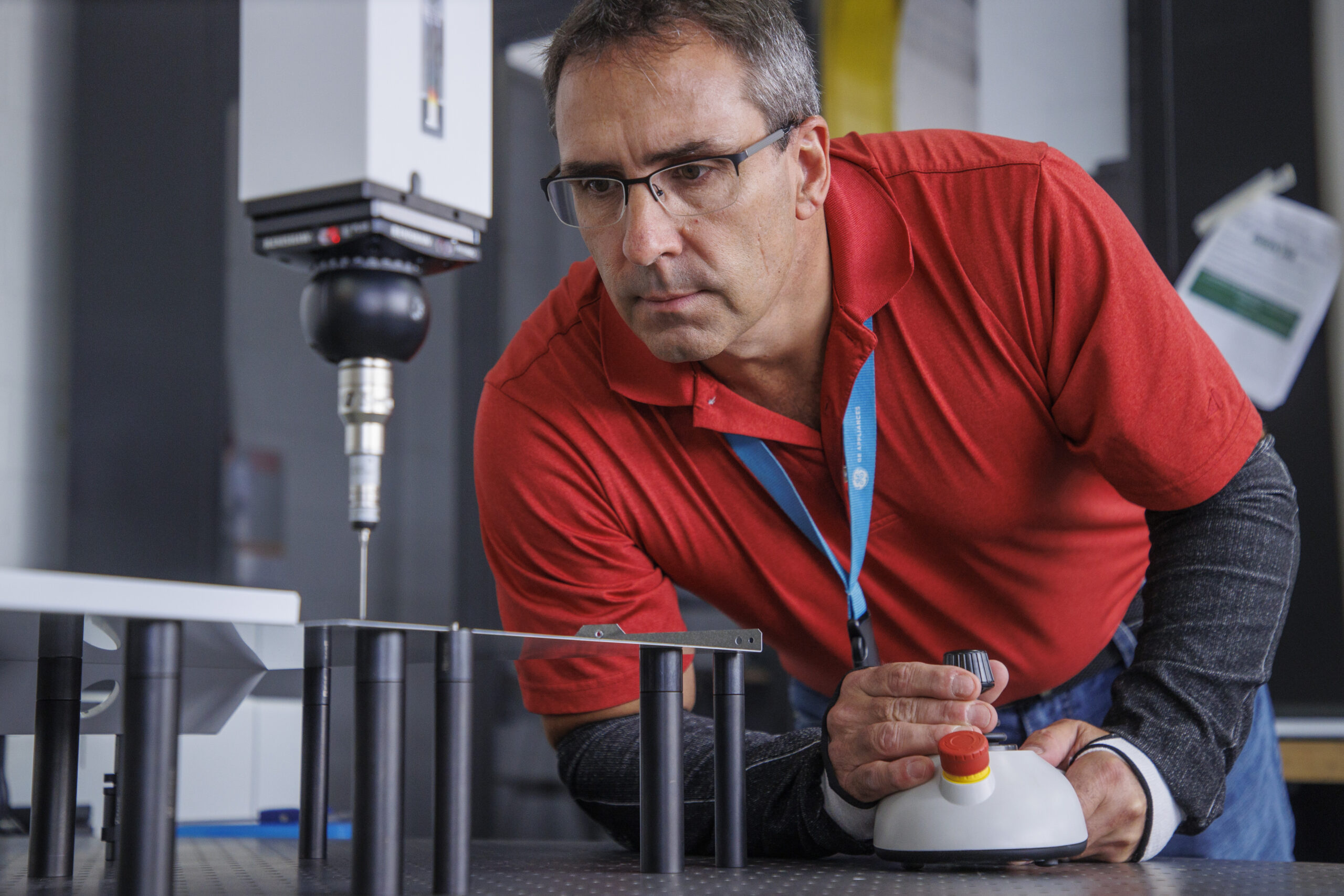
Quebec City’s InnovMetric helps GE appliances improve product design with 3D metrology
Quebec City-based InnovMetric and Louisville, Ky.-based GE Appliances have joined forces to drive efficiency, precision and collaboration in product design and manufacturing.
GE Appliances began its journey into digital metrology nearly a decade ago, transitioning from traditional point-to-point linear measurements to advanced 3D scanning and data-driven decision-making. This shift has significantly improved the efficiency and accuracy of product design and manufacturing.
For decades, manufacturers relied on traditional point-to-point linear measurements and manual inspection methods to assess product quality. At GE Appliances, this approach was standard practice—until a decision was made nearly a decade ago to transition toward a more data-driven, 3D metrology-based system.
This shift has not only transformed the company’s quality control process but has also streamlined production and improved accuracy across its operations.
Breaking away from traditional methods
Historically, GE Appliances’ metrology approach was heavily reliant on coordinate measuring machines (CMMs) and linear dimension drawings. This meant manually measuring specific, predefined points on a part and comparing those against a 2D drawing—a time-consuming, sometimes limiting process that left gaps in the full-picture analysis of a product’s geometry. In effect, engineers were making critical decisions based on a handful of points rather than a complete dataset.
The shift to 3D metrology marked a significant step forward for GE Appliances. Using advanced scanning technology, the company was able to develop a more accurate and repeatable quality control process. Engineers could now analyze entire surfaces, visualize deviations with colour mapping, and use real-world data to drive decision-making—a stark contrast to the limited insights offered by traditional methods.
“The beauty of 3D scanning is it shows you the entire lay of the land,” says Dave Leone, senior director of engineering and dimensional control at GE Appliances. “You can start at 50,000 feet and then let the data speak to you in terms of, ‘Hey, there’s a dent in the part’ or ‘What’s the mismatch here?’ or ‘There’s a little bit of a twist.’ And so you’re more knowledgeable about your parts than you’ve ever been in the past.”
Now, with full-field scanning, they can see what’s happening with the whole surface of a part we get a much better understanding of any variation that exists.
“It’s been amazing journey, but it’s crazy how far we’ve come,” Leone says. “It’s almost indistinguishable today from what it was eight years ago.”
This transformation also reduced the trial-and-error approach traditionally associated with product design and validation.
Colour mapping
One of the most transformative elements of this digital shift has been the adoption of full-field 3D scanning and colour mapping—which visually represents deviations between a scanned part and its CAD model, instantly identifying out-of-tolerance areas.
“It used to be all that would be sent is a report, a PDF or something with hard numbers— go/no-go,” says Louis-Jérôme Doyon, vice president of business development at InnovMetric. “At best, maybe a few colour maps, but people could not consume easily by themselves.”
Seeing a colour map for the first time was a lightbulb moment for Leone. Engineers can now visualize the entire surface geometry of a part, identifying defects, deviations and inconsistencies in real-time. “It’s like walking into a dark room and you turn the lights on and you’re seeing the parts for the first time. And you’re like, ‘Oh.’” This shift has provided a new level of clarity in evaluating product quality, enabling faster and more informed decision-making.
“With colour mapping, we can immediately see what’s happening with a part,” Doyon says. Rather than interpreting a long list of numbers from a CMM report, they get an intuitive visual that highlights problem areas instantly.
This technology played a key role in analyzing and improving a prototype refrigerator door assembly. When engineers noticed a door wasn’t closing properly, they scanned it using digital metrology tools. The colour map revealed significant swelling, indicating the outer door was above the CAD model specifications. Further investigation pointed to issues in the foaming process during prototyping, where inadequate clamping led to distortion. By adjusting the foaming fixture and applying additional support, engineers corrected the issue, producing an improved version within days.
Centralized data, enhance collaboration
Before partnering with InnovMetric, GE Appliances faced a common challenge in manufacturing: disorganized metrology data, scattered across different labs and computers. So while engineers in one facility might take critical measurements, that data wouldn’t always be easily accessible to design or quality teams in another location.
With PolyWorks|DataLoopTM, all metrology data is now stored in a structured, centralized system, ensuring that everyone—from design engineers to manufacturing specialists—can access the latest measurement results instantly. It also gives real-time visibility. Instead of waiting for manual reports or searching through disconnected databases, teams can now analyze inspection results as soon as they are collected.
“Every single CMM that we have—all 21 of them—in our whole fleet across all of our factories, they all feed PolyWorks|- DataLoop,” Leone says. “So we have one software platform, one metrology team. It all feeds the database. It’s a beautiful architecture. If you were to do it any other way, it would be very inefficient, very cumbersome and, ultimately, not effective.”
The centralized approach also improves communication and collaboration across different departments. Designers, engineers and quality assurance teams no longer have to rely on emails or file-sharing workarounds to access critical data— it’s all available in one place. And with automated version control, PolyWorks|DataLoop also ensures that all teams are working with the most up-to-date measurement information, reducing errors caused by outdated or conflicting reports.
Interoperability with CAD
A major focus has been ensuring seamless integration between metrology software and CAD systems. Traditionally, manufacturing teams relied on 2D drawings and manual data entry to define product specifications.
“In the old way, it would be traditionally you could export right out of your CAD system, and all the inspections are essentially compared directly to that file,” Leone says. “That’s the state-of-the-art for most software companies.”
By leveraging product manufacturing information (PMI)—a system that encodes key manufacturing and inspection requirements within the CAD model—and model-based definitions, GE Appliances is reducing human error and accelerating product development. The CAD models serve as the single source of truth for both design and inspection. Every critical dimension, tolerance and geometric feature is digitally embedded into the model, eliminating the need for separate inspection plans and reducing the risk of human error.
Seamless integration between CAD and metrology software also accelerates product development cycles. By linking design, quality and manufacturing teams through a shared digital framework, GE Appliances is able to identify and resolve issues earlier in the process, reducing costly delays.
Doyon also highlighted InnovMetric’s solution to help embed 3D measurement plans within an organization’s native CAD platform. “The software —which is called PolyWorks|PMI+LoopTM—is a bridge to the CAD world, where we’re supplementing CAD with missing information that is relevant for inspection folks.” It provides the digital traceability needed to automate the consumption of its measurement plans plus digital connectivity to open up access to 3D measurement results to all CAD users.
Future-proofed
GE Appliances’ digital transformation journey is far from over.
The adoption of 3D scanning and data-driven metrology has positioned the company to take full advantage of emerging technologies like AI and automated inspection systems. These technologies are being integrated to detect deviations and streamline inspection setups, bringing a new level of efficiency to the production process. “
AI is everywhere, AI is very powerful,” Doyon says. “First, people need to realize, in order to do AI machine learning, you need a ton of data. You need historical data. Well, the beauty in here is that GE Appliances has that; they’ve centralized their data.” This centralized data makes GE Appliances stand out most places, where data is scattered, making deeper learning very difficult: “That rich quality data is everywhere, but nowhere, so forget AI—you’re not going to be able to do it.”
One of the biggest challenges in manufacturing is identifying process deviations early enough to prevent costly defects. Traditionally, engineers rely on historical data and manual analysis to pinpoint potential quality issues. AI is changing that equation, allowing manufacturers to detect patterns in real-time and make data-driven decisions faster than ever before.
Alongside AI, automation is transforming metrology setups. GE Appliances is working with InnovMetric to automate the inspection process by integrating PMI and PolyWorks|PMI+Loop with their PLM system. This automation lets robots generate inspection templates, read PMI and CAD data, and seamlessly process scanned parts. In the metrology lab, once a part is scanned and named correctly, the system can automatically locate, import and analyze it—performing key inspections before any human intervention is required.
For more information about InnovMetrics and how it helps drive manufacturing excellence, visit www.innovmetric.com.