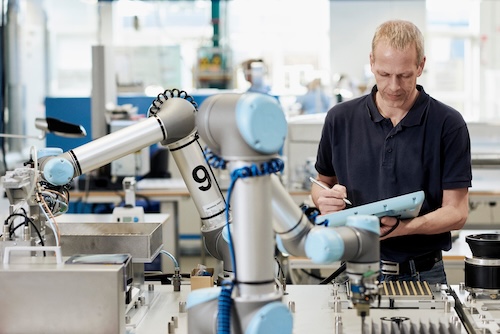
Technological fusion transforming engineering and manufacturing.
As the industrial automation landscape continues to shift and evolve, the integration of artificial intelligence (AI) into robotics is signalling what could turn out to be a new age of efficiency, adaptability and collaboration. Dubbed ‘Physical AI’, this powerful fusion of advanced technologies is enabling robots to perceive, learn and interact with the physical world in ways previously thought impossible. For design engineers and machine builders, understanding the current and future implications of Physical AI is critical in order to remain on the cutting-edge of innovation.
Understanding Physical AI
The term Physical AI refers to the application of AI and machine learning technologies that empower robots with the human-like abilities to perceive and respond to their physical environments. Unlike traditional robots that are preprogrammed and operate following a set of predetermined instructions, robots enabled with AI are equipped to make real-time informed decisions, adapting, adjusting and learning from their interactions.
It’s an incredible technological breakthrough that poses the potential to completely transform a number of different industries and sectors. And, according to Anders Beck, Vice President of Innovation and Strategy at Universal Robots, it’s impact could be most significant within manufacturing and logistics, resulting in tangible enhancements for a number of sectors.
“Physical AI allows robots to go beyond merely executing pre-programmed instructions and gain the ability to learn, adapt, and make informed decisions based on their sensory input,” he asserts. “This advancement is pivotal in enabling robots to handle complex tasks in unstructured settings, thereby reducing the need for manual intervention and enhancing operational efficiency.”
Reshaping advancements
Beck points to a host of recent advancements related to Physical AI that are currently reshaping industrial robotics altogether:
Enhanced perception capabilities – AI-powered vision systems enable robots to recognize and interact with objects under a number of different conditions. Traditional vision systems often require high contrast and repeatable shapes in order to function properly. Deep learning-based vision systems are equipped to adapt to changes in lighting, surface finish and object orientation. Beck notes that, “Deep learning vision systems allow us to train this kind of variability into a single model, so it can handle a range of environmental variations.”
Advanced path planning – The integration of AI accelerators, such as NVIDIA’s Isaac Manipulator’s cuMotion planner, has proven to significantly improve path planning, allowing robots to effectively plan trajectories in complex environments, enhancing speed and precision in tasks like CNC machine tending and assembly.
Learning from human demonstrations – Reinforcement learning techniques enable robots to learn complex tasks by observing human actions. It’s an ability that’s proving to be incredibly beneficial in applications like assembly, where robots can mimic human movements to perform intricate tasks without the need for preprogramming.
Impact on design and machine builders
Given the transformative capabilities of Physical AI, there’s no doubt that its introduction will in turn alter the roles of design engineers and machine builders. Because AI-driven robots can handle many of the complex tasks often undertaken by engineers, their time is freed up, allowing them to focus on honing robot behaviour and system design.
“AI is changing the way design engineers and mechanical engineers approach robotics development by handling the line-by-line programming of motions and I/Os,” says Beck. “This approach allows engineers to focus on commanding higher-level robot behaviours to complete tasks successfully.”
With respect to machine builders, Beck continues, AI-enhanced robotics provide the opportunity to create more flexible and adaptable automation solutions. However, he warns that integrating these technologies presents challenges, including the need for new expertise in AI and machine learning.
“Machine builders will need to learn to leverage AI capabilities when building machines at the user level,” he says. “This may require them to acquire AI technology skills in order to adapt, and to train and work with AI on a technology level.”
Practical industry applications
Beck stresses that although industries are still just approaching the tipping point when it comes to the potential uses and applications of Physical AI, there are already a number of ways in which the technological advancement is demonstrating its transformative potential:
AI-powered metrology – At the NVIDIA GTC conference, 3D Infotech showcased dynamic metrology using Universal Robots’ UR3e cobot to scan and compare workpieces to CAD models, while projecting inaccuracies, thereby enhancing precision in quality control processes.
Generative AI for CNC tending – T-Robotics recently demonstrated impressive GenAI-driven CNC tending, in which a Universal Robot UR5e cobot was able to interpret natural language for CNC tasks using its ActGPT, simplifying programming and enhancing the versatility of robotic systems in machining environments.
Reinforcement learning in assembly – Using a Universal Robot UR5e cobot, AICA was able to demonstrate reinforcement learning assembly which resulted in the cobot being able to locate and assemble a gear by leveraging AI-driven skills. This approach enables robots to learn complex assembly tasks through trial and error, resulting in improved efficiency and adaptability.
Bimanual assembly – By leveraging two Universal Robot UR5e cobots, Acumino has perfected bimanual assembly in which the cobots learn complex manipulations such as cable handling by simply observing, resulting in significant enhancements to the dexterity and coordination of robotic systems.
AI quality assurance – AI-powered technologies can also be used to improve quality assurance through the detection of anomalies on products and in manufacturing processes, thereby reducing waste and dramatically improving product consistency.
Enhancing production flexibility
A number of significant advantages result from the use of AI-enhanced robots, particularly within high-mix, low-volume manufacturing, Beck explains. He adds that their ability to perceive and respond to the real world allows them to adapt, yielding tremendous benefits.
“AI allows robots to adapt to different part shapes and sizes without requiring extensive reprogramming or fixturing, enabling flexible, high-mix manufacturing.”
This adaptability results in the reduction of downtime and enhancements to labour utilization, making automation accessible to small- and medium-sized businesses and manufacturers, many of whom up until now faced barriers due to the complexity and cost of traditional automation solutions.
Predictive maintenance and operational efficiency
Beck goes on to explain that AI’s role extends far beyond task execution to include predictive maintenance and operational efficiency. By collecting and processing operational data, AI-powered systems can consistently improve robot performance over time, estimating required service intervals.
Further, automated anomaly and quality detection adds to improved operational efficiency by identifying potential issues before they lead to downtime. Aligning with the goals of predictive maintenance, this proactive approach serves to anticipate and prevent failures, thereby improving uptime and operational efficiency.
The future of physical AI in robotics
Looking ahead, Beck cites several advancements in Physical AI that are poised to significantly impact the development and use of industrial robotics:
Vision-language action models – The development of vision-language action models is providing robots with the ability to understand and execute tasks described in natural language, resulting in simplified programming and enhanced human-robot collaboration by enabling intuitive communication.
Robotics foundation models – Robotics foundation models provide a framework for the development and deployment of robotic systems, facilitating the creation of adaptable and scalable solutions, accelerating the adoption of robotics across industries.
Navigating barriers to AI-driven automation
Given the plethora of enhancements and improvements that Physical AI can help manufacturers achieve, including greater flexibility, precision and efficiency, Beck cautions that there are a number of practical hurdles that remain in the way of the mass adoption of these technologies.
“One of the primary challenges for manufacturers is selecting the right technologies and navigating their integration,” he says. “Traditionally, incorporating AI into cobot-based applications using standard teach pendants or graphical tools has been both challenging and time-consuming—even for experienced engineers.
The process often involves considerable trial and error, especially when integrating vision systems and machine learning capabilities into legacy workflows.”
Compounding the difficulty, adds Beck, is the scarcity of in-house expertise able to maintain the technologies. AI vision systems, for instance, particularly those not designed for ease of use, typically require advanced configuration and maintenance. This complexity leads some manufacturers to resort to leveraging traditional fixturing methods, which, while less flexible, are more familiar to them and easier to manage with existing resources.
Then there’s the cost. The significant initial investment in automation equipment that’s required remains a major deterrent for those looking to implement the advanced technology. However, without the implementation of AI, traditional robots often demand added infrastructure—such as jigs, indexing systems and safety cages—driving up expenses all the same.
For small- and medium-sized businesses and manufacturers, these barriers can seem even more pronounced. The combination of limited resources and a distinct lack of technical expertise often restricts their ability to invest in or experiment with advanced AI solutions. In addition, the dependence of traditional automation on static environments poses issues related to reliability in dynamic production settings where frequent changeovers or irregularities are the norm.
Human-robot collaboration: getting it right
As robots become smarter and more autonomous, explains Beck, ensuring safe and seamless collaboration with humans is becoming increasingly essential. Fortunately, he adds, AI does more than just power robot actions—it also serves to improve situational awareness and adaptability.
Equipped with advanced perception capabilities, AI-powered robots have the ability to detect and respond to the presence of humans, resulting in safer interactions on the factory floor. In addition, says Beck, if leveraged properly, intelligent automation can also complement human labour through the handling of monotonous but cognitively demanding tasks, allowing workers to focus on other tasks, improving productivity and efficiency.
Future-proofing the workforce
For design engineers and machine builders, keeping pace with these advancements means investing in new skill sets, asserts Beck. In fact, he suggests that continuous learning and the ongoing development of skills is likely the biggest advantage anyone working within these disciplines can provide for themselves going forward.
“The rise of AI in industrial automation presents significant opportunities,” he asserts. “But to future-proof your career, you need to build a deep understanding of AI, machine learning and supporting software platforms.”
Among the key areas of required growth are:
- AI and machine learning fundamentals, including deep learning and computer vision;
- Robotic programming environments like Universal Robots’ PolyScope X and NVIDIA’s Isaac SDK;
- Sensor technologies, particularly the use of 3D cameras and real-time data integration;
- Simulation and digital twins, which allow AI models to be trained and tested in virtual environments;
- Human-robot interaction and safety design, which represent an increasingly critical focus as cobots become more prevalent in shared workspaces.
Beck stresses that engineers who embrace the notion of continuous learning and maintain a pulse on emerging technologies—from generative AI to robotics foundation models—will position themselves well to lead the next wave of automation innovation.
A future built on collaboration
It’s clear that the capabilities that can be afforded engineers and machine builders as a result of the implementation of Physical AI are immense. And equally visible is the fact that by overcoming implementation barriers, they will be able to unlock the full potential of intelligent robotics and automation. And, by enabling the right technologies, developing strategic partnerships with AI leaders, and an increasing emphasis on ease of use, industries are steadily moving toward more accessible and adaptable automation. As Beck points out, those that figure out the collaboration piece that serves as the foundation of intelligent automation will thrive, receiving the full spectrum of its benefits.
“Ultimately, the future of industrial robotics is going to be shaped by how effectively humans and AI-powered machines can learn to work together. For manufacturers, engineers, and machine builders, the journey ahead promises not only technical innovation but also a reimagining of work itself toward something much more intelligent, far more collaborative and significantly more human.”