As industrial machinery continues to become increasingly complex and software-driven, engineering teams everywhere face mounting pressure to deliver more advanced, flexible and customized solutions faster than ever before. In an effort to understand the ways in which model-based design is shaping the future of product development across industrial sectors, we speak with Rares Curatu, Industry Manager – Industrial Automation and Machinery at MathWorks.
As OEMs and machine builders continue to search for advantages in the digital age, the use of model-based design – an approach involving, at it’s core, the systematic reuse of models throughout the development lifecycle – is gaining momentum. Rather than starting from scratch at each phase of a project, model-based design allows engineers to create a system-level model that serves as a single source of truth for design, simulation, verification and deployment.
“Model-based design means starting with a model—ideally reusing something that already exists—and using it to size actuators, design controls, simulate, refine and ultimately generate deployable code,” says Rares Curatu, Industry Manager – Industrial Automation and Machinery at Mathworks. “That code can then be loaded onto an industrial controller, whether it’s a PLC, PAC or something else.”
Ensuring flexibility and speed
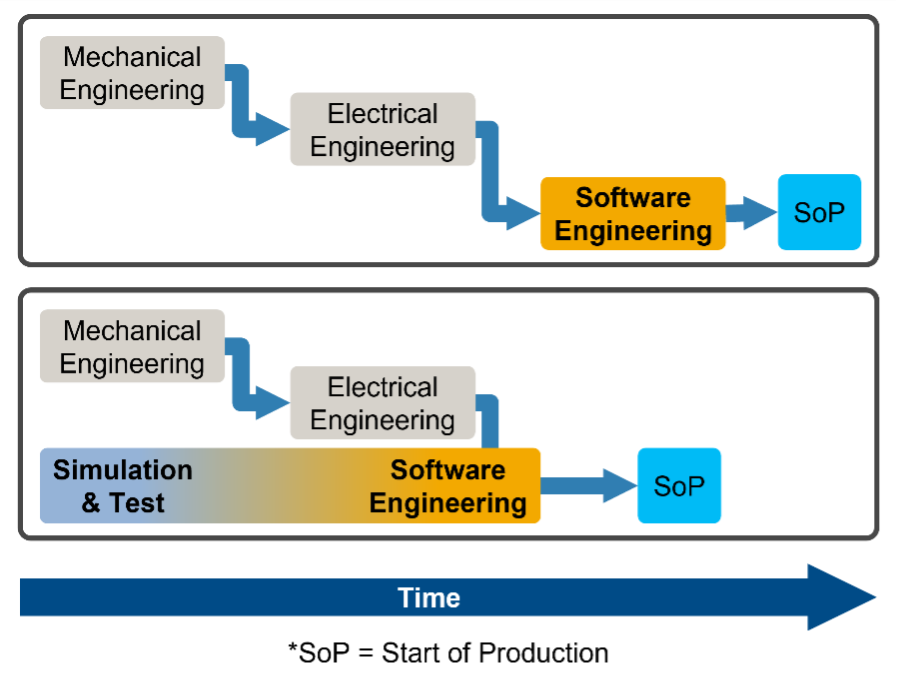
Curatu goes on to explain that the growing complexity of industrial systems is serving as the primary driver of adoption for a model-based design approach. Today’s OEMs, he says, are expected to produce machines that are not only efficient but adaptable to different products, quick to reconfigure and rich in software functionality. As a result, traditional engineering workflows centred around physical prototypes and handwritten code are no longer sufficient.
“Machines are becoming more complex,” he asserts. “Customers want more flexibility, faster delivery and better integration. With model-based design, you can simulate early, identify problems sooner and iterate faster, without waiting for hardware.”
As an example, in packaging or semiconductor equipment, virtual testing and commissioning allow development to proceed before the machine even exists in physical form. This “front-loading” of design tasks helps companies reduce changes late in development, avoiding costly rework and allowing them to hitt the market faster.
Practical advantages and benefits
Beyond the theoretical benefits, model-based design is starting to deliver tangible results within manufacturing and machinery design. In fact, Curatu points to customers like ENGEL, a leader in plastics processing machines, who used model-based design to develop control logic without physical hardware. Another MathWorks customer, Shibaura Mechatronics Corporation, a manufacturer of semiconductor manufacturing equipment and vacuum application devices, used model-based design to develop a temperature controller for organic film deposition, performing real-time verification without relying on the actual equipment.
Curatu recognizes the benefits both companies received, explaining that there are so many other advantages offered by model-based design that are often up to the users to realize for themselves. Through early simulation and commissioning, users experience a significant decrease in errors, and as a result achieve shorter development cycles—sometimes up to 50% faster. In addition, thanks to remote diagnostics and predictive maintenance capabilities, support costs are lowered. Cross-team collaboration is also improved, especially between mechanical, electrical and software engineers. However, Curatu points to the simplification of the process that really helps users find results.
“One customer told us, ‘I don’t have to walk my programmer through the requirements anymore. I build the logic in Simulink, generate the code, and the programmer just integrates it,’” he says. “That’s a huge leap in efficiency and a result that allows customers to continue development with fewer barriers and restraints.”
Expanding the engineering toolbox with AI, advanced controls and digital twins
Model-based design, however, is not only about getting to market faster—it’s also an incredible facilitator of innovation. And, as industrial controllers grow more powerful, teams are moving beyond conventional logic and exploring advanced strategies including model predictive control (MPC), AI-driven analytics and digital twins.
“A few years ago, running an MPC algorithm directly on an industrial controller was unthinkable,” says Curatu. “But today, we have customers doing just that. Thanks to increased processing power and MathWorks’ code generation tools, we’re able to help support companies in their efforts to optimize their potential and enhance their design and manufacturing capabilities.”
Bridging the old with the new
Despite its benefits, however, integrating model-based design into traditional workflows is not always straightforward. Many OEMs are currently working with legacy code, outdated platforms and engineers who are experts in mechanical and electrical systems but less comfortable with modern software development.
“A common situation that we run into is having code written 20 years ago for a PLC IDE that’s no longer supported,” Curatu explains. “And, within most organizations, it’s likely that there is only one person left in the company who understands it.”
To address this, companies often use co-simulation techniques—developing new components with model-based design and interfacing them with legacy systems. By leveraging this technique, over time, older systems can be replaced as part of a phased modernization strategy. However, as Curatu explains, perhaps the biggest hurdle to overcome with respect to the implementation and integration of model-based design is organizational culture.
“Model-based design represents a shift in mindset,” he says. “You move away from paper documents and charts to building executable models. Some teams see this as a threat—especially PLC programmers who worry about being replaced,” Curatu notes. “But the goal isn’t to replace them—it’s to augment their work.”
New skills required?
Fortunately, engineers don’t need to become software developers overnight. Most already possess the domain expertise required for controls, mechanics or electronics. What’s required, explains Curatu, is familiarity with the tools and a willingness to adapt.
“There’s definitely a learning curve that’s involved,” he says. “But to address this, MathWorks offers a wide range of onboarding resources—free ramp-ups, online courses, training and consulting. It’s very manageable and helps get people up to speed pretty quickly. Our AI tools, including MATLAB and Simulink, are designed to minimize barriers. We’re focused on providing engineers with apps and workflows that build on their existing knowledge, not force them to become coders.”
Faster, smarter, better
So how do companies measure the return on investment from model-based design? According to Curatu, the clearest benefits show up in time-to-market acceleration and the reduction in physical prototyping costs. For instance, by leveraging MathWorks tools, Shibaura Mechatronics Corporation reduced a half-day physical test to a 10-second simulation, dramatically increasing productivity.
In addition, some other benefits include earlier bug detection which translates to reduced downstream debugging and field repairs; platform flexibility, enabling support for different control systems across global markets; the ability to reuse models across product lines, and the potential to generate after-sales revenue from digital twin-enabled services, predictive maintenance and more.
Quantifying some of these benefits—like reduced downtime or improved customer satisfaction—can be challenging, especially for companies without detailed historical data. However, Curatu emphasizes that many customers report up to 50 per cent faster development times when using model-based design.
Hardware-agnostic flexibility
One often-overlooked advantage of model-based design, points out Curatu, is its hardware flexibility. MathWorks supports code generation for over 30 different industrial control targets, meaning the same model can be deployed across different PLCs and control platforms.
“For global OEMs, this is a game-changer,” says Curatu. “You can develop one core model and deploy it on Siemens in Europe, Rockwell in North America, or Omron in Japan—without rewriting the logic from scratch.”
This also positions OEMs to better serve customers seeking customized or regionalized solutions and supports their efforts to compete on quality, features and speed, rather than just price.
Embracing the future of industrial design
As industrial automation continues to evolve, model-based design and code generation are proving to be valuable tools, not only to help companies survive in a competitive market, but to thrive through innovation as well. And, while Curatu admits that the challenges around legacy systems and cultural shifts are real, the benefits that model-based design offers in terms of flexibility, speed and product quality provide reasons for companies to explore its use further.
“Model-based design isn’t just about faster development. It’s about building better machines, with fewer errors, in a way that scales. And once you adopt it, you’re not just solving today’s problems – you’re preparing to meet and solve tomorrow’s, too.”