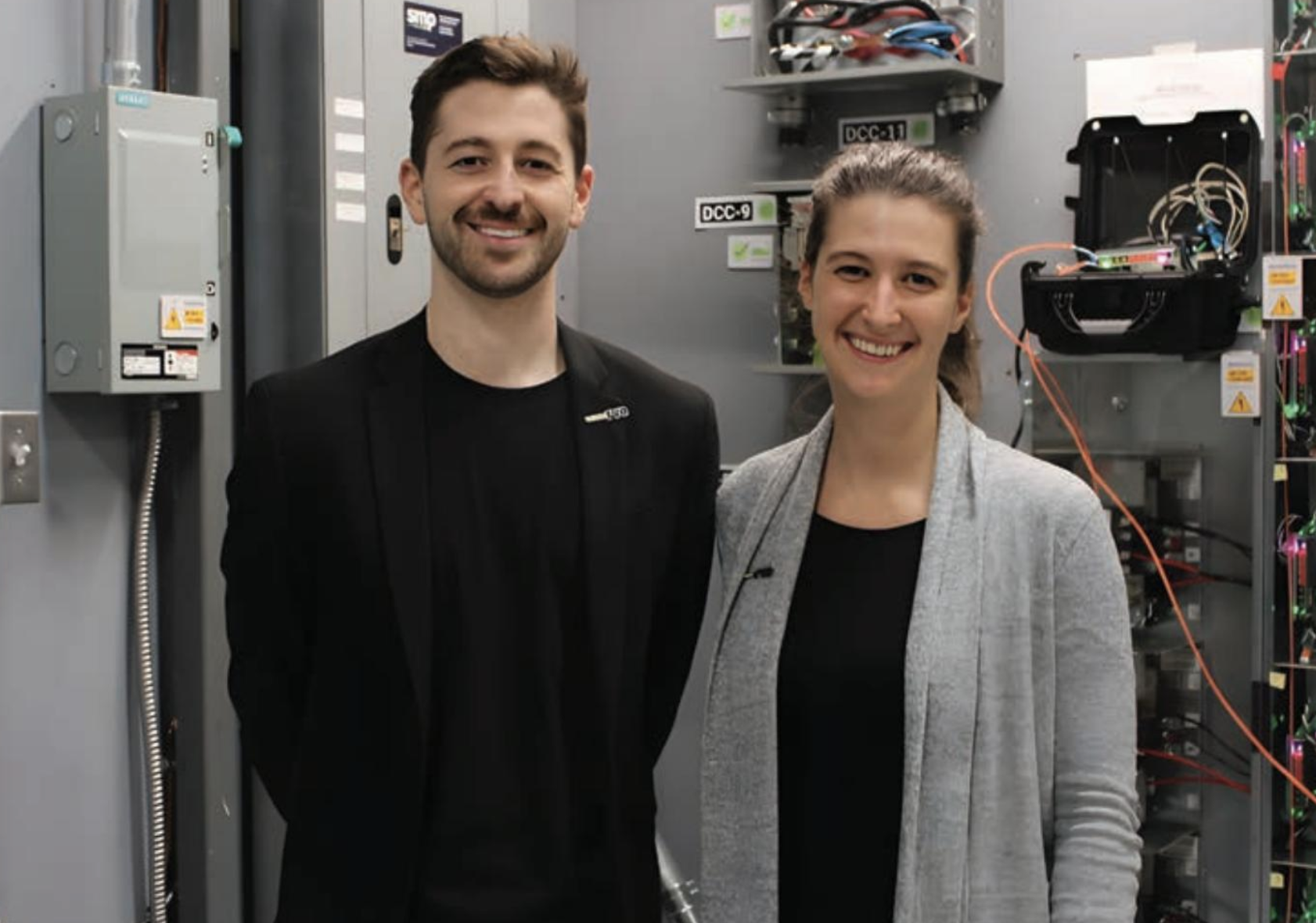
CSA recently published a new standard, the CSA C22.2 No. 343 for electric vehicle energy management systems (EVEMSs), setting out strict requirements for enhancing the electrical safety of EV charger installations. To help us understand what CSA SPE-343 means in practice, Electrical Business spoke with the president and co-founder of RVE (Recharge Véhicule Électrique), David Corbeil.
David has served on the CSA SPE-343 EVEMS subcommittee since August 2021, and the subcommittee on EV charging systems since September 2023. He’s also provided training at the Corporation des maîtres électriciens du Québec (The Corporation of Master Electricians of Quebec) on EV charging systems and infrastructure, served as a board member with Electric Mobility Canada, and continues to serve with the Quebec Electric Vehicle Association (AVEQ).
Nor is he a stranger to the electrical trade, as he is trained as an electrician and has previously worked on charging station installations.
EBMAG: For electrical contractors who might not deal with this every day, why do we need energy management systems for EV charging in the first place?
DAVID: EVs are good for society, as they will help us move away from fossil fuels. But for EVs to operate, we need a good supply chain. We need affordable batteries for those cars to move. And we need affordable charging at scale.
And when you think about the grid, it wasn’t designed for all our transportation to be electric. The assumption was that transportation would use fossil fuel; we could use natural gas for heating, and electricity for a couple of appliances. That’s basically how the North American grid was built.
Then you look at the rise of EVs in just 15 years… how do we integrate this new technology into a grid, and distribution within buildings that weren’t designed for those loads?
But, if done in a smart way, there is technology that can enable more electricity to flow toward electric transportation. That’s where we need EVEMSs.
EBMAG: In the creation of CSA SPE-343, what gaps were you and your colleagues seeing that made it necessary? What problems were you trying to solve?
DAVID: We started working on this five years ago. The problem we saw was that industry was heading in 10 directions rather than one. So CSA SPE-343 was really about streamlining the process and making sure that products would align with Section 8 of the CE Code, and that AHJs around the country could point to just one Canadian standard as the way to do things with regard to EVEMSs.
We looked at best practices from other device standards, and applied them to electric vehicle energy management systems to improve safety and resilience… and customer experience, too. You want to set a standard for EV chargers where they work 99% of the time.
EBMAG: So what does CSA SPE-343 actually cover, and where does that coverage end?
DAVID: The intent is to make sure that, if you’re going to deploy charging infrastructure where there is limited infrastructure capacity, you deploy an EVEMS as a system. It could consist of multiple products, but CSA SPE-343 covers the whole system.
Officially, CSA SPE-343 applies to the design, construction, and testing of electrical equipment that comprises or forms part of an EVEMS. Basically, it applies to all aspects of controlling EV supply equipment (EVSE) loads through the process of activating or suspending, increasing, or decreasing electric power to the EVSE loads and/or monitoring or calculating electric current (power) loads in a consumer service, distribution equipment, feeders, or branch circuits.
The last thing you want is to put a system in place and then, the very next day, somebody can play with it and alter all of the safety systems because maybe they want to charge faster… this puts people at risk.
So it’s really about making sure that there’s a way for OEMs, like RVE and plenty of others, to have a clear and safe path to success.
EBMAG: What are some of those safety considerations or hazards when energy is not properly managed?
DAVID: One of CSA SPE-343’s requirements is for an EVEMS to have a really short latency—the speed at which the system reacts to a potential or a real overload, and to have backup communication protocols in place. It pushes for local-based firmware and software and, should the network go down, it ceases to operate and holds in a safe position.
EBMAG: The work on the CSA SPE-343 started in 2021, and it was finally published in July 2025. Why did it take so long to publish the standard?
DAVID: There was a lot of reflection along the way as to the scope of the standard. Would it interfere with existing standards? Should we just focus on EVEMSs and EV-related loads? Should we focus on power efficient design that is agnostic to the type of load. At one point we wondered whether to consider heat pumps.
At the end of the day, we kept the scope to EVEMSs and safety. But I’m really glad it’s now out because companies can start certifying their products.
EBMAG: From the electrical contractor’s point of view, what’s different today versus before CSA SPE-343?
DAVID: When you don’t have a clear standard, what ends up happening is that you have all these products that bear certification marks, like CSA and UL, but they don’t have the right listing.
With the standard, they can focus on using only the products that are certified. OEMs can help them with their design, with commissioning and permitting, which really limits the contractor’s liability when the EVSE is up and running, because they’re not working with individual components, but an entire certified system.
EBMAG: So, following CSA SPE-343 helps electrical contractors avoid rework and delays, and possible failed inspections.
DAVID: Definitely. When they ask for a permit, the inspection body will see how it fits within the code. When the contractor’s design includes the right standard, then the inspector can refer to the code and approve the installation much faster.
Because EVEMSs are still a new technology, having a standard will help reduce overhead and headaches around getting EVSE projects approved.
EBMAG: Standards are always trying to keep up with technology. The Canadian Electrical Code went from a five-year to a three-year cycle for that reason. Looking at CSA SPE-343 from that perspective, what updates could we possibly see down the road?
DAVID: I would like to see requirements where Section 8 doesn’t have only relaxation around EVEMSs, but around power control systems for any type of loads.
If you’re building townhomes with 20 units, and you’re putting in power control systems using UL 3141 for power control systems certification, for example, then you can offset your heat pumps, EV charging, even your heating. And I think that’s a big win.
So I really hope the Section 8 subcommittee will look at that and really focus on providing more flexibility within that framework. I think it would be a big win for the industry.
EBMAG: If you had to leave our audience with just one final thought about CSA SPE-343, what would it be?
DAVID: Contractors should challenge the status quo and look at new certification pathways when designing a code-compliant EV charging system. Local codes are often a little behind schedule, but there’s a lot of value in educating yourself so that you can educate your customers. You can help them futureproof their projects so that their investment is better protected.
Closing thoughts
As we learned from Code File columnist Nansy Hanna back in February 2018, electric vehicle energy management systems have always promised cost savings, load control, and safer systems. Now, with the publication of CSA SPE-343, those principles are no longer just fancy notions, but formalized in a standard that electrical contractors can rely on.