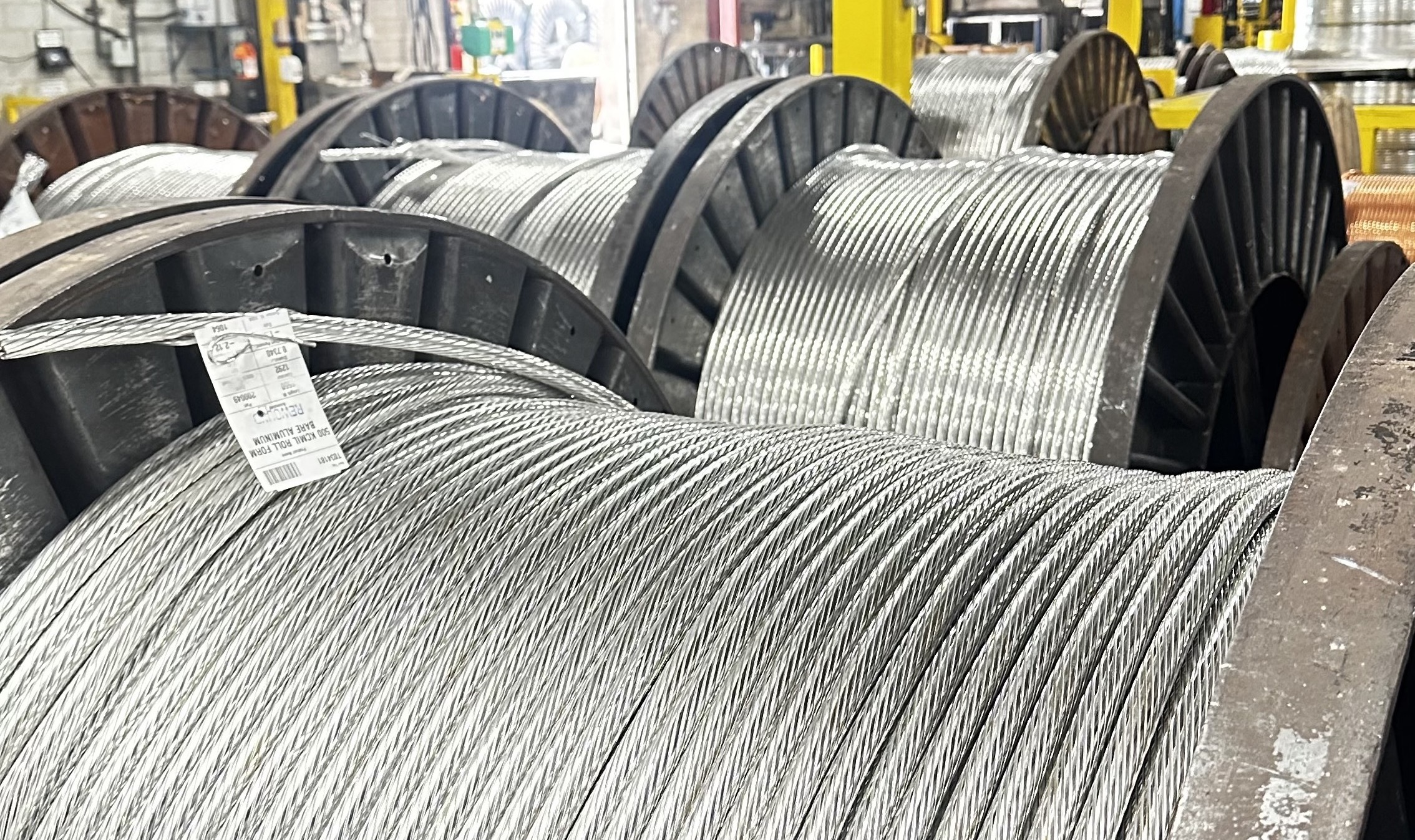
When it comes to the materials that power electrification, copper has long been king. And no wonder, considering how easy it was to discover and manipulate by early humans—and in great abundance to boot! But its long relationship with mankind does not necessarily make copper a superior conductor over other materials.
During Electrical Business’ Education Session “Rewriting the Spec: Aluminum’s Role in Modern Electrical Design,” Pete Pollak opened the conversation with a clear message: aluminum’s advantages are real, measurable and, sadly, still largely misunderstood.
“Copper wasn’t used because it was the best electrical conductor. It was used because, in the 1880s, it was plentiful and cheap. Aluminum was the better material, but there just wasn’t much of it around, and it was too expensive,” said Pollak who, while now retired, spent nearly 35 years with the Aluminum Association leading Product Standards and Electrical Services initiatives.
He traced aluminum’s history back to the late 19th century when it existed only in small, precious quantities. By way of comparison, the Statue of Liberty contains hundreds of thousands of pounds of copper, while the world’s largest aluminum casting at the time—the cap of the Washington Monument—used just 100 ounces.
“Nikola Tesla said aluminum would annihilate the use of copper for electrical applications. I don’t normally use the word ‘annihilate’—that’s Tesla’s word—but he had a pretty good track record,” Pollak said, noting that Tesla also used copper for his inventions; again, because of aluminum’s scarcity.
That scarcity changed, however, with World War II. Enormous smelting capacity was built to supply aluminum for aircraft, with most of those North American plants sited near hydroelectric generating stations. When the war ended, those aluminum smelters turned their attention to producing wire & cable.
Pollak explained that aluminum’s electrical performance, on a pound-for-pound basis, actually doubles that of copper. “One pound of aluminum provides the same conductance as two pounds of copper, and it costs about one-eighth as much.”
Weight reduction, price stability, and a reduced risk of theft are added benefits. Yet misconceptions persist about using aluminum for building wire, largely because of the U.S. Consumer Product Safety Commission’s declaration in the 1970s.
“The CPSC branded aluminum wiring as a fire hazard 50 years ago, and that label stuck,” Pollak said. “But those same homes are still standing, still working fine.”
From history to application
Pollak described how the electrical industry’s reliance on copper hardened into tradition. The material’s early monopoly became codified in standards, so even when aluminum became widely available and affordable, the default specification never changed.
“Every electrical standard was written for copper,” he noted, “so the brand became baked in.”
He then tied that history to today’s shift toward electric vehicles. “Replacing copper with aluminum inside an EV can cut cost and weight,” he said, “and that means longer range and lower price.” Industry has the opportunity, Pollak argued, to revisit assumptions that have gone unchallenged for a century.
Discussion turns practical
Following Pollak’s formal presentation, he was joined by Electrical Business Magazine’s editor Anthony Capkun (moderator) and Northern Cables CEO Shelley Bacon to tackle questions from the audience of electrical engineers, contractors, and specifiers.
In the realm of sustainability, Bacon emphasized that aluminum’s benefits aren’t just mechanical or economic, but environmental.
“In Canada, all our aluminum is made with hydroelectricity. That means a very small carbon footprint compared to aluminum made with fossil-fuel power elsewhere in the world,” he said.
This is a key message behind the Clean Aluminum educational campaign, which highlights how Canadian-made aluminum contributes to decarbonization. Because hydroelectricity powers every smelter in British Columbia and Quebec, the carbon intensity of Canadian aluminum is among the lowest on the planet.
Bacon strongly believes this distinction should be top of mind for all building designers.
“If we’re talking about LEED and embodied carbon, we should be talking about the wiring too. There’s a tremendous amount of cable in every building, but nobody counts it,” Bacon said.
He pointed out that a single multi-unit development can contain thousands of metres of cable—an enormous amount of material that does not get factored into a building’s embodied carbon footprint. He wants to see Leadership in Energy & Environment Design (LEED) and other sustainability programs take into consideration the origin of a building’s wire & cable, and whether it was produced with clean electricity.
For him, the next step is advocacy: encouraging LEED and other sustainability programs to include wiring and cabling in their metrics.
Pollak agreed, framing it as both an engineering and policy issue. “Three times as much aluminum as copper is produced globally today,” he said. “If we’re serious about decarbonization and resource efficiency, well, aluminum gives us both.”
One attendee asked how aluminum could be considered a better conductor when it oxidizes more readily and has lower mechanical strength than copper. Pollak was quick to address both points.
“That oxide coating is angstroms thick—almost imperceptible. When you tighten a connector, the pressure breaks through it and the bare metal makes contact,” Pollak answered.
As for strength, he pointed out that electric utilities have used aluminum conductors for decades in overhead lines, often with a steel-core reinforcement. “If aluminum’s good enough for airplanes at 20,000 feet, it’s good enough for building wire. The strength is there.”
Bacon agreed, adding that advances in materials science have made this even less of a concern.
“The 8030 and 8176 grades are about 99.5% aluminum with a little bit of alloying to improve creep and strength. They perform beautifully when terminated with proper connectors.”
Another attendee asked whether aluminum’s softness and greater thermal expansion translate into higher maintenance requirements.
“All metals creep. Copper creeps, too. The question is: ‘Is it a big deal?’ For small conductors inside buildings, it’s not,” said Pollak. “People say aluminum creeps, aluminum moves. Sure, but utilities have known how to design for that for decades.”
Another attendee, this one a journeyman electrician and professional engineer, commented that every aluminum failure he’d seen over the last 50 years stemmed from poor workmanship and had nothing to do with the aluminum conductor itself.
Pollak reiterated his dismay with aluminum’s undeserved reputation. “When copper fails, you just fix it. But when aluminum fails, you get a whole story about how it’s no good. What a lot of people call ‘aluminum problems’ are really just electrical problems—loose connections, overloads, bad devices—which can happen in any installation.”
He added that technologies such as ground-fault and arc-fault protection address these electrical hazards regardless of conductor type. Bacon, meanwhile, pointed out that regular maintenance practices, such as thermal imaging and mechanical inspections, should be standard practice for all electrical systems.
“In our factories, we do infrared scans one year and mechanical checks the next,” he said. “If you’re modifying a system—adding a heat pump, EV charger, or hot tub—it’s smart to have a licensed contractor check those terminations.”
As the discussion unfolded, a common theme emerged: workmanship, not material, tends to determine reliability.
One participant noted that insurance companies still compel homeowners to rewire their homes when aluminum branch circuits are present, and he asked whether insurers are being challenged by the industry.
Pollak acknowledged this frustration and said insurers often lean on outdated CPSC material. “There’s nothing wrong with the aluminum; the problem is the story people keep repeating.”
“I petitioned the CPSC to review its own hypothesis [about aluminum branch wiring]. They ran experiments 50 years ago and predicted what would happen in the future. Well, the future’s here, and that didn’t happen. Aluminum installed decades ago continues to power millions of homes across Canada and the U.S.”
A wider lens on electrification
The pair also fielded several questions about emerging applications—battery storage, renewable energy interconnections, and modular construction—where aluminum’s combination of weight, conductivity, and cost could make it a preferred choice. For the audience, it underscored how “rewriting the spec” isn’t just about wire sizes or cost tables; it’s about re-examining assumptions as technology evolves.
The conversation circled back to the broader energy transition. Pollak noted that rising copper prices and supply constraints could make substitution inevitable.
As the session closed, both speakers echoed the same message: education is key.
“This isn’t the end—it’s the beginning. Once people understand the full story, they can make informed choices about design and specification,” said Pollak.
For Bacon, the change is already underway. “Fifteen years ago, aluminum was barely considered outside utilities. Now we see it across commercial projects, with modern alloys and terminations that perform reliably and help cut costs and carbon.”
For the audience of Electrical Business Magazine, “Rewriting the Spec” was both a technical briefing and a call to question long-held beliefs and misconceptions. In this era of electrification and decarbonization, that challenge feels overdue.