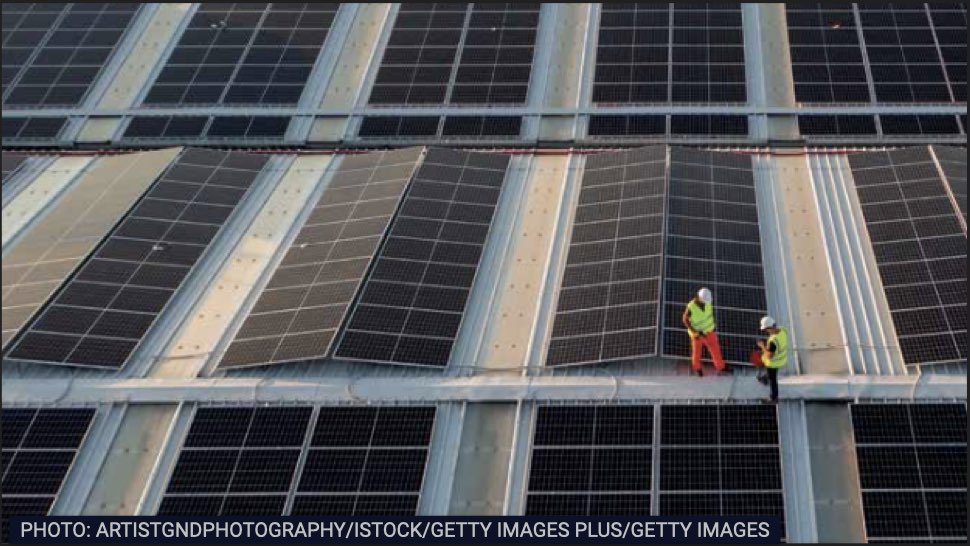
According to the Canadian Renewable Energy Association, Canada’s solar energy capacity—utility-scale and onsite—grew 92% from 2019 to 2024. Since 2020, Canada saw nearly 2 GW of new utility-scale solar, and over 600 MW of new onsite solar.
And while solar PV systems may look straightforward from a distance, establishing and maintaining optimal performance requires careful planning, accurate diagnostics, and a clear understanding of each component’s role in the overall system.
As we closed out our special Theme Week on Alternative Energies in July, Electrical Business Magazine turned its attention to troubleshooting the Top 3 solar PV problem areas—ground faults, photovoltaic modules, and inverters. The goal: to understand how to keep these installations performing reliably for years to come.
For this discussion, I was joined by Fluke senior applications specialist Will White. With nearly two decades in the renewable energy sector, Will has worked across installation, sales, design, project management, curriculum development, and teaching. His practical insights provide a valuable guide for both installers commissioning new projects and technicians called in to maintain or troubleshoot existing systems.
Ground faults
A ground fault occurs when a current-carrying conductor contacts a grounded metal part that shouldn’t be there, Will said, like when a conductor gets trapped between the module frame and racking. “Over time that insulation wears away, causing a ground fault … pretty common for solar installations.”
The most common causes of ground faults are, in fact, poor wiring techniques and overall poor installation quality. Will emphasized that quality wiring and good wire management will significantly reduce ground faults.
While poor wiring may be obvious on a very small installation, I asked Will about large, utility-scale installations. What are the telltale signs of ground fault problems there?
“It all starts with the inverter. Every modern inverter has ground fault detection and an interruption device built right in, and that includes everything from a microinverter on the residential scale up to giant utility-scale inverters. So the inverter is typically going to be your first sign.”
Additionally, inverters will alarm when something is amiss. A homeowner might get an email, whereas utility-scale plants are actively monitoring their installation. They’ll know the moment an inverter goes down, Will said, and will issue a maintenance ticket so that technicians can go out and start troubleshooting.
Ultimately, installation quality will reduce the likelihood of ground faults. So pay attention to wire management, Will said. Make sure wiring is not routed over sharp edges and that it is supported properly, and has a little bit of give so it can expand and contract without rubbing against sharp edges and damaging the insulation.
“Once you get into the commissioning phase, we can do insulation resistance testing, which is essentially like pressure testing the wiring, making sure we didn’t damage the insulation during the installation process,” Will said. “Good installation techniques on the front end are going to make it much easier to maintain on the back end.”
Speaking of maintenance, I asked Will about troubleshooting existing solar PV installations for ground faults.
“There’s a couple of ways we can do it. Again, the inverter is going to tell us if there’s a ground fault, but there are cases where the ground fault occurs at such a low level that the inverter doesn’t quite catch it.”
Voltage testing—testing from the positive to ground, negative to ground—is the usual way of finding ground faults in strings of solar modules.
Solar PV modules
Will identified the solar photovoltaic modules themselves as the No. 2 area of concern in a solar power installation.
“Before the system is turned on at commissioning, it’s very common to do a series of tests. You can do voltage testing again to make sure you have the proper voltage in the string of modules,” he said, adding that polarity testing is important for ensuring everything was wired correctly, plus insulation resistance testing to ensure that it hasn’t been compromised.
“And I-V curve tracing—a test specific to solar modules. This is testing open circuit voltage to short-circuit current, taking different measurements between those two points, then creating a graph. And that’s really the only way to get the true picture of how a module or string of modules is operating. It can show you things that you wouldn’t see with just voltage and current testing. So I-V curve testing is an excellent tool for diagnosing problems with modules.”
Once you’ve got the system up and running, thermal imaging—especially aerial thermography—is helpful, particularly for very large arrays, as you can identify problems, such as underperforming modules, very quickly. Photos of the installation are analyzed, typically by software, to identify possible problem areas for field technicians.
But even with all the tools available, Will believes nothing beats walking around the plant to see if there are any problems. While a solar installation may look simple, it requires a little TLC no less than anything else.
“I’ve been in solar for almost 20 years now and, back in the day—especially on residential systems—we would say ‘Put it up on the roof, leave it there, and it’s great for 20 or 30 years’.”
“Turns out that’s not the case,” Will said. “It’s a piece of equipment that needs to be maintained properly to ensure it’s going to produce the return for the owner that we forecasted.”
Inverters
Rounding out the Top 3 list are the solar PV inverters which, according to Will, are already pretty savvy.
“Inverters often have error codes, so the monitoring platform is going to tell you if something’s wrong. We can also look at actual performance compared to our expected performance. Those are going to be our leading indicators.”
Armed with information, especially those error codes, technicians will get an idea of the source of the problem and carry out further testing, such as voltage, current, and insulation resistance.
“On the A/C side, we can look at things like power quality, which has a huge impact on our inverters. In my experience, when we’re having power quality issues, it’s not necessarily coming from the inverter. It’s issues with the utility that’s impacting the output of the inverter. So oftentimes we’re using the power quality instruments to prove to the utility that ‘Hey, we’re having a problem and it’s coming from your end’.”
Another good test for inverters—really, any electrical equipment, Will said—is to look at whether terminals are overheating. “Maybe there’s a loose connection that’s heating up, and we can see that with a thermal image before it becomes a catastrophic failure. We can also see things like fuse holders that are operating at a lower temperature than other fuse holders that are under the same condition.”
“And that could indicate that the fuse is blown. Or maybe there’s a break in the circuit out in the array that we would need to address. But we can see all kinds of things with thermal imaging that you wouldn’t be able to see with just a visual inspection.”
Will had already said that inverters deliver error codes, but if the unit is malfunctioning, would we know? How do we know it is actually delivering the correct error codes?
“Yeah, it’s getting on site and getting into the equipment and using the different diagnostic tools to verify. But the go-to is going to be the data monitoring system,” Will said, and for that to work correctly, we need robust data communications.
“You know, we don’t think about that in solar, but there’s a lot of data that comes from the system,” he noted, such as data from multiple inverters and weather monitoring stations. “And we’re going across long distances. So we’ve got a combination of both copper wiring and fiber, and we need to maintain those, as well.”
Beyond the Top 3
As our conversation wrapped up, Will circled back to the bigger picture. Ground faults, modules, and inverters may be the most common problem areas, but the underlying issue is always the same: quality. Careful wire management, comprehensive commissioning tests, and ongoing maintenance programs all reduce downtime and extend system life.
Equally important is ensuring there are enough trained operations and maintenance professionals to support the growing number of PV systems. Technicians must be equipped not only with diagnostic tools but also with the training to use them safely and effectively.
For Will, safety is paramount. Reliable systems matter, but the well-being of the people who build and maintain them matters most. “We always want to make sure our technicians go home to their families at the end of the day.”