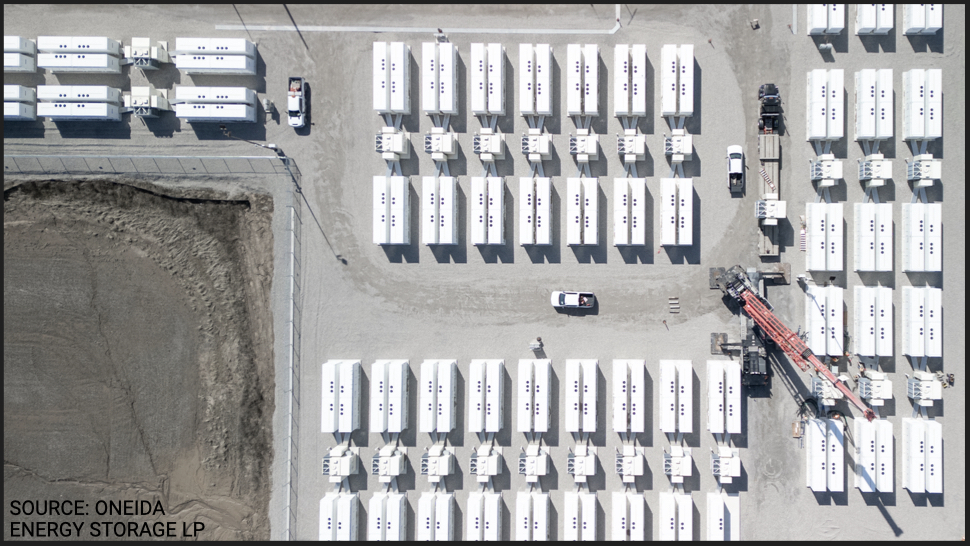
With 278 lithium-ion battery units—each weighing more than 84,000 lb—now drawing and storing power from Ontario’s electricity grid, the Oneida Energy Storage Project has officially entered commercial operation, becoming the largest battery energy storage facility in operation in Canada, and among the largest globally.
Located in Haldimand County, Ontario, the 250-MW/1000-MWh facility was delivered through a collaborative partnership between majority owner Northland Power Inc., Six Nations of the Grand River Development Corp. (SNGRDC), NRStor Inc., Aecon Concessions, and the Mississaugas of the Credit Business Corp. (MCBC).
Together, these partners form Oneida Energy Storage LP.
Northland owns approximately 70% of the Oneida project, with the remaining ownership held by SNGRDC, NRStor, Aecon, and MCBC. The project was completed two months ahead of schedule for about $100 million less than the initial $800M estimate—even though the cost of lithium ion increased three times (once by 600%).
Originally developed under a 50/50 partnership between SNGRDC and NRStor Inc., the project also received significant funding from Natural Resources Canada and the Canada Infrastructure Bank.
The project generated more than 180 jobs during peak construction—with a workforce that included over 40 Aecon-Six Nations employees.
“One of the things that I’m really proud of with this project is that it was delivered safely: 300,000 hours of effort and zero incidents. That is something I’m super proud of, and that commitment to safety is something we look for in every company we work with, and in every person that works on our projects,” says Northland Power president & CEO Christine Healy. “It’s non-negotiable for us and, I would say, for any credible developer.”
Partnerships make it happen
NRStor planted the Oneida project seeds several years ago, explains chair and CEO Annette Verschuren, which then took six years to develop and less than two years to build. She values the experience of having worked with the Six Nations community; learning what was important to them and finding ways they could benefit with equity in this project.
The next step for NRStor was to engage the Canada Infrastructure Bank, who was pleased to be working on their first energy sector project with a First Nation equity partnership.
“Then we went through the another great moment when presented a 250-MW project to the [Independent Electricity System Operator]. And I think we blew them away!” Annette laughs. “And we did it together: our NRStor team and the Six Nations team, led by Matt Jamison.”
And all of it during Covid.
But additional partners were needed for the storage project. Aecon became a partner early on, says Annette, as they could “help design and build this project with us from an EPC perspective.”
Northland Power came on board as the major equity investor. Christine Healy, president & CEO, recounts that period:
“We spoke with Annette and NRStor, and the Six Nations of the Grand River; they had an idea for a first-of-its-kind battery storage project in Canada. They found a great location to do it, and they had a great concept. And then they went looking for some partners who could help them make it happen. And I’m really happy that Northland Power could be one of those partners.”
Annette could not have been more pleased. “We couldn’t have done it without Northland. They’re great executors of projects, with a great ability to get things done.”
The Mississaugas of the Credit First Nation then also joined the Oneida project, making this endeavour, according to Christine, “a story of partnership and a shared vision, and then persevering to make it happen.”
“Our partnerships-first approach to energy projects with Indigenous peoples really enabled the Oneida vision to become a reality and also resulted in a true Canadian success story, which serves as the model to replicate moving forward,” says Annette.
“It takes a lot to come up with an idea like this, but then also to figure out how to turn it into reality. There are many, many great ideas that never see the light of day,” Christine says. “So to take an idea and turn it into something real—that’s on the grid right now delivering energy solutions as we speak—it’s a big deal. And to do the first one is an even bigger deal… and we’ve done it safely.”
Hurdles and successes
Annette recalls the regulatory hurdles they had to overcome: “There was no such thing as energy storage regulations. Was it a generator? Was it a load? It wasn’t either, right? And so we had to work with the Ontario Energy Board and with the IESO to help them understand what this facility could do.”
When she was president of Home Depot Canada, Annette oversaw the opening of 160 stores across the country. How did Oneida compare? “This was tougher,” she says.
“The reason this project was so successful is because of the great partners that we had,” Annette affirms. “It’s having the patience, developing the plan and executing superbly, and making it right as you go along. This is like a poster child of how a project should be done.”
A template for others
Both Annette and Christine believe Oneida’s success creates a strong template for future battery energy projects to follow because, as Christine notes, “there’s already a path cut through the snow.”
“And I think it will be easier [for future installations] to do that when they can point to one that’s already been done.”
Oneida LP will receive fixed capacity payments through a 20-year capacity services contract with IESO and generate revenue from energy sold into the grid, as well as from providing ancillary services to the system.
The storage facility enhances the province’s grid by adding capacity and reliability to support the rising demand for energy, and doubling the amount of energy storage resources from 225 MW to 475 MW.
Each of those 278 battery packs is capable of a 4-hour discharge, which is enough to power a city the size of Oshawa, Ont., for an hour. The installation is expected to support grid reliability and reduce emissions by an estimated 1.2 to 4.1 million tonnes over the life of the project.
Battery energy storage future
Annette is convinced that Oneida and similar battery energy storage installations are just the tip of the iceberg, and we are on the verge of massive sea change—not dissimilar to the transformation of corded power tools she witnessed while at Home Depot Canada.
“When I started, everything was plugged in. Then, two years into my tenure, these great big clunky batteries started to be put on power tools,” Annette recalls. “Oh, and they were awful! They were heavy and the contractors were complaining […] but I saw what was happening with lithium ion. Over 10 years, I saw all the power equipment move from plug-in to battery.”
With energy storage, Annette would like to see an even faster transformation. “We have to go faster. We really do, because despite all the things that are happening south of the border, companies are still looking for clean energy. That’s not going to go away. And Canada has the most clean energy in all of the world,” Annette says.
Christine agrees: the future is loaded with potential. She advises newcomers to seize any opportunity to join a project, because “nothing beats learning by doing”.
“We see the need and the demand for energy storage projects everywhere. It provides technical solutions, it provides shaping, and it responds to peak demand. Those things all fundamentally lead to a more stable grid, and they should lead to better energy prices for all of us as consumers,” Christine adds.
According to Christine, fewer than 10% of large-scale capex projects over $100 million around the world get delivered on time and on budget.
“And Oneida—the first of its kind in Canada and fourth largest in the world—was delivered ahead of schedule and under budget… and with an excellent safety record! I cannot tell you how proud I am and how happy I am to be a part of that.”
Perhaps Annette sums it up best:
“Energy storage is like bacon: it tastes good and goes with everything.”