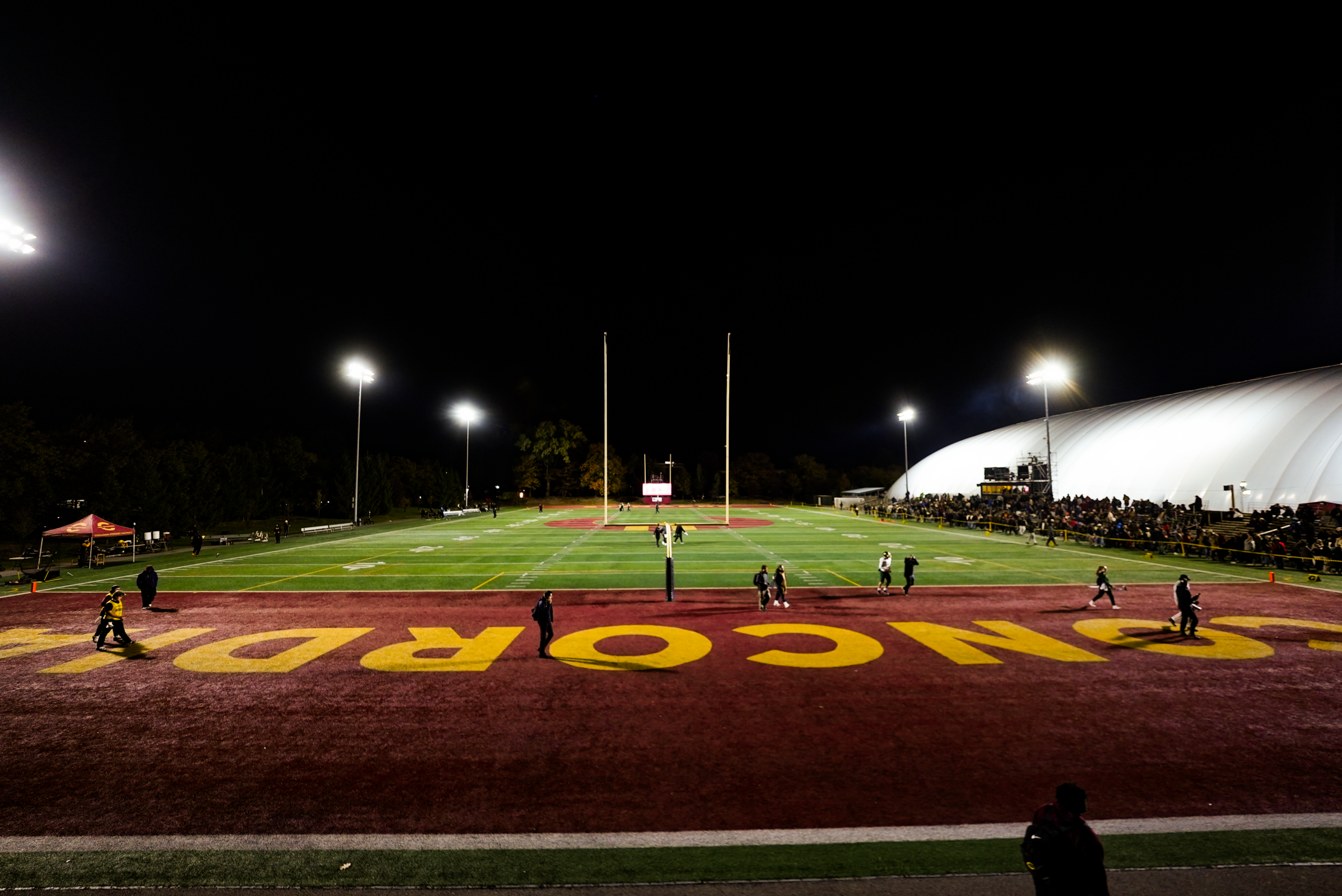
When it comes to winning the game of outdoor stadium lighting, elements such as poor illumination quality, costly maintenance, and convoluted changing procedures are players best left on the bench.
These shortcomings had all long-plagued the outdoor lighting system at Concordia University’s namesake stadium in downtown Montreal, made up of 144 separate 1,500-watt metal halide (HID) lamps positioned on 65-foot poles surrounding the field.
While the 4,000-capacity stadium has played to host to the Concordia Stingers varsity football, soccer, rugby, and field hockey teams since its construction in 2003, wear and tear to its lighting system over the decades – combined with costly and inefficient maintenance demands – had the University looking to give its stadium’s lighting system a second wind.
“Previous lighting set-ups, typically utilizing metal halide lamps, frequently fell short in areas of energy efficiency, light uniformity, and colour rendering,” shared Ledvance’s Eastern region account manager, Martin Leclair.
Leclair explained that contemporary standards for outdoor arena lighting systems had long outpaced the current set-up at Concordia Stadium across a number of different elements – a gap that Ledvance, in collaboration with Concordia and several other local partners, joined forces to help close.
“Contemporary Illuminating Engineering Society (IES) standards for outdoor arena lighting, primarily guided by ANSI/IES RP-6-20, emphasize high-efficiency LED technology, precise glare control, improved uniformity, and specific illuminance levels tailored to the level of play needed,” said Leclair.
In addition to Ledvance, Concordia assembled a team comprised of Longueuil, Quebec-based architectural lighting firm Luxtec, electrical engineers from Montreal’s Dupras Ledoux and Groupe Specs, along with Quebec-based electrical contracting firm Groupe LML to execute the full-court press on replacing the stadium’s lighting system.
The project spanned 2022 to late 2024 between tendering and completion, with the new lighting system, now comprised of 134 separate 400 to 1200-Watt 4000K Ledvance LED Sports Light fixtures, helping to modernize the quality, efficiency, and maintenance needs of the stadium for the athletes that call it home turf.
“Thanks to our upgrade, we reduced energy consumption on the field by 100kW annually, which has driven substantial reductions in maintenance and operational costs and helped ensure that the project is both a financial and sustainability success,” shared the manager of Concordia’s Internal Expert Services, Brendan O’Neill.
Winning the long game
While even the best bulbs eventually need replacing, the positioning of the stadium’s former lighting system on 65-foot poles made changing them out a prolonged and costly affair. This was partially due to the previous set-up requiring the University’s electricians or subcontractors to rent lifts in order to perform the necessary maintenance.
Lighting maintenance in specialized outdoor settings such as stadiums or arenas is far from a standard affair, with Leclair further explaining that an array of unique demands and durability considerations are required by these types of systems. This means that solutions which drive efficiency across the maintenance process are given top priority, he said.
“Installing and maintaining large-scale outdoor arena or sports field lighting requires specialized expertise compared to standard commercial or residential outdoor lighting, focusing heavily on durability, high-precision aiming, and sophisticated control systems,” he said. “Some key differences include high-pole mounting, alongside the need for IP-65-rated fixtures to withstand harsh environments, with the wind playing a big factor as well.”
The costs and processes associated with this level of maintenance led to many of the burnt-out bulbs at Concordia Stadium being ignored, further worsening the facility’s lighting conditions, especially during the shortened autumn days that comprise season kickoff.
“Many of the lamps were out, so the lighting quality was poor,” said O’Neill. “Our electricians or subcontractors had to go up on lifts to change them, and we had a hard time procuring the lamps as well due to delivery delays and costs. While our lighting system was functional enough when the bulbs were replaced, our operations team found the system difficult and costly to maintain.”
In addition to the declining quality of its lighting coverage, the stadium’s previous system also lacked alignment with Concordia University’s PLAN/NET ZERØ decarbonization initiative, which is comprised of a number of deep retrofits and research campaigns focused on achieving net zero carbon emissions in buildings across both of Concordia’s campuses by 2040.
“In support of ‘PLAN/NET ZERØ’ – our university’s proactive approach to the decarbonization of our facilities and activities – we’re encouraged to achieve our sustainability goals,” O’Neill said. “Freeing up electricity from our lighting allows it to [now] be used for heating, cooling, and other purposes, and helps our university support the global challenge of reducing fossil fuel consumption.”
The comeback kid
Once Luxtec signed on to the project, the firm conducted a photometric audit that identified the need for a lighting system that provided stronger light, more uniform structure, and increased efficiency in alignment with contemporary IES recommendations.
The project partners decided to go for a one-for-one changeout with Ledvance’s 4000K LED sports fixtures, configured in 3×3, 4×4, and 5×5 beam distributions to optimize lighting coverage.
The decision to use Ledvance fixtures was influenced by a number of features, including easy installation, significant rebates from Hydro Quebec due to their Design Lights Consortium (DLC) 5.1 Premium certification, high-visibility from their 4000K lighting temperature, and perhaps most importantly, their 150,000-hour lifespan that minimized maintenance costs and turnaround times associated with the stadium’s prior lighting.
The answers these lighting solutions provided to the range of challenges that high-performance outdoor lighting must contend with made them the ideal choice for Concordia’s upgrade, shared Leclair.
“Outdoor lighting systems in arenas such as outdoor sports field complexes face significant challenges due to exposure to harsh weather year-round, leading to high maintenance needs,” said Leclair. “Ledvance addresses these issues with durable, ANSI 3G vibration rating, IP65 ratings, and a polycarbonate lens to ensure a robust housing with 10kV surge suppression for an additional layer of protection, endurance, and long-lasting performance.”
Additionally, the teams integrated the lighting system with remote-control features that allow University staff to operate or adjust lighting intensity via tablet for additional energy savings, along with a laser for each fixture to assist with aiming purposes.
With the new system now operational for over a year, O’Neill confirmed its impacts both on and off the field.
“In our profession of providing building services, it often costs more money or requires more energy to get a better result, but in this case, we achieved a better outcome while reducing both energy costs and consumption,” he said.