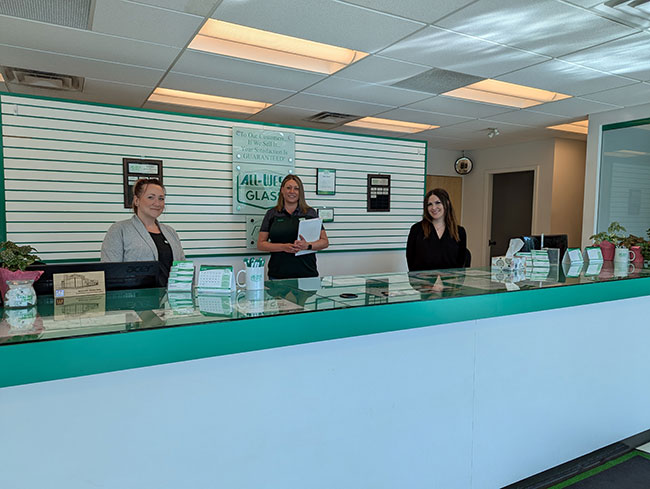
Remember glass shops? That place in town where everyone went for whatever they needed involving glass. Windows for your house? Check. A new storefront? Check. A windshield for your car? Check. A pane of glass cut to size to replace the one you put a rake handle through in your shed? Double check. They might even do that last one for free. The glass shop did it all and it didn’t take two hours of poking around on the internet to figure out where to go.
Glass shops are mostly only a memory now. The inexorable market logic of specialization and economies of scale have claimed them, along with a lack of succession options as Mom and Dad retired, skilled glaziers became hard to find and the kids had little interest in the business.
But not in Canada’s northwest. Meet All-West Glass, operating 18 good-old-fashioned glass shops across northern B.C., Alberta and the Territories, supported by a major glass fabrication operation in Prince George, B.C., and a sister company called Independent Distributors that ships automotive glass right across the West and into Ontario.
“Every company, every store, is slightly different in mix,” explains Laura Leonard, president and daughter of the company founders, Dan and Carole Young. “When you combine the whole company, we’re pretty much a third auto glass, a third fenestration residential and a third commercial.”
Who among us can say that any more?
All-West’s origins lie in Dan’s keen entrepreneurial eye. As a journeyman glazier in the late ‘60s, he bounced around a few different companies between Vancouver and Prince George. From Prince George, his boss would send him west along Highway 16 into the northern B.C. interior. Government support for these regions was flowing at the time, with formerly remote and undeveloped communities building schools, government offices and infrastructure. Leonard relates that Dan would return from his trips and tell Carole “there’s a gold mine out there” for the glass business. By 1971, she’d tired of hearing him talk about it to the point where she said it was time to make a decision.
That decision was to move to Smithers, B.C., and set up Bulkley Valley Glass. Why Smithers? First, it sits almost exactly half way between Prince George and Prince Rupert, minimizing the delivery distance to both of the largest towns in the region. But also the Youngs just loved the amazingly beautiful area.
Bulkley Valley Glass did well enough that the Youngs were soon bringing in Dan’s old colleague, Eugene Morris, in Prince Rupert and Doug Peters of Terrace, B.C., to expand into those locations. The company name was changed to All-West Glass to reflect the broader aspirations. Today, AWG Northern Industries is the umbrella organization incorporating the All-West Glass retail outlets, the glass fabrication operations of AWG Northern Distribution and Independent Glass Distributors that supplies automotive glass.
In the late ‘80s, AWG got into manufacturing its own insulating glass units. It had been buying glass and aluminum systems from third parties and wanted to get more control over its costs and availability. The IG manufacturing is still done in the 25,000-square-foot, 20-person facility in Prince George and the units are shipped to AGW’s outlets across its market area. Vinyl comes from Kohltech’s Edmonton factory and is picked up by AWG’s trucks for delivery to the individual stores, where the windows are glazed.
In recent decades, AWG’s commercial business has expanded, bringing with it an increased demand for tempered glass. On commercial projects, delays are deadly and AWG could not tolerate the risk of being let down by a third party supplier. Leonard reacted by purchasing a tempering oven five years ago. Delays due to COVID meant everything only got up and running two years ago, but now the company runs a full shift on the tempering line. Leonard hopes to add another shift or even two in the coming years.
Leonard’s involvement in AWG took a winding path. Like most children of fenestration company owners, she worked in the business as a young person, posting receivables with a typewriter and fax machine. But after graduating high school in 1989, she moved to work in Vancouver with no immediate intention of returning to the family business. That changed several years later when her mother, Carole, was diagnosed with early onset dementia at the age of 51. It was a significant blow to the company that threatened its ability to continue. Like many Mom and Pop operations, Dan and Carole had divided responsibilities, with Dan overseeing operations and technical matters and Carole running, well, just about everything else. As Carole’s abilities sadly diminished, Leonard started to get calls from her father asking questions about how the business side operated and asking for help with administration and planning. In 1997, Leonard moved back to Smithers and joined the company full time while completing her chartered accounting certificate. She became vice-president around 2010 and president in 2015, assuming full control over AWG.
One challenge of the small glass shop model is maintaining the expert presence needed onsite at each outlet. “We pride ourselves on being an all-service glass shop,” Leonard says. “It’s getting harder and harder to be that with attrition and with journeyman glaziers retiring. It’s hard to find suitable replacements. So we have to go outside the industry to hire managers, people who have never done glazing work. Some of them are carpenters. But we still try because we’ve been in these communities so long that you still have Mrs. Smith coming in with her screen roller.”
Smithers itself has a population of around 6,000 and the two nearest communities, Houston and Hazelton, are about 45 minutes away and similar-sized. Contrast AWG’s Edmonton location serving over a million and Prince George with a population around 80,000. These differences in the markets AWG serves means the local stores need to maintain quite different capabilities and product mixes in order to be effective. The Edmonton facility does a lot of fabrication and concentrates on commercial work, with AWG’s commercial manager located there. The needs in places like Hazelton and Houston change from week to week, so Leonard relies on the managers to bring in what they need to cover the market. It’s not the most efficient or highest-margin business model, but it gives Mrs. Smith somewhere to get her screen fixed, and that has to count for something.