The more AI tools can curate quick and accurate data firefighters need to save lives, while also monitoring their own health emergencies, the more future-ready the fire services community can be, according to report on a new project summary from the Fire Fighting Technology Group at the National Institute of Standards and Technology (NIST) in Maryland.
The program directors and report authors focused on three research areas they’re currently testing across the U.S., from evacuation planning to monitoring firefighter heart data. What’s emerging in Canada, too, is an eagerness to develop similar systems leveraging AI’s pattern-recognition abilities.
Real-time forecasting
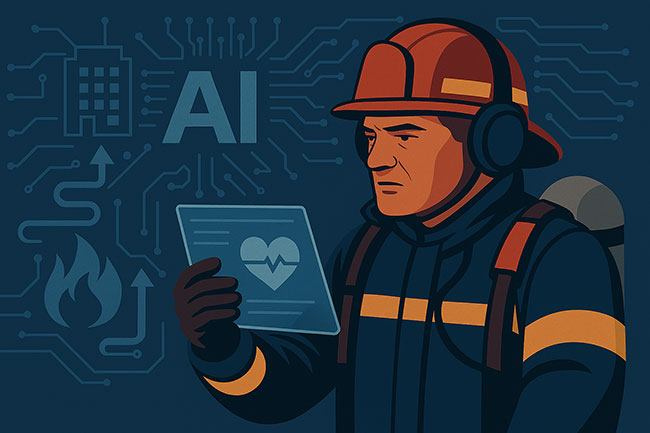
The NIST report’s goal was to test new technologies to “enable real-time forecasting and provide actionable information to enhance safety and situational awareness.” Their research looked at three key areas of AI tech: using building-temperature data to help predict flashovers before they happen, optimizing the best route for firefighters and evacuees with real-time information, and leveraging sensors to detect sudden health problems a firefighter might encounter during a call.
Andy Tam, a mechanical engineer at NIST’s Fire Fighting Technology Group and the project lead, said in an interview: “Many firefighters support and want this kind of technology, and it starts by building trust and saying how we all want the same thing, for them to go home to their family at the end of the night.”
One of the emerging AI technologies in the NIST report reflects a key motivation for Tam and his team, and that’s monitoring heart and pulse data on devices worn by firefighters. Tam said, “We want firefighters to look at data about their health and understand what’s happening when, say, they feel anxious, their heart rate is going up. Our sensors detect ECG information with an accuracy rate of 94 per cent and physiological monitoring is getting a lot of support.”
A study of 112 career firefighters trialed this AI-enabled sensor to cull data about their physiological health. The conclusions found that these AI models can improve “situational awareness and safety…and help reduce firefighters’ injuries and deaths caused by sudden cardiac events.”
These trials are important for future research into fire-tech solutions with an AI layer. Tam says the more firefighters he can trial for these sensors detecting ECG data, the smarter the product will be. “We need firefighter data for firefighter products.”
Bridging the communication gap
These NIST programs mirror Scott Ramey’s projects in Halifax. The assistant chief at Halifax Fire and a PhD student at the University of Waterloo with an interest in AI-human computer interfaces, Ramey has been partnering with companies, universities and research specialists to develop projects such as heart-monitoring tech infused with AI models.
As a board director of the Canadian Emergency Services Collaborative Innovation Lab, he helps secure funding to develop AI systems that can, for example, bridge the gap between communications systems during emergencies among firefighters on the job.
“We based our projects talking to frontline people and incident commanders to determine real needs and risks,” he said, “and to understand the tech to gauge if it makes sense.”
Ramey pointed to their own health-monitoring wearable project where their AI model listens to mayday calls and instantly alerts incident commanders with audio or vibration signals. Today’s approach isn’t flawed, Ramey said, but people are still capable of cognitive awareness delays, the phenomenon of delaying any action due to disbelief or emotional processing.
“That time before jumping into a plan is critical,” he said, sharing an example of a firefighter suffering from a sudden heart attack and requiring immediate help. Seconds matter in moments like these.
NIST also analyzed research into developing the shortest and safest evacuation path for firefighters, especially in large commercial units. Tam’s team created an AI model that considers the distance to the exit and the cumulative effects of hazards like toxic smoke and gases.
His team envisions this smart system embedded in a building’s fire system, culling data from heat and smoke detectors. The AI recommendation engine would provide the safest path to an exit based on where the fire is forecast to reach at human-height level.
“At a certain time during an evacuation, an exit might be possible but then that exit could have smoke and fire spreading there within seconds, and that’s why we need machine-learning technology to process all that data quickly,” Tam said.
Ramey considers this research sector ripe with challenges but also opportunity. “Firefighters are trained to keep contact with the hose line, you never leave it because it’s your lifeline, but it can be important to also give firefighters some situational awareness for exit plans by bread-crumbing routes out of a building.”
The final research area in the NIST paper pointed to flashover forecasting as a critical focus for their lab: Tam said they developed an AI system that uses temperature data from fire detectors to accurately predict flashovers. The hardware using this model would likely be a headphone-type device, Tam said, noting how their future trials will begin to experiment on how to relay flashover forecasting to incident commanders. “A tablet type of technology would be too overwhelming for them since they’re already ingesting so much data, so we think an AI assistant offering recommendations through headphones would be ideal for this model.”
The paper noted that it’s one of the first AI models to focus on multi-compartment residential structures, accounting for a wide range of fire and vent conditions, as opposed to previous flashover technology only targeting single residences. Also, other models needed high-performance computing, a costly budget line item for many fire districts.
Skepticism of efficacy
In areas of Canada, adopting AI tech hasn’t been a front-burner priority. When Fire Chief Steve Dongworth of Calgary heard about the NIST research areas, he was impressed but wary. “For flashovers, to help predict when they happen, you need data there,” he said, “and these are unsurvivable events. How do we know this new tool has reliable data? That’s why some fire departments have been slow to try new technologies, we’re cautious about how reliable it is.”
Skepticism of AI’s efficacy isn’t a surprise. Chief Dongworth’s comments come only days after the B.C. Wildfire Services announced a surge in AI-generated wildfire images, which can contribute to online misinformation and exacerbating stressful situations.
Montreal Fire Chief Richard Liebmann said risk management is a key focus on the ground. “They’re already dealing with a lot of data, and with biometric sensors working, would it be too much?”
He highlights another obstacle: funding. “This is a financial issue because to deploy this kind of new tech on scale will be extremely costly, and we have other priorities,” Liebmann said.
In the U.S. funding flows at a different pace thanks to a U.S. fire administration (Canada doesn’t an equivalent body) instructed to provide grants to new projects. Every new initiative costs taxpayer money, Liebmann said, and it has to be strategically invested. AI solutions to analogue problems may be rippling into other sectors, but for Canadian fire services, investments such as Ramey’s research network are the exception not the rule. Tam has found in the U.S., some fire chiefs have been skeptical of emerging technologies. “There are two groups of people, those who love AI and those who don’t, but we have to find common ground. We also make sure everyone realizes this is technology to complement operations, not to fully replace anything.”