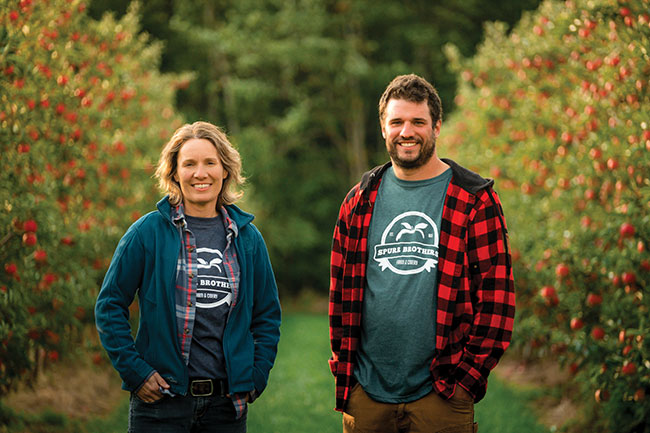
Meet Lisa Jenereaux, Katie Campbell and William Spurr, the youngest generation of farmers at the helm of Spurr Brothers Farms in Wilmot of the Annapolis Valley, Nova Scotia. They are the fifth generation of farmers and have mastered the combination of growing produce for wholesale distributors, while introducing a completely vertical retail model where fruit, vegetables and 12 flavours of cider are delivered at their market and taproom.
Managing a family farm five generations deep is a tough assignment. There is a freight train of emotion tied up in the legacy of the farm, and at the same time, it is a business – farming is a tough enterprise that demands a combination of hard work, dedication, sharp-witted focus, courageous decision making and skillful execution.
Building on a solid foundation
Established in 1875, Spurr Brothers Farms is in the Melvern Square of the Annapolis Valley. Shippy Spurr started the farm with 62 acres of hay, grain and apples. William, Shippy’s son, joined the farm 46 years later in 1921, adding another 20 acres of land and potatoes to their crop. In 1946, William’s sons Lawrence and Cameron, the third generation, took over the operation of the farm expanding to 500 acres. In 1982, the fourth generation made significant changes, separating the farm into two divisions: Cameron retained control over some orchards and strawberries; Bill and Gordon, (Lawrence’s two sons) took on potatoes and the rest of the orchards. Together they increased and diversified the farm.
The farm currently is 650 acres made up of 45 acres of onions, 10 acres potatoes, two acres peaches, five acres pears, 85 acres apples, 150 acres grains, 80 acres soybeans and 100 acres in cover crops. 150 acres are rented out to other growers. Garden production has 10 dedicated acres, and 350 acres are dedicated to wholesale.
The fifth generation
Lisa Jenereaux, Bill’s daughter, and current president and CEO, joined the farm in 2001, launching the fifth generation of the family farm with her new ideas for planting additional varieties and expanding fruit production. In this role, she continues to be a significant influence on the growth and success of modernizing the farm.
Katie Campbell, Gordon’s daughter joined in 2006. Like her father, Katie manages the packing house, oversees food safety, the market and much of the farm’s business side.
Bill’s son William Spurr took over growing strawberries and small vegetables in 2012. After Gordon’s passing in 2016, Spurr assumed many of his responsibilities, including potatoes, onions, carrots and cover crops.
Most recently, Spurr Brothers Farms launched a new division of the farm, brewing hard cider made from ingredients produced on the farm. The grand opening of the market and taproom, celebrated in 2022, brings fresh cider, local goods and a true farm experience to guests—signalling the beginning of Spurr Brothers Farms retail and their agri-tourism journey.
“I’m proud of the whole business, like I’m just proud of the fact that we are now fifth generation. We’re celebrating 150 years this year. I’m super-proud of the fact that our multi-generational family farm is still running. Here we are 150 years later, and the fifth generation is running it, and it’s successful,” says Campbell.
Early lessons in production and management
All three worked on the farm from a very young age. Talk to them and they will share the fun they had as kids stamping potato bags, sorting fruit, picking up the remnants from winter pruning – all the while, learning the complex workings of a farm.
“It was just part of life—I would help on the farm—that really instilled in me a powerful work ethic. In this business, you must want to put in the work and effort,” says Campbell.
Intergenerational planning is crucial
A five-generational legacy requires planning. So, the family developed a succession plan. A year later, Campbell’s father became seriously ill and passed away within months. Because the family tackled succession planning in an effective way, everything was in place. The transition was smooth despite dealing with the grief of losing a close family member while managing urgent production and operational issues.
“We went into the next generation with a clear picture of how we are moving forward. We treat it like a business. (Because it is.) No one gets a free ride. Family members working on the farm are compensated according to their responsibilities. What happens to shares when someone passes away or leaves the farm (needs to be addressed and resolved),” says Jenereaux.
“I tell people to make sure that you must plan for succession because you just never know what’s going to happen. You just need to start it. That’s the biggest thing. Once you get started, it’s easy, but nobody wants to get started. Seriously, get started – talk. Communication is the biggest thing,” adds Spurr.
Making tough decisions for a bold future
The three of them came to a consensus on how to alter the wholesale versus retail segments of the business, pursued significant changes in production and how Spurr Brothers Farms went to market.
Spurr very much wanted to pursue cider-making, meanwhile Jenereaux and Campbell saw the benefits of expanding the market. As Spurr became more proficient at making cider, he began to focus on adding value. Cider is the perfect product to use blemished apples. His pursuit of making cider led him to a local college course and eventually to Cornell University for an intensive hard cider course. That changed his approach and helped perfect the cider produced at the farm today.
“We had a little farm market right at the farm. That was going well, but we really wanted to expand, so we built the farm market tap room,” says Spurr.
The tap room has seen double digit growth year over year. Spurr saw an opportunity to use strawberries and peaches that were not suitable for retail sale and incorporate them into specialty ciders with great success. Spurr Brothers Farms is two different businesses now. William says that this format works well.
“Someone asked me when we first [started to open] the market, ‘what’s more important, the wholesale aspect of the farm or the retail aspect of the farm?’ They’re both important. We were too heavy in the wholesale because of the peaks and valleys in that business. There’s a lot of up-front costs and you don’t get paid for a long time. With direct-to-consumer sales it’s more consistent, which helps us with the cash flow,” says Spurr.
“The (expanded) farm market and Taproom have been fabulous. It’s been encouraging to see the community support, and how much growth we’ve experienced. We had a vision for this place and for what we wanted to do. I will tell you it is a scary thing because you jump into a project like this, and you just don’t know what’s going to happen. We have phased out of some of our wholesale stuff, like wholesaling potatoes. We used to grow up to 250 acres of potatoes, now we grow a few acres just enough to supply our market, and a few local stores. Potatoes were one of our main things, we phased out of that and into the cider, and the market. It’s a big leap. It has also been very exciting. We experienced huge support from our lenders, the community and our team.”
Planning for the future
Jenereaux has this advice for family farm operators: “If you aren’t on the same page from the beginning, get a professional to help you through the process. Everyone needs to speak up and be honest about what they want, what they think is fair and where they see the future of the farm.”
There is no question the fifth generation of the Spurr Farm is passionate about continuing the farm’s legacy, holding close to the family’s values of producing the highest quality products in the Annapolis Valley.
Editor’s note: Katie Campbell and William Spurr of Spurr Brothers Farms were named Atlantic’s Outstanding Young Farmers for 2025. The regional event was held July 20-21, 2025, at Luckett Winery in Wolfville, N.S. Campbell & Spurr represented Atlantic at Canada’s Outstanding Young Farmers competition in November 2025 in Toronto. Canada’s Outstanding Young Farmers Program recognizes young farmers who exemplify excellence in their profession.