Why pop-up?
Pop-up stores enable companies to “market-test without being bound by long-term leases and costly tenant improvements.”2 By their very nature, pop-ups are cost effective and mobile, allowing “brands to gauge demand by testing new products and promotions, while creating a boutique-style shopping experience” Because their costs are low, pop-ups enable brands to learn about a specific market’s needs and to “be nimble” when adjusting to “a market’s unique demands.”2
Companies look to pop-ups to solve a number of issues. Dr. Janice Rudkowski, an assistant professor in the department of retail management at the Toronto Metropolitan University, notes companies should approach a pop-up store with “clear goals/objectives”. Some pop-ups are used to “liquidate merchandise, while others launch new products, create excitement and brand awareness, test out a location and/or product, or build community.” Pop-ups are “less risky and less expensive than committing to a permanent store,” notes Rudkowski.
Pop-ups add revenue streams, which is helpful in these uncertain economic times. In March of 2020, Darvonda Nurseries, a producer headquartered in Langley with locations across Western Canada, was informed by its “largest wholesale buyer” that it could not take on most the company’s plant order for the spring.1 The solution, Lawrence Jansen, owner of the 47-acre operation, found was to establish, in four weeks, seven pop-ups in Alberta and Saskatchewan. The pop-ups sold Darvonda’s “vegetable, flower bedding plants, and hanging baskets” originally destined for “garden centres at big box retailers.”1
Look before you lease
Pop-up stores may be fleeting, but they have legal requirements. According to a 2018 Export Development Canada blog post on the perks of pop-ups, a business licence or registration for the jurisdiction where the pop-up will be opened is needed. If selling a food product a special permit may be needed. It is also important to have a “written agreement with the property owner or management company you’re working with.” For pop-ups a lease agreement is usual, and the terms and conditions should be carefully considered. Additional insurance will be needed for comprehensive coverage on a short-term basis. 2
Beauty in the aisle of the beholder
A temporary retail space can offer a customer a wraparound experience that engages the senses and makes the customer feel that they have access to a fleeting, exclusive event. “The pop-up should also offer an experience (vs. just selling products) to appeal to the ephemeral and experiential nature of pop-ups,” observes Rudknowski. “Fruits, vegetables, and plants would be excellent products as they can be displayed really beautifully and feature in season/limited time only items.” These surprise stores give consumers an opportunity to try products that are new, seasonal, luxury, or bulk. In Toronto’s Union Station one store often hosts pop-ups by Louis Vuitton, Oreo, SodaStream, Kombi, M&M, Bauer, and Great Canadian Sox.3
Convenience, potability, and attractiveness will capture consumers’ attention. “Products that have immediate appeal on a shelf” as well as “limited time or exclusive products that can’t be found easily elsewhere; products that can be easily purchased on the spot and taken away by the customer” will attract customers to a pop-up store according to Rudknowski.
Planning a pop-up
“Consider how products will be displayed. Pop-ups don’t have a lot of storage, so may need daily shipments to re-stock. Cold storage will also need to be considered,” comments Rudknowski. The location and stores in the area need to be investigated. Rudknowski advises asking questions such as “What competition is nearby?”; “Are the products unique or can similar products be purchased nearby?”; does product and pricing fit with the “neighbourhood demographic.”
Find out when the neighbourhood does its shopping and who is doing that shopping and for whom. Is locating, for example, near the local hockey arena or in a busy mall a better choice? As Rudknowski notes, knowing if parking or public transit nearby is also important.
Since pop-up stores have to compete, temporarily, with established neighbourhoods stores the pop-up has to be inviting. As Rudknowski asks, “Is the pop-up space very appealing and aesthetically pleasing? Is the pop-up going to create some buzz and/or excitement in the neighbourhood?” The short-lived nature of pop-ups is part of their appeal.
“Limited time pop-ups tend to be more successful, when the timing aligns with consumer demand. Pop-ups that create an experience also tend to be more successful,” Rudknowski points out.
The pop-up must be efficient. This means having “a convenient POS system as customers are used to just tapping their phones or credit cards to pay for items,” Rudknowski advises, “People don’t carry cash anymore, and if the POS is multi-step or malfunctions, this can result in a lost customer.”
The people hired to manage the pop-up need to be very skilled at customer service, but also product knowledge. They are an important part of creating a memorable experience.
Hosting a pop-up or a pop-in
“Spring 2025 marked the beginning of pop-ups supplying our nursery products,” said Valerie Kristjanson, marketing and media manager for Waterdown-located Connon Nurseries.
The producer farms more than 400 acres for retail and wholesale markets. Connon’s perennial production facility is comprised of more than seven acres of greenhouse which house tropical plants and houseplants prior to distribution, Kristjanson explains.
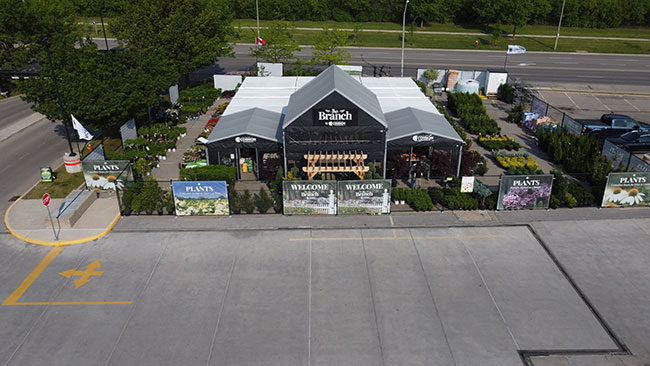
“Identifying the need for plants to be readily accessible in busy hubs outside of our existing nurseries, we opened seven locations branded ‘The Branch by Connon Nurseries,’” she said. “Operating from April into the end of September/October, Branches are stocked with our nursery plants and complemented with annuals and seasonal products produced by valued grower partners.”
Greenhouses can also function as locations for pop-ins bringing in the curious and potential customers. Connon Nurseries offers an example.
“We began hosting market events during our quieter months in 2018, first at our Waterdown sales yard, then our Newmarket location. This season will be the first for our sales yard in Trenton,” said Kristjanson. “We started out small with 25 to 30 vendors and have grown to over 75 vendors in Waterdown each week. We felt our beautiful indoor spaces could be shared with the community, welcoming people that may not be plant people. It is hoped market attendees become customers over time.”
Pop-in markets held at Connon Nurseries “feature local culinary creators, artisans, and makers of unique foods and wares. We curate the selection of vendors to ensure a wide offering,” Kristjanson said. “We create offers for attendees to use on our products while at events, along with ‘come back and save!’ incentives. We work with a shop local platform, ‘Get in the Loop,’ that provides an app to encourage patrons to return, purchase from ourselves or our vendors multiple times, obtaining a reward.”
The final step of a pop-up or a pop-in is the post-event analysis. “Sales volume, foot traffic and conversion rates” are needed to measure performance.4 Reviewing customer feedback in person, online, on comment cards is constructive.
Pop-ups and pop-ins can establish good will for a brand, and warm feelings in the community for a local business. In difficult economic times growers can develop multiple revenue streams through reaching out with pop-ups or by being a good host with pop-ins. The best ROI is customer loyalty and community good will.
Read about more retail innovations in Greenhouse Canada.
Sources
- Avison/Young (A/Y), 2020, Alberta/B.C. Greenhouse nursery teams up with…, https://www.avisonyoung.ca/news-releases/-/aynp/view/2020/05/04/alberta-b-c-greenhouse-nursery-teams-up-with-avison-young-to-create-pop-up-garden-shops-glow-gardens-/in/calgary
- B. Sirois, 2018, Pop-up shops, EDC, https://www.edc.ca/en/blog/pop-up-shops.html
- D. Israelson, 2022, ‘Here today, gone tomorrow’, Globe and Mail, https://www.theglobeandmail.com/business/industry-news/property-report/article-here-today-gone-tomorrow-the-rise-of-pop-up-and-short-term-retail/
- L. O’Neill, 2024, 11 Tips To Make Your Pop-Up Shop…, https://www.lightspeedhq.com/blog/pop-up-shop/
- Retail Insider, 2021, Canadian Pop-Up Facilitator…, https://retail-insider.com/bulletin/2021/09/canadian-pop-up-facilitator-pop-up-go-to-expand-into-the-united-states-in-new-partnership/