Buildings come in many shapes and sizes, which create different challenges in their design and construction. Likewise, their locations may put different demands on the architectural systems that compose them. A facade in the subarctic climate of Yellowknife will be subjected to different weather conditions than one in Toronto. The same can be said about use. A medical centre will have different goals than a data centre. It follows that the architectural glazing systems used throughout a built environment may be called to fulfill different demands. In some cases, typical architectural glazing may not be able to satisfy a project’s needs.
In these instances, project teams might turn to specialized architectural glass to help them achieve code-driven requirements and performance goals without compromising design intent. These can include fire-rated glazing systems, channel glass, systems that can resist extreme weather, systems that address specific life-safety challenges in health care, glazing that meets multiple demands for privacy and access to daylight, energy-efficient glass and more. With such a wide range of specialized glazing systems currently available, there is likely an appropriate glass solution for a given scenario.
This project round-up details how specialized glass and framing systems allow design without compromise. From an office building in St. John’s, Nfld., to a youth social services center near Montreal, the following projects showcase the creative potential that can come with specifying specialized glazing systems.
Two specialty glazing systems bring daylight into a Toronto subway station
The Vaughan Metropolitan Centre Subway Station in Vaughan, Ont., has a striking exterior. Its saddle-shaped roof and curved exterior walls stand in stark contrast to the rectangular construction of the buildings that surround it. According to Grimshaw Architects, the firm behind the design, giving a functional building an elevated esthetic gives people something to remember and enjoy. Specialty glass and framing helped Grimshaw Architects achieve this design goal.
Within the subway station is a stainless steel clad elevator shaft. The cars and the shaft itself include fire-resistive rated glass and framing to lend the elevator an open esthetic and to meet code-driven requirements for fire and life safety. The fire-rated glass system defends against the spread of flames, smoke and heat while its narrow-profile steel frames maintain visual harmony with the exterior non-rated curtain wall system. The ability for the fire-rated glass to offer code-compliant defense without disrupting visual harmony is what makes it particularly special in this application.
The exterior curtain wall also has notable characteristics. Its convex and elliptical shape necessitates a strong framing system, and Toronto’s weather makes corrosion resistance essential. Narrow-profile steel framing, with roughly three times the strength of aluminum systems, hold large spans of architectural glass between horizontal and vertical mullions. Because this system could use any type of steel back member, it accomplished this without disrupting the station’s curved look. Since it can use nearly any type of customer steel member as a back mullion, it was possible to segment the curtain wall around the exterior and create the entry’s trademark curved look.
Due to the narrowness of the frames, the designers could maximize the glazing area to flood the station’s interior with daylight. They could also improve the system’s weather-resistance by customizing the stainless steel alloy frames The result is a design-forward exterior durable enough to withstand inclement weather year after year and an interior that continues the open esthetic all the way to the subway platform.
Glazing combines safety, security and occupant comfort
Rehabilitation Centre for Youth with Adjustment Difficulties (CRJDA) located in St-Therese, Que., just north of Montreal, also features a curved exterior glass curtain wall. In this application, the glass and framing are concave to create a gentle curving connecting point between the CRJDA’s two wings. The exterior curtain wall’s ability to meet design goals is impressive, but another innovative use of architectural glazing is within the building.
Throughout CRJDA, many rooms incorporate windows with integrated blinds. Sealed between impact-rated glazing, these blinds allow occupants to control daylight and manage internal heat gains. By sealing the blinds within the glazing unit, the system also prevents dust and bacterial buildup – minimizing cleaning requirements and reducing building maintenance costs. Integrating the blinds within impact-rated glass allowed these windows to blend architectural innovation with requirements for psychiatric occupancies.
The blinds are motorized and allow for centralized or zoned control. This helps ensure optimal internal thermal comfort while also eliminating issues related to dust and bacteria buildup. Both the curved curtain wall and windows with integrated blinds demanded a high level of precision. And together, these specialty glazing systems contributed to the safety, security and comfort of young children and adults in need.
Channel glass balances daylight access, visual appeal and energy efficiency
Integrated blinds are not the only way specialty glazing can support occupant comfort. Channel glass, which is U-shaped self-supporting cast-glass channels, allows for large glazed areas that can diffusive natural light. It can be cast or sandblasted to achieve a specific level of transparency, ranging from fully clear to a netted screen surface and more. This level of customization can help designers texture façades in unique ways and optimize an exterior glazing system for privacy and translucency.
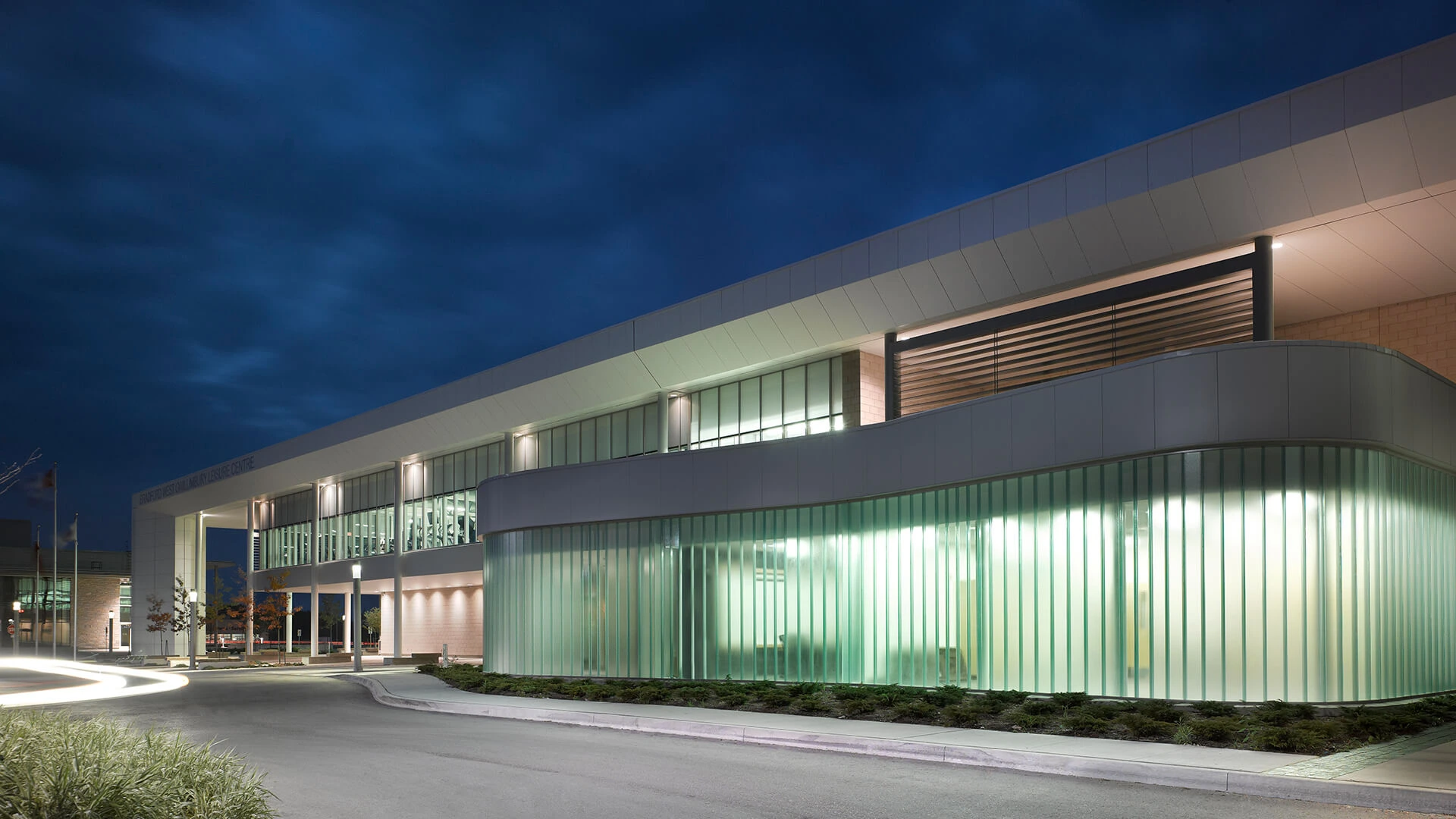
For instance, the Bradford West Gwillimbury Leisure Centre in Ontario combined fully transparent and lightly dimpled channel glass segments in a serpentine exterior system. The combination allowed the design to meet the different light transfer, privacy and visibility goals of the various rooms it encloses. Further, because the channel glass allows for tight radii, as low as 1.9 meters, the system had the flexibility to achieve the curving façade design while keeping a homogeneous appearance in areas with different radii. To ensure the U-shaped channel glass did not interfere with the joint connection and interrupt the glass wall’s uniform look, flanged L-shaped channel glass planks were installed on one side of a joint transition and full U-shaped channel glass planks on the opposing side. This configuration allowed the channel glass framing head and sill components to be stretch-formed into a smooth continuous structure with a precise radius.
This system incorporates both a low-emissivity (low-E) coating and aerogel insulation within the channels. With both additional materials, the channel glass used in this project contributed U-values between 0.21 and 0.19 to bolster the thermal performance of the glass wall. By limiting the transfer of heat, this specialty glazing system supports an energy-efficient design, a key consideration for Ontario construction.
Fire-rated glazing blends seamlessly into the built environment
While specialty glazing can be eye-catching, it does not have to be. Commonly, the intent behind specifying fire-rated glass is to dissolve visual boundaries between adjacent spaces. Transparent, fire-rated glass helps design teams replace solid walls to create open space and allow daylight to stream deep into a building. That said, to meet the most stringent requirements for fire and life safety, some glazing systems need to be fire-resistive rated for 120 minutes.
Lites of glass that achieve this rating can weigh three to four times that of non-rated glazing. In the past, this may have required bulkier framing profiles or smaller spans of glass between mullions. These limitations were especially challenging in stairwell design, where visual discrepancies between fire-rated and non-rated systems can be very apparent. However, roll-formed steel subframes can achieve the strength necessary with a smaller profile. This supports a more cohesive design when fire-rated and non-rated systems are next to one another.
For example, KMK Place, an office building in St. John’s includes a stairwell with a 120-minute fire-resistive curtain wall system on one side and a non-rated curtain wall system on the other. Occupants looking out of KMK Place could easily see large, visually distracting differences between each system. The team behind the project solved this challenge by specifying fire-rated frames that provide a close visual match to the exterior system’s dimensions and material.
Whereas other specialty glass offers visual distinction, this system blends into the built environment to create a more unified design esthetic.
Collaborative design eases challenges in specification
Specialized glazing systems can broaden the possibilities of occupant-centered design. Whether it is through transparent fire barriers that all but disappear or one-of-a-kind facades that softly diffuse light, these systems marry form and function to meet the most exacting specifications.
As the above projects demonstrate, there are many types of specialty glazing systems to choose from. Each one prioritizes different benefits to a building’s design and a user’s experience interacting with it. And each comes with particular limitations.
Knowing the details of every specialized glazing system currently on the market is not exactly feasible. Thankfully, design firms do not need an encyclopedic knowledge of every option. Instead, by collaborating with experienced, industry-leading manufacturers and systems engineers, they can find a specialty glass and framing system that offers the right performance capabilities in the desired esthetic option for the project at hand.
Collaborating early in the design phase can result in a building better optimized for its use and users. It can also support a more efficient path from concepting to certificate of occupancy.
Devin Bowman is general manager of Technical Glass Products (TGP) and AD Systems. With over 20 years of industry experience, Bowman is actively involved in advancing fire- and life-safety codes and sits on the Glazing Industry Code Committee (GICC).