Sustainable building regulations to date have focused almost exclusively on the thermal insulating value of facades. For good reason – the energy used by a building for heating and cooling is a major contributor to its climate change impact when the building uses a fossil fuel source for its power. But after decades of incremental tightening, regulations are approaching a point where further improvement to thermal performance is technologically difficult, economically unfeasible, offers diminishing returns in terms of lower carbon emissions, or all three. So the focus is shifting to embodied carbon and with it new terms are rising in importance: “resiliency,” “circularity” and “low-carbon” will be heard as much or more in the years ahead as “energy-efficient.” Architectural glazing designers will need to get familiar with technologies that reduce the amount of carbon emitted to manufacture facades, extend their life, make them easier to maintain, and make them easier to recycle or replaces.
The chip fix
RFID tags (tiny flat data chips placed, in this case, on each fenestration component) are already being used to some extent in this context. Accessing the data used to require a special scanner-gun device, but it can now be accessed through smart phone apps. Data can also be stored and accessed using a similar bar code system (used by Island Facades in New York, for example), and you can add data in both barcode and RFID technologies.
Roberto Bicchiarelli, director of business development for strategic projects at Island Facades, notes that data tags are required now in most large building contracts for warranty purposes. This is also noted by Mic Patterson, an adjunct professor at the University of Southern California School of Architecture and founder of the non-profit Facade Tectonics Institute (focused on meeting sustainability goals through facade design). However, with regard to maintenance and extending lifespan, the data (which can include materials used, the manufacturing batch/date/time, the purchase order, who installed the item when, etc.) can be helpful with predictive maintenance.
However, the materials and manufacturing data can also be useful, explains Daniel Arztmann (head of international custom engineering at Schueco and professor of facade construction at Detmold University of Applied Sciences in Germany) at facade end-of-life in the dismantling process. Patterson notes the concept of making facade replacement easier through “design-for-disassembly” is “building up steam lately and a very important dialogue in my opinion.” (Indeed, it was covered in Glass Canada’s March 2025 issue).
In addition, RFID/barcode data could help in future decisions about aging facades, says Bicchiarelli. That is, taken together with information on a building’s heating system and other factors, reliable materials and manufacturing data could help in deciding whether to add fenestration over the old, replace fenestration, or to demolish and construct a new building – with these decisions greatly impacting the total embodied carbon of the building over time.
More glass?!
Island Facades is also using an innovative new facade design strategy to reduce carbon impact. “We have done some projects with much larger facade panels,” Bicchiarelli shares. “Not all buildings are suitable for this, sometimes the site logistics does not permit it, but we are getting more requests now. The panels stretch from bay to bay. Instead of being 1.3 meters across and one storey high for example, you have a mega panel that’s six, eight or 10 meters across and one storey high. So, you have four or five times fewer joints and less aluminum. You can also have different types of IGUs and different types of mullions. Taken all together, that’s a big contribution to the thermal efficiency of the building.” Patterson adds, “This mega-panel strategy championed by Island Facades is a growing trend in facade system design.” He says that these systems often utilize conventional windows in punched openings, “making them potentially quite easy and relatively inexpensive to maintain and replace.”
Also, in the overall realm of building trends, Bicchiarelli says more stringent building codes have resulted in a current tendency for facades to have 60 to 70 percent opaque area and 30 percent vision area (where only five to 10 years ago, it was the opposite). This obviously provides large building efficiency gains. Regarding this development, Patterson says New York Magazine recently recognized the trend in an article by Justin Davidson called Brick is Back. “Might it finally be,” he asks, “that opacity in the building skin is making a comeback after the decades-long trend of the highly glazed facade?”
Smart facades
In order to extend facade lifespans, there is also discussion of embedded sensor technology that can efficiently monitor and relay performance parameters that can assist with maintenance strategy and execution. Sensors monitor thermal performance, water infiltration and more.
“These systems aren’t used on big scale yet,” says Arztmann, “but I think their biggest impact would be with openable elements. How often they are opened and closed is a big wear factor. We also, in
double-skinned closed-cavity facades, can expect a lot of overheating, which can destroy materials. Therefore it would be useful to have cavity sensors and monitoring of temperature development to predict the durability of the plastic and motor components of, for example, the shading system.”
Negar Heidari Matin, director of Oklahoma University’s High Performance Interior Architecture Laboratory, is now working on a project exploring how advanced materials can be used to engineer facade systems that respond dynamically to environmental conditions. There is also “smart glass” already on the market that can detect moisture and temperature changes, and some types have the ability to darken. Active technologies include electrochromic, liquid crystal and suspended particle, and passive versions include thermochromic and photochromic technologies.
Do the recycling
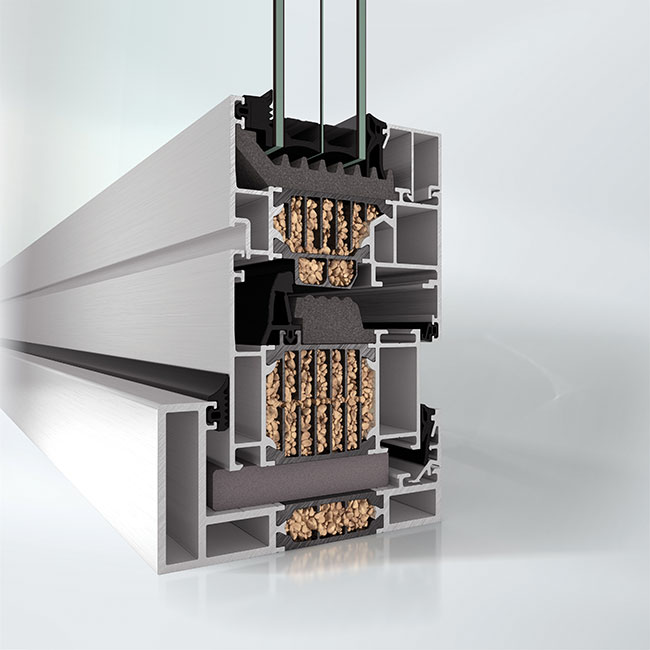
In January, at the BAU 2025 building exhibition in Germany, Schueco presented a prototype window called AW Circular that features almost 100 percent materials that are recycled and/or can be recycled, including reused glass and gasket material. “It got a lot of attention at the show, and we had a lot of questions from the scientific-minded,” says Arztmann. “We also got quite a few inquiries afterwards about when it will be available for purchase. So, we have proven it is possible, but the costs are higher for recycled materials and that is a barrier.” He suggests that perhaps governmental funding could play a temporary role in bridging the cost gap, helping speed adoption which would then support in costs coming down.
Also, although AW Circular is not available for purchase yet, its creation has led to Shueco currently determining which of its window and standard facade components can be made easily from recycled materials at the same cost, and which can be replaced at greater cost. Already, Schuco has achieved silver and bronze certificates for its standard facade from the Cradle to Cradle Products Innovation Institute.
Robot welders
Arztmann also outlines two avenues already being explored where robotics can reduce the embodied carbon of buildings through facade construction. The first has to do with a process – welding aluminum – that’s existed for a long time but has never been used. “It would take too much time and cost to have even highly skilled welders do this,” Arztmann explains.
But robot welders that are widely used in manufacturing are now entering the construction realm. These machines can weld with a level of precision and at angles and in enclosed areas that provides results that are impossible for the best human welder to achieve, and as many times as you like. Their skill is being improved weekly through the use of artificial intelligence to guide weld lengths, angles, speeds and more. All of this, says Arztmann, could make welding aluminum in facade construction feasible.
Indeed, a team of U.S. engineering researchers are currently developing a fully automated mobile construction robotic welding system capable of path planning and tracking for two butt joints. Progress was recently reported in a paper published in the December 2024 issue of the journal Automation in Construction. These robots use a visual system, but in his second example of automating facade construction, Arztmann notes that robots only need virtual vision. That is, if you have a robotic system for fixing facade brackets to the slabs, “and it’s connected to a digitized twin version of the building,” says Artzmann, “the robot will know exactly where the steel reinforcements are located and attach the brackets there. This means you can make your floor slabs thinner and thinner, and reduce the carbon footprint of the building substantially.”
Adding it up
As we move toward a holistic understanding of a construction project’s carbon impact, data, recyclability and low-carbon building approaches will increase in importance. Integrated electronics and automation can contribute, and are technologies the wise glazing contractor is taking a look at right now. •