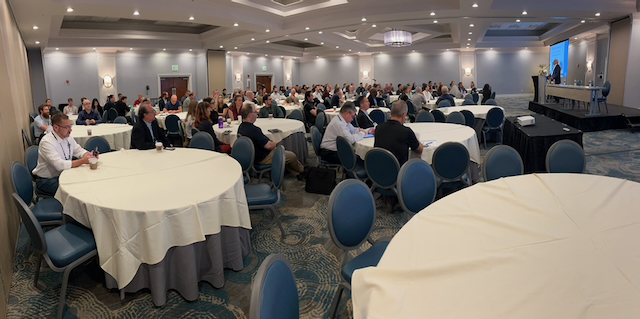
ASHRAE and Oak Ridge National Laboratories is hosting its Building XVI Conference in Clearwater, Fla. The event happens every three years and is located at the lovely Sheraton Sand Key Resort, just steps from the beach. Not a bad assignment for a Canadian in December. It’s also a fun assignment because the conference is packed with dozens of the top building science experts from all over the world and you can spend all day hearing about the very latest research and ideas that will inform how we build things for years to come. About 100 attendees were at the opening plenary.
Trowel-on insulation
Ali Naman Karim of Chalmers University in Sweden showed his research into aerogel-coated mortar. ACM is a coating mortar with the sand replaced by aerogel particles – a substance with an extremely low thermal conductivity. The coating has to go on quite a bit thicker than regular coating mortar – 50 millimeters versus 10 – and takes an additional four months to completely dry. But it cuts heat transfer through the wall by about half. Karim suggested it could be a good solution for heritage renovations where adding regular insulation is not an option and the cost is less of an issue.
Bright days, dark nights
Wahid Maref of the University of Quebec talked about research into whether solid state phase change material (SSPCM) coatings on windows behaved differently depending on building orientation. These are the materials that are used to to create dynamic glass that can change opacity in response to electric current or heat. They absorb heat and block its transmission even more than low-E coatings and are therefore useful for enhancing the insulating value of windows. However, they are not as transparent as low-E and affect the opacity of the glass. They also change opacity as they are heated, becoming transparent in high sunlight and clouding as the window cools. Maref and friends found a 8.2 percent reduction in winter heating loads in the spaces where the SSPCM was used. The study was done in Montreal and the north- and west-facing windows stayed transparent longer on sunny days. On cloudy winter days, the windows sometimes did not clear at all. Maref suggested the technology might be useful in commercial applications where the building is only used during daytime work hours.
Fenestration street view
Mehdi Ghobadi of the Construction Research Centre at the National Research Council presented his study evaluating an experimental method for estimating a building’s energy use by calculating its window-to-wall ratio. What his team developed was a software vision system that could capture images of a facade from the street and recognize what are the windows and what is the wall without being trained or having the data manually manipulated. From there, the software generated predictions about the building energy use using a simplified model of the building. Ghobadi’s team tried the system out on a University of Ottawa dormitory and found the vision system was 90 percent accurate in identifying window area. More interestingly, the software they used was much more accurate in predicting building energy use based on the measured WWR than calculations using the assumptions in the National Energy Code for Buildings. This research could someday lead to easy Google Street View-style measurements of building facades that can be quickly turned into estimates of building energy use that are closer to the actual performance of the building.
The effect of thin triples
Robert Hart of Berkely Lab presented his study measuring the effect of retrofitting eight units in a 1971 Santa Rosa, Calif., multiunit complex with thin triples featuring two low-Es, a 1.6mm centre lite in a one-inch gap and argon fill. The existing fenestration was monolithic with aluminum frames. Hart’s team may have gotten more realistic results than they were even looking for because the study was plagued by a series of real-world problems that will be familiar to anyone in the window and door industry. The 50-year-old units were of course in various states of disrepair and alteration, with large gaps around A/C units; attic insulation piled up to one side and not replaced; heaters and thermostats not functioning; and other problems that made accurate measurements and comparisons difficult. The residents didn’t help either. One woman left one window open at all times so her cats could go in and out. Two residents used zero energy throughout the study, never turning on either heat or cooling no matter the temperatures. Others went the other direction, sometimes running heat and air conditioning at the same time. The chaos was such that Hart had to admit they couldn’t arrive at any firm conclusions on the effect of the replacement thin triples, but for what it was worth they measured an average of four percent heating demand reductions and 25 percent cooling demand reductions over a year following the replacements.