| |
| |
 |
 |
| |
 |
|
@{mv_date_MMM d, yyyy}@ |
| |
|
| |
Happy Fourth of July to our American neighbours and readers! Earlier this week, our Canadian team celebrated Canada Day (July 1) and now it's your turn. Let's all take this time to celebrate what makes both nations united and not what divides us.
- Jean Ko Din, Editor
|
|
| |
|
| |
Washington Department of Fish and Wildlife (WDFW) is laying off 29 staffers and not filling many of 170 vacancies, says a report by the NorthWest Sportsman website. The department is also shutting down a hatchery and closing a Steelhead fishery to meet the recently approved budget constraints.
» Read More...
The aquaculture sector could generate up to 22 million new jobs by 2050, said the World Bank. Their report, written with the World Wildlife Fund (WWF), touts aquaculture as “one of the most promising opportunities for building a more sustainable food system over the next 25 years.”
» Read More...
Kentucky State University (KSU)’s Dr. Andrew Ray is co-leading a Joint Project Agreement between the U.S. and South Korea to foster aquaculture. The agreement between the U.S. National Oceanic and Atmospheric Administration (NOAA) and the Republic of Korea’s Ministry of Oceans and Fisheries (MOF) is intended to boost aquaculture research and collaboration.
» Read More...
|
| |
|
| |
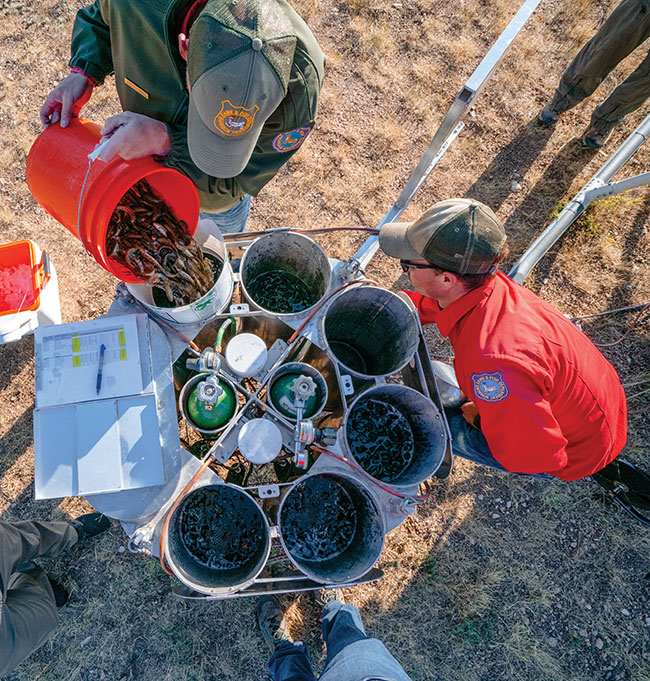 The success of Wyoming’s helicopter stocking operations is dependent on months of careful planning and coordination. Each year, Wyoming Game & Fish Department stocks approximately 100,000 fish (three to four inches) into roughly 80 high alpine lakes.
» Read More...
The success of Wyoming’s helicopter stocking operations is dependent on months of careful planning and coordination. Each year, Wyoming Game & Fish Department stocks approximately 100,000 fish (three to four inches) into roughly 80 high alpine lakes.
» Read More... |
| |
| |
|
| |
Bionetix International, a waste treatment company, suggests the use of probiotics for aquaculture. Probiotics are living organisms that digest waste, clean up water and promote intestinal health. This promotes better water quality and healthier species in fish farms.
» Read More...
Laboratory observations showed a reduction in shrimp mortality when raised in a biofloc system. In such a system, beneficial heterotrophic bacteria recycle ammonia and nitrate into a less toxic form. This helps improve water quality, recycle nutrients, and grows a beneficial microbial community that boosts shrimp growth and immunity.
» Read More
|
| |
|
| |
» Read More...
|
|
» Read More...
|
|
» Read More...
|
|
» Read More...
|
|
| |
|
| |
|
|
| |
| |
