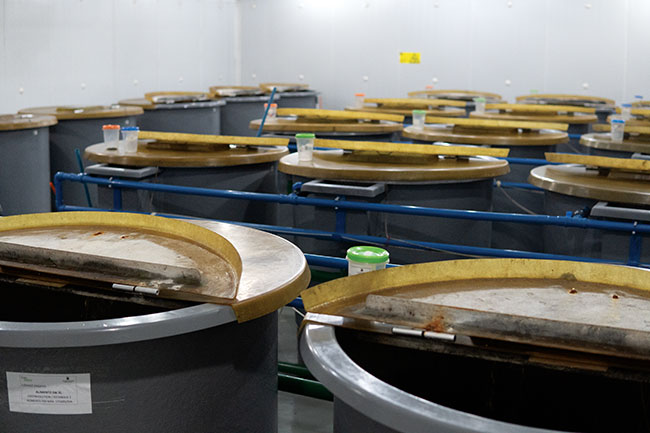
Chile’s salmon farming industry has reached a pivotal moment in its fight against devastating diseases. Central to this effort is Salmon Clinical Trials, the nation’s first university high-biosecurity wet laboratory specifically designed for experimental clinical trials on salmon pathogens. This cutting-edge facility, led by Ricardo Enríquez, represents a significant leap forward in understanding and combating pathogens that threaten farmed fish, ensuring a sustainable future for one of Chile’s key export sectors.
Behind the vision
The idea for Salmon Clinical Trials, Faculty of Veterinary Sciences, Universidad Austral de Chile, was born in 2010 when researchers recognized the urgent need for a specialized unit to conduct clinical trials on salmonids. Traditional facilities were cost-prohibitive for researchers relying on public grants such as Fondef and Fondecyt. Enríquez, dean of the university’s Veterinarian Institute, said the lack of an affordable option to study the physiological and metabolic relationship between fish and pathogens hindered scientific progress.
In 2012, after securing funding from Innova Corfo, the laboratory was inaugurated. It consists of two primary sections: a fish production area, which includes a small ova incubation unit, a production area with 14 tanks (one to seven cubic metres) and a clinical trials area, designed with state-of-the-art biosecurity measures.
Inside the design
The clinical trials area is the cornerstone of the lab’s work, allowing researchers to study pathogens under tightly controlled conditions. The facility features eight independent hydraulic systems, each with three one-cubic-metre tanks. This setup enables trials to be conducted in duplicate or triplicate, ensuring reliable results.
“The design prevents cross-contamination, even when different pathogens are tested simultaneously,” explained Enríquez. Additionally, the lab’s filtration system, which uses mechanical filters, zeolite, and activated carbon, recirculates 100 per cent of the water, with partial water changes depending on biomass pressure.
The facility’s technical design reflects its commitment to precision and innovation. The fish production area includes ova incubation units and tanks of varying sizes to rear fish to the appropriate size for experiments. This ensures that physiological and metabolic studies are conducted on fish that have not been exposed to external treatments, such as vaccines or antibiotics.
Additionally, temperature control systems, including chillers, allow researchers to simulate environmental conditions necessary for specific pathogen studies. For instance, trials on Renibacterium salmoninarum are conducted at 9-10 C, while experiments with Piscirickettsia salmonis require 13-14 C.
Pathogen research and limitations
The lab has been authorized to conduct clinical trials on all major salmon pathogens except the Infectious Salmon Anemia virus (ISA), which requires stricter containment measures by the Authority (SERNAPESCA-Chile) due to its designation as a reportable disease by the World Organisation for Animal Health (WOAH).
Nevertheless, the lab focuses heavily on Piscirickettsia salmonis, the causative agent of Salmonid Rickettsial Septicemia (SRS), and Renibacterium salmoninarum, responsible for Bacterial Kidney Disease (BKD). Both diseases have had severe economic impacts on the industry.
Bridging science and industry
Salmon Clinical Trials bridges the gap between academia and industry. The lab prioritizes academic research, providing cost-effective resources for university projects. “We’ve supported studies on metabolism, immune response, and smoltification, among others,” noted Enríquez.
Notably, several doctoral theses and groundbreaking research projects have been conducted here, including work on the interaction between P. salmonis and host macrophages. This research has revealed the pathogen’s ability to evade immune responses by exploiting host cells, a phenomenon likened to a Trojan horse.
In addition to academic studies, the lab collaborates with private companies. For example, trials have been conducted to test vaccines, diets, and immunostimulants. Recent projects include vaccine validation for Green Evolution SpA and diet trials for Skretting Chile.
Contribution to disease management
The lab has made significant strides in disease management, including developing cohabitation infection models for P. salmonis that achieve DL30, DL50, DL70 and 100 per cent mortality rates, closely mimicking natural outbreaks. These models have become a critical tool for understanding pathogen behavior and testing new treatments.
Similarly, long-term studies on R. salmoninarum have helped refine diagnostic techniques and deepen the understanding of its transmission dynamics. The lab’s ability to maintain controlled conditions for up to 80 days in these experiments demonstrates its technical capabilities and commitment to advancing the field.
Salmon Clinical Trials also serves as a National Reference Laboratory for exotic fish diseases under the supervision of Sernapesca, Chile’s national fisheries and aquaculture service. The lab plays a crucial role in monitoring and diagnosing exotic pathogens, including rhabdoviruses, iridoviruses, totivirus, herpesviruses and alphaviruses.
“We participate in rigorous ring tests with European laboratories (EURL) to ensure the reliability of our diagnostic methods,” Enríquez shared. The lab also supports quarantine monitoring for ornamental fish, ensuring Chile remains vigilant against new disease threats.
Challenges and future directions
Operating in Valdivia presents unique challenges, particularly with temperature fluctuations during the summer months. However, the lab’s advanced cooling systems have mitigated these issues, ensuring consistent experimental conditions year-round.
Looking ahead, Enríquez envisions expanding the lab’s capabilities to include reproductive management and embryonic development studies, which could further enhance its role in aquaculture research.
Ultimately, Salmon Clinical Trials exemplifies how scientific research can directly address industry challenges. By offering affordable, high-quality research services, the lab has filled a critical gap, enabling both academic and commercial stakeholders to advance their understanding of fish health.
“This is not a commercial facility,” emphasized Enríquez. “Our mission is to contribute to the development of scientific knowledge and provide solutions for the industry, ensuring the sustainability of salmon farming in Chile.”
As the global demand for salmon continues to grow, Salmon Clinical Trials stands as a beacon of innovation and collaboration, paving the way for a healthier and more sustainable aquaculture industry.