Much like the life cycle of Alaska’s salmon, the state’s oldest operating salmon hatchery that began life as a two-year aquaculture and fisheries science program in 1972 at Sitka’s Sheldon Jackson College, has evolved into what is now the Sitka Sound Science Center (SSSC). It is the only aquaculture educational facility of its scope in Alaska.
Sheldon Jackson was founded by Presbyterian missionaries in the 1880s to train Alaskan Natives in vocational skills. Over the years it served as a vocational school, grade school and high school, a two- and ultimately, a four-year college.
Now occupied by the SSSC, the Sage building, one of many structures on campus, was constructed in 1929 and served many fields of study from art, astronomy, carpentry, shoe making, and of course, science classrooms, according to Lisa Teas Conaway, SSSC communications coordinator. The basement was renovated in 1974 to create an educational salmon hatchery space that obtained the first state-issued salmon hatchery permit in Alaska. A small public aquarium was added in 2005.
Sheldon Jackson College closed its doors in 2007, after which SSSC was formed as a non-profit focusing on scientist research and education and increasing awareness of our natural world, added Teas Conaway. “We have continued to be an educational facility aimed at training students to become skilled employees in a growing workforce.”
“The Sheldon Jackson Hatchery (SJH) naturally fits well within our mission with its ability to help scientists expand their knowledge of the salmon we rear and the ability to bring in students of all grade levels to learn about the salmon life cycle and the hatcheries place within it,” she said.
“Salmon are a vital part of our community with deeply engrained ties to our local indigenous population,” said Teas Conaway. “We strive to ‘do salmon right’ by putting the needs of the fish first and at all costs, raise them to be as healthy and viable as possible.”
From forestry to raising fish
William Coltharp has been SSSC’s aquaculture director since 2018, but his life path didn’t start out that way.
He arrived in Sitka in 1980 to study forestry at Sheldon Jackson College, but soon learned forestry jobs in Southeast Alaska were more about logging than planting trees – and the industry was slowing down.
“In 1987, I went back to school for a Bachelor of Science degree in aquaculture with a minor in mariculture and doing work study at the Sheldon Jackson Hatchery,” explained Coltharp.
After working remotely at area lakes, he fell in love raising fish. When the managerial position opened at SJH in 1990, Coltharp jumped on it. During his 10-year tenure, he ran the hatchery with only college work-study students as help, while also teaching fish husbandry and hatchery practicum.
Coltharp left the hatchery in 2000 and worked for the Northern Southeast Regional Aquaculture Association (NSRAA), conducting salmon enhancement projects throughout northern Southeast Alaska for 19 years before returning to SSSC.
Unique among hatcheries
Sheldon Jackson Hatchery is the oldest and smallest hatchery operating in Alaska and one of only two training facilities on the west coast, according to Coltharp. But the hatchery is also unique in its “fish first perspective.”
“We approach each day with a fish first perspective,” said the director. “I start every day based on tides, weather, seasons and the needs of the fish.”
SJH Fish Culturist Haley Jenkins concurs.
“Sheldon Jackson Hatchery was built and operated by students and for students. It has remained that way ever since the 70s’,” said Jenkins. ”This hatchery, unlike others in the state, is an educational and training facility. We have two permanent staff members, a one-year full-time apprentice and several interns (high school and college age). This essentially means that the majority of our staff are learning and training every day.”
No typical work days
The hatchery is permitted to rear and release on site three million pink salmon, three million chum salmon and 250,000 coho salmon, according to their web site. In addition to fish reared and released from the hatchery, nine million chum salmon are reared and released at Deep Inlet, a remote site south of Sitka, under the care of NSRAA.
A typical workday changes with the seasons.
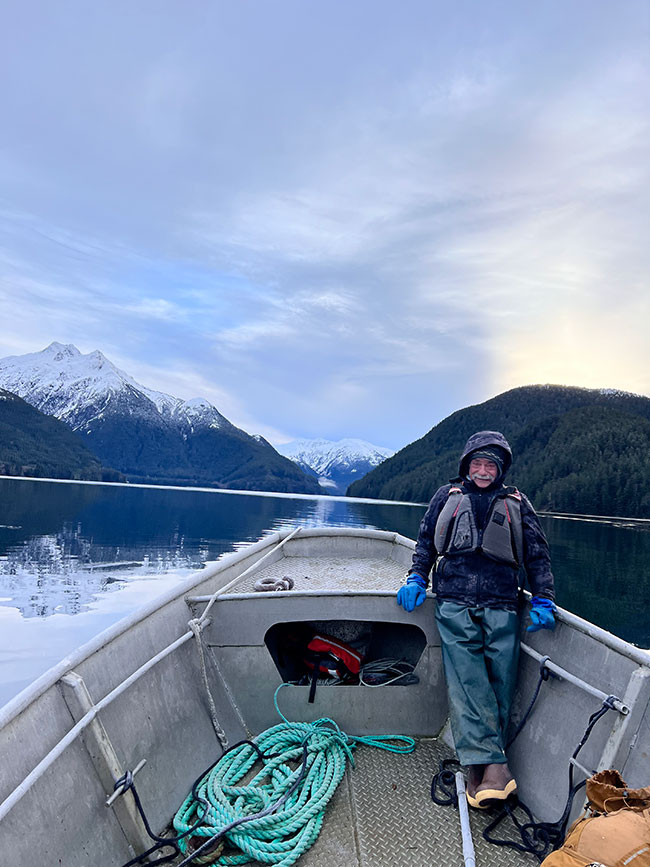
“In late summer/early fall, we are spawning pink and chum (taking eggs and fertilizing),” explained Jenkins. “We take three million eggs from each of those species. By October, we are picking through those eggs to get any of the unfertilized out. November is when we spawn the adult coho and take 250,000 eggs. By January, the pink and chum have hatched and are almost ready to be transported to their saltwater nets. February to May we are out on a boat five times a day, every single day, feeding those pink and chum fry. Summertime is for special projects and taking care of baby coho.”
“It’s so difficult to describe a typical workday at a hatchery because we operate on the salmon life cycle,” she added. “It is one of my favorite things about working in aquaculture.”
“To work in salmon aquaculture in Alaska, you must be able to adapt and act quickly when things happen,” said the Virginia native. “We are supporting the lives of millions of fish, so expecting the unexpected every day is normal, but it can be a real challenge at times.”
Jenkins started in an entry-level job at SJH after graduating from Virginia Tech and was promoted to the fish culturist position after one year, where she is in charge of the day-to-day aspects of raising fish.
Programs for all ages
“Our goal is to not just incubate fish but also the future of the mariculture industry,” so states the SSSC web site.
That future includes students of all ages.
Pre-kindergarten programs involve experiencing salmon anatomy – showing eggs during spawning season and includes art fish pressings, said Teas Conaway. Sitka’s first graders visit the hatchery multiple times throughout the year, the first visit coinciding with spawning and observing “their” baby salmon grow to the point of release in spring.
Fifth grade students get a salmon ecology lesson, learning about the role hatcheries play in the fishing industry, Teas Conaway continued. Seventh graders learn about the bio-genetics of salmon and get hands-on data collection opportunities through measuring weight and length.
“Sitka High’s field science aquaculture classes visit our hatchery weekly and help with the day-to-day operations of the hatchery crew from spawning adults to feeding babies,” said the communications coordinator. Internship opportunities are open to all three high schools in Sitka.
Don’t forget the public.
A “Salmon Release Party” is celebrated in May where the whole community can help carry little containers with smolt (young salmon) to pour into the ocean along Sika’s beach for their first big swim. Wild Alaska Salmon Day is celebrated in August with art activities and a hatchery tour for the community.
“We start all of our hatchery tours with discussing food webs and helping visitors relate this concept with what goes on within their own homes,” said Teas Conaway. “From cows in the mid-west to fruit orchards in the south, we all have food webs around us. Here in Southeast Alaska, salmon play a vital role in our food web and have been immensely important to our communities since time immemorial.”
Wild salmon stocks
Wild salmon stocks began feeling the strain when commercial fishing started growing in the 1940s.
“We got into this business producing hatchery fish to relieve fishing pressure on the wild stocks and in that respect we have had some success, mainly with pink, chum and some stocks of coho and sockeye,” said Coltharp.
“Overall, hatchery salmon are known to have less genetic diversity and we in the scientific community do not want hatchery and wild salmon to interact,” said Jenkins. “This is obviously very difficult to control in some ways, but luckily salmon like to return to the same waters that they were born in.”
“I do think wild salmon and hatchery salmon can and do co-exist, but I also think there is a limit to production and we may be close to that point,” advised Coltharp. “Good research and sound science should be in the forefront to determine that.”
“We strive for good health, low mortality and high ocean survival,” said Jenkins. “While we are permitted to raise a relatively low number of fish, we aim to contribute as much as we can to the fisheries and to the community.”
Sites on the future
The newly constructed Spawning Platform and Incubation Facility has upgraded hatchery operations to the top of modern standards, taking in its first broodstock in fall 2023.
“The facility has greatly increased efficiency, increasing our ability to care for our salmon,” said Teas Conaway. “Our students will now be learning on modern equipment and will be better prepared with the skills and knowledge needed to enter the workforce.”