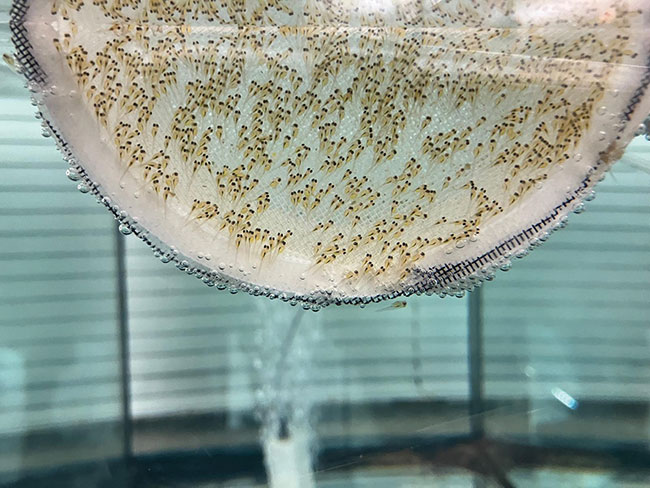
Fish larvae are the basic building blocks of a successful hatchery operation.
Their survival and development into healthy adults is a big asset for hatcheries and, eventually, seafood consumers. Proper development and growth of fish larvae depends on a variety of factors, that can be physiological, or environmental, or a combination of the two.
Think of the larvae as babies: they need time to grow and develop but also require a lot of attention and appropriate environmental factors and feed to grow in good health. Feed is a broad umbrella under which falls a lot of criteria that we need to be mindful of in order to ensure optimal growth of our larvae.
Such criteria include but are not limited to the nutritional composition of the feed, the quality of the ingredients, palatability, particle size, position in the water column (i.e., floating or sinking feed), quantity offered, and feeding frequency. These criteria need to be adjusted to meet the needs of the fish without compounding production expenses.
Feed but don’t confuse
Larvae in their early stages of development are extremely sensitive to feed deprivation.
As soon as they start losing their yolk sac, the larvae become in desperate need of a rich source of nutrients that will meet their need for energy. After all, they’re in a state of rapid growth, and they’re in need of all necessary building blocks to develop properly.
Therefore, it’s always recommended to start weaning the fish early, so that they can get used to exogenous sources of nutrients. Those sources, however, need to match the yolk reserves in a variety of aspects: energy density, nutrient availability, quantity, and accessibility at any time needed.
Accessibility is often confused with overfeeding. Overfeeding larval fish can be detrimental for a variety of reasons. Other than the usual decrease in water quality, offering larvae excess feed results in a confusion effect, which can often be overlooked.
Larvae by instinct are programmed to forage. However, if they constantly find feed dropping within their field of vision, they end up overlooking it while searching for it. That eventually results in them not consuming anything.
All of that increases production expenses, as more labour is needed to feed, and all that feed offered is just wasted. Accordingly, research efforts have been put into finding the perfect balance between feed quantity and feeding rates.
How many meals vs. how big of a ration
Larval digestive physiology has been studied in order to optimize the environmental factors surrounding the fish for better digestion and growth.
Studies have shown that feeding time can differ greatly among species. Some larvae feed the most at sunrise and sunset, while others have the ability to eat at any point during the light cycle.
In general, it seems that larval fish prefer to eat during light time, as a lot of the enzymes are produced and work on digesting feed during the night. Accordingly, hatcheries work on extending the photoperiod in rooms containing larval fish to stimulate fish feeding and indirectly, larval growth. But that doesn’t stop at feeding periods.
Studies showed that offering larval fish feed multiple times a day significantly improves their survival and their specific growth rate.
In a study evaluating feeding frequency of yellow croaker larvae, the authors concluded that the best specific growth rate can be obtained when the larvae are offered feed eight to 12 times a day. Such big number of feedings ensures enough feed is offered to the fish to sustain their growth. Additionally, the increased number of feedings gives the opportunity to almost all the larvae to obtain feed to satiation, which allows for better growth.
If we solve the issue of multiple feedings and increased labour by relying on automatic feeders, we still need to account for feed ration issues. Larvae have the tendency to “gobble up” when feed is offered, especially when offered in big quantities, trying to use all they can as fast as they can. The problem with that is decreased digestion, which eventually compromises their growth.
Feed needs to spend a sufficient time in their digestive tract, allowing for proper mechanical and chemical digestion and later on absorption at the gut level. Depending on the fish species in question, there is no alternative to the traditional hand feeding method. Some fish are continuous eaters, while others prefer to eat at specific times.
Additionally, their requirements for feed will definitely differ with their growth. Therefore, a skilled technician needs to keep an eye out on the larvae, offering them feed to apparent satiation while recording how much feed is being dispensed.
Proper feed quantity records, in tandem with growth over time data, will allow for the formation of feeding tables that help the hatchery operate at maximum efficiency. After a while, the needed feed quantities at the optimal rates will become a part of the hatchery routine.
Feed for thought
There’s no substitute for proper data keeping and feed management. After all, we all would like our fish to grow well, hence maximize our benefits, while minimizing waste and expense.
For that, we need to master the “art” of aquaculture.
When working with fish larvae, we need to keep in mind that they’re no different than babies and their feeding is very sensitive. This sensitivity requires an artistic touch of the technician in charge of feeding that will promote the larvae to feed.
Some species need to be trained on how to feed as their instincts become different when they’re reared in captivity. But with proper feed training for both the fish and the technicians in charge, the hatchery will observe an increased efficiency and a decrease in wastage.
Don’t let your larvae gobble up! Slow and patient feeding in adequate amounts will get them all to grow well and healthily.
References
- Cho, S. H., Lim, Y. S., Lee, J. H., Lee, J. K., Park, S., & Lee, S. M. (2003). Effects of feeding rate and feeding frequency on survival, growth, and body composition of Ayu post‐larvae Plecoglossus altivelis. Journal of the World Aquaculture Society, 34(1), 85-91.
- Papandroulakis, N., Dimitris, P., & Pascal, D. (2002). An automated feeding system for intensive hatcheries. Aquacultural Engineering, 26(1), 13-26.
- Rønnestad, I., Yúfera, M., Ueberschär, B., Ribeiro, L., Sæle, Ø., & Boglione, C. (2013). Feeding behaviour and digestive physiology in larval fish: current knowledge, and gaps and bottlenecks in research. Reviews in Aquaculture, 5, S59-S98.
- Xie, F., Ai, Q., Mai, K., Xu, W., & Ma, H. (2011). The optimal feeding frequency of large yellow croaker (Pseudosciaena crocea, Richardson) larvae. Aquaculture, 311(1-4), 162-167.
Magida Tabbara is a PhD candidate in Aquaculture at Auburn University with an emphasis on aquatic animal nutrition. She has over five years of experience in aquatic nutrition, feed formulations and feed manufacture, in addition to experience in scientific writing, technical writing, and journalism.