Every time a local fisherman reels in a rainbow trout from the waters in Kentucky, they’re reaping the benefits of the essential operation of Wolf Creek National Fish Hatchery.
For 50 years, the Wolf Creek National Fish Hatchery (NFH) has raised and stocked millions of fish for local ecosystems to thrive.
It was first created to mitigate the impact of U.S. Army Corps of Engineers water projects on fish populations. It was constructed from funds by the Department of Interior and Related Agencies Appropriation Act for 1968, and the facility was authorized under the 1934 Fish and Wildlife Coordination Act.
Although Wolf Creek NFH was established in 1975, it began its distribution program with fingerling rainbow trout stockings in 1976. The catchable rainbow trout program started in 1977 when the first lot of fingerlings reached a suitable size. Today, the hatchery raises mostly rainbow trout, several brown trout and brook trout.
How the hatchery works
The hatchery gets its rainbow trout eggs from other federal hatcheries: Erwin NFH in Tennessee, Ennis NFH in Montana, White Sulphur Springs in West Virginia, and Saratoga National Fish Hatchery in Wyoming.
Most of the fish are stocked into federal mitigation waters in Kentucky. James Gray, project leader at Wolf Creek NFH, said if the facility releases fish into state-managed waters, the Kentucky Dept. of Fish and Wildlife Resources reimburses it for those. A total of 125 different waters in the state are stocked with trout from this facility.
The hatchery used to stock about a million fish per year, and in recent years has started stocking 750,000 fish, weighing about 275,000 lbs., after the public said they’d rather have bigger fish than more fish. Just a small number of fish are stocked at four inches, six inches, eight inches, 12 inches and 15 inches. Most fish at this hatchery are stocked at nine or 10 inches and takes about 16-18 months to get a trout from egg to that size.
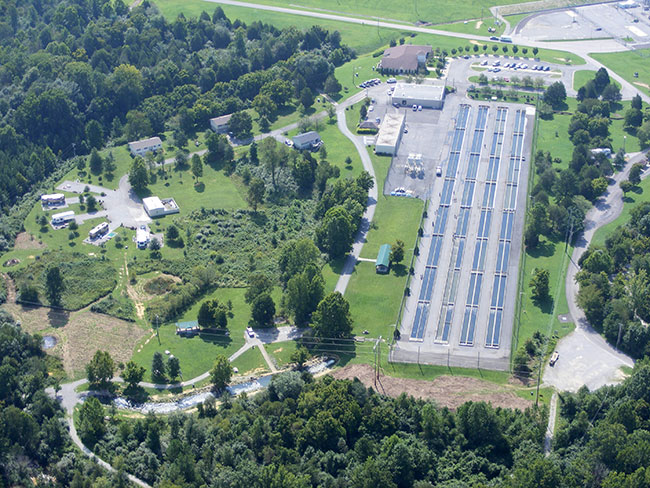
Wolf Creek hatchery uses a flowthrough system in its operation. It has 64 raceways and 20 smaller indoor tanks where it hatches the eggs and raises small fish. The hatchery is on Lake Cumberland, on the Cumberland River. There’s a pipe that comes from the lake, goes through the dam and then comes down to the hatchery.
“All of our water is gravity-fed from the lake, and we utilize it essentially one time … We don’t recirculate any water. It may go through more than one raceway. It may go through three or four raceways, but essentially, the water flows through the hatchery one time and then empties back out into the Cumberland River,” said Gray, who has been at the facility for 31 years.
While it hasn’t gone through any big renovations, over the years, it has gone through some technological changes, improving its water, oxygen, and degassing systems.
Giving back
This hatchery has had an eventful fifty years raising fish. In 2006, an 8,700-square-foot environmental education centre was opened to the public, featuring a classroom and a theatre. Workshops on topics ranging from mushrooms to fly fishing draw around 100,000 visitors each year.
In the same year, three RV sites for volunteers with 50/30A electric, water, sewer, propane, phone, and internet were constructed. This provided the means to build a resident volunteer program. Two additional sites were built in 2007.
For 20 years, Wolf Creek NFH has raised different threatened and endangered species, like freshwater mussels, small-bodied fishes, darters and topminnows, and chubs. The hatchery aalso supplies fish to university students for research projects.
For 37 years, the hatchery also hosts a kids’ fishing event called Catch A Rainbow Kids Fishing Derby where children can catch fish and win prizes. The hatchery also hosts an event for kids with special needs in the area.
“And that’s always a really rewarding event, ‘cause a lot of those kids kind of get overlooked a lot of times. And so we try to help them catch a fish,” Gray said.
The hatchery also organizes a wounded warrior fishing activity for veterans who have suffered injuries related to their service, a fishing derby for seniors in the community, especially those in nursing homes.
At its Outdoor Eco Adventure event, fourth-grade students from the local school district are given mini-lessons on different subjects by partners from federal and state agencies.
“Some of ‘em may talk about water quality and some air quality and some about the soil, and some might talk about recycling. And then we have some talk about fish and wildlife and firefighting,” Gray said.
He said this brings a lot of positive feedback from the school system.
“They really like that because a lot of kids, you can keep their attention for 15 or 20 minutes, and they’ll really listen to you and focus. And so they get 10 different lessons on 10 different subjects, and they soak it all in pretty well,” he added.
Facing challenges head-on
Running this hatchery takes a budget of US$1.3 million yearly. This money comes from a variety of sources, including the U.S. Fish and Wildlife Service, the Corps engineers, and the Kentucky Dept. of Fish and Wildlife Resources.
“We really can’t speak to what our budget levels will look like in the future. Of course, our budgets are allocated by Congress, and so we are just in a period of reorganization,” said Lanier Clegg, public affairs specialist at the U.S. Fish and Wildlife Service.
Gray said that with the changes the U.S. federal government is going through right now, the hatchery has lost a couple of staff members due to early retirements.
“Obviously, when you lose staff, that impacts what you can do… and we’ve been really fortunate over the last few years, we’ve been pretty well staffed and had adequate budgets,” Gray said. “There’s also a hiring freeze… So the tricky part is we’re not able to replace those people right now. So that’s the one thing, but that’s not just us, that’s across the whole government.”
Volunteers
This hatchery boasts a robust volunteer program with more than 12,000 hours of volunteer service yearly. From high school students to college students who need an internship, these volunteers can keep the hatchery afloat.
Gray remains hopeful. He doesn’t see a lot changing in the next decade. “Just hopefully we could maintain our staffing levels that we are at now and the budgets to support that, or programs that we have in place,” he concluded.