In the heart of Northern Uganda, where lush wetlands meet the sunbaked soil of Lira City, a quiet revolution in aquaculture is taking shape.
At Dewilos Fish Farm, a five-acre hub of innovation and determination, Fiona Achayo Birungi and her husband, Felix Edie Owilo, are building what is set to become the region’s largest fish hatchery, an ambitious facility with the capacity to produce over 800,000 fingerlings annually. But this isn’t merely a story about numbers. It is a testament to vision, resilience, and a bold reimagining of how Africa can sustainably feed itself while cultivating prosperity below the water’s surface.
Located in Arecho Cell, Amuca Ward, Lira West division, Lira city, Achayo describes her daily routine as a mix of hatchery management, pond maintenance, water quality monitoring, and feeding. She emphasizes the importance of efficiency guided by a detailed daily work plan and supported by a dedicated, skilled workforce.
Since its founding in 2019, Dewilos has evolved from a handful of modest ponds into a model enterprise, integrating fish farming with piggery, poultry, and organic innovations.
Lessons from the Netherlands
Armed with insights from a government-sponsored training trip to the Netherlands and honoured as Uganda’s Best Farmer of 2023, Achayo is championing climate-smart practices and youth employment in a region long overlooked and shattered by war and insecurities but full of potential.
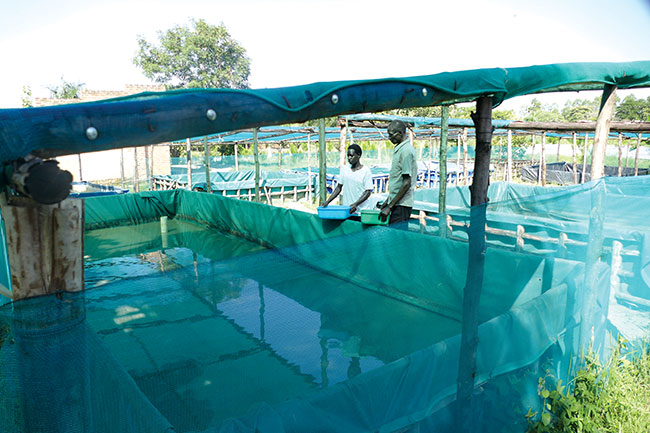
“The trip to the Netherlands was my turning point as a fish farmer,” she says. “I learned about innovative pond designs, like concrete ponds, efficient water recycling systems, sustainable feeding, and even modern packaging methods. Today, we have five concrete ponds, and we have introduced low-cost tarpaulin ponds made from wood and tarpaulin ideal for smallholder farmers.”
The farm now boasts 22 earthen ponds, 11 tarpaulin ponds, and five concrete ponds. Dewilos also cultivates azolla, a nutrient-rich aquatic plant, and raises black soldier fly (BSF) larvae, producing up to 100 kilograms daily to feed their fish and poultry alongside a growing piggery project. The farm mainly produces Nile tilapia and catfish.
“These innovations have significantly improved productivity and sustainability,” Achayo adds. “Tarpaulin ponds are not only affordable but offer better water quality control. Organic feeds like Azolla and BSF promote faster, healthier fish growth.”
Tackling climate change head on
Northern Uganda, with its semi-arid climate, faces unpredictable weather, high temperatures, erratic rainfall, and prolonged dry spells. Achayo says climate change has deeply impacted local fish farming.
“We have seen extreme rainfall that floods ponds during the wet season, and in the dry season, ponds can dry up completely,” she explains. “This requires backup water supplies and often increases operational costs.”
To build resilience, Dewilos has implemented climate-adaptive practices including pond bunkers lined with lime and solid-filled sacks, tree planting to combat erosion, and a water pumping system to transfer water between ponds. Two reservoir ponds have also been constructed to ensure water availability year-round.
Tackling climate change has not stopped inside and around the farm; the company has made further steps to educate and support local farmers in understanding the link between climate change and aquaculture, and adapting their own practices accordingly. It provides farm training and education using the media on climate-smart aquaculture practices. It has again helped to build a water recycling system for small-scale farmers, empowering them to adapt to climate change.
“We have given our neighbours each 20 trees to plant in their neighbourhood to ensure that even the environment around us is protected to overcome the effects of climate change,” she says.
With the region’s growing concerns of sustainable water use and conservation, Achayo implemented efficient water management systems to minimize waste and ensure sustainable use of water by building two reservoir ponds to collect and distribute water to the other ponds.
Lending a hand
To ensure accessibility for smallholder fish farmers, Dewilos has embarked on establishing distribution points across the region, making it easier for smallholder farmers to access fingerlings.
The company also offers competitive pricing for fingerlings, making them affordable for smallholder farmers, and provides training and support to smallholder farmers on best practices in fish farming including handling and care of fingerlings.
“We have partnerships and collaboration with local organizations, cooperatives, and extension services to reach more smallholder farmers and provide necessary support. We also regularly monitor and evaluate the quality of fingerlings and the satisfaction of smallholder farmers to identify areas for improvement,” explains Achayo.
With steady growth and increasing production capacity, Dewilos is poised for expansion across the East African region.
“We now have the infrastructure to scale up. While our primary market remains Uganda, especially Northern Uganda, we are exploring export opportunities to Kenya, South Sudan, and the Democratic Republic of Congo,” says Achayo.
“Our long-term vision is to become a leading aquaculture player in East Africa, known for quality fingerlings and sustainable practices. We are laying the groundwork, strengthening our logistics, distribution networks, and meeting regulatory standards for exports.”
Currently, Dewilos is the chief supplier of fish to the districts of Gulu, Oyam, Amuria, Kwania, Omoro, Lira, Kole, Dokolo among others.
Learning from Africa’s best
Dewilos draws inspiration from successful hatcheries across the continent.
“We have studied aquaculture models from Kenya, Nigeria, and Egypt,” says Achayo. “Kenya’s disease-resistant fingerling programs and hatchery systems are impressive. Nigeria’s success lies in innovative feed production and strong public-private partnerships. From Egypt, we have learned about water optimization and the importance of research and development.”
By applying these insights, Dewilos is building sustainable production systems, improving fingerling quality, and nurturing collaborations with local farmers, researchers, and private sector players.
Felix Eddie Owilo, who co-owns the farm with wife Achayo, adds that Dewilos is quickly becoming a leader in aquaculture innovation across Northern Uganda.
“One of the biggest challenges in fish farming is the cost and availability of quality feed,” he notes. “We have tackled that by growing our own azolla and BSF larvae. It has allowed us to produce healthier fish more affordably. The production of BSF reduces the costs of buying maize bran and the fillets. You produce your own BSF, you have your own azolla and your expenses on feeding are reduced,” explains Owilo.
Dewilos is also pioneering broodstock crossbreeding to enhance genetic quality and growth rates. The farm is now capable is able to raise tilapia weighing around 800g to 2kg after nine months and catfish from 1.5-2kg after six months.
To achieve consistent, high-quality fingerling production, Dewilos is investing in rigorous hatchery management practices.
“We carefully select broodstock for disease resistance and genetic diversity,” Owilo explains. “We grow them for one to two years before breeding. We monitor water quality and follow standard operating procedures for spawning, larval rearing, and fingerling production.”
These systems ensure that Dewilos delivers fingerlings that are both healthy and reliable for farmers across the region.
Looking ahead
From humble beginnings in 2019 to becoming the largest fish and fingerling supplier in Northern Uganda, the journey has not been easy.
“We faced major hurdles,” Owilo recalls. “Lack of skilled personnel, high operational costs, and limited access to affordable quality feed were major challenges. Initially, we funded the farm from our salaries and small loans.”
Importing feed remains expensive, and the technology to produce it locally is still limited, especially for fish fry. By growing azolla and BSF, the farm has significantly cut costs without compromising quality.
Owilo explains that the company plans for partnerships with other hatcheries in East Africa and beyond in the areas of collaborative research and development, sharing expertise and technology, coordinated production and distribution, and trade agreements to facilitate cross-border transactions.
“I see significant potential for cross-border partnerships and regional value chains in aquaculture. The East African region, in particular, presents opportunities for collaboration and mutual benefit. For example, partnering with hatcheries or fish farms in neighboring countries could enable the exchange of genetic materials, best practices, and technology,” he says.
“Regional value chains could also enhance market access, enabling hatcheries like Dewilos to supply fingerlings or fish products to a broader customer base. This could lead to economies of scale, improved quality, and increased competitiveness.”
He stresses that by working together with other countries in the region, Dewilos and other hatcheries can take advantage of new opportunities, grow their business together, create and improve market stability, create jobs for the local community, and increase food supply.
Owilo calls for harmonization of fish hatchery standards and regulations across African countries in order to ensure quality fingerling production and trade. He says this is crucial for ensuring quality because it can facilitate regional collaboration, improve quality control, and promote sustainable aquaculture practices.
“Our dream is to become Northern Uganda’s largest fish farm,” Owilo concludes. “We want to raise awareness about aquaculture, ensure food security, and boost the region’s economy. We aim to expand operations, become the most reliable fingerling source, maintain consistent fish production, create more jobs, and promote sustainable practices.”
As Africa embraces the promise of the blue economy, Dewilos Fish Farm may well be the blueprint the continent needs where innovation, resilience, and sustainability converge to feed a future from beneath the water’s surface.
Correction: This article, originally published in the September/October 2025 issue, indicated that Dewilos Fish Farm was able to harvest Nile tilapia weighing up to two kilograms and catfish averaging three kilograms within a six-month cycle. The farm is able to raise tilapia weighing 800g to 2kg after nine months and catfish 1.5-2kg after six months. Hatchery International regrets its error.