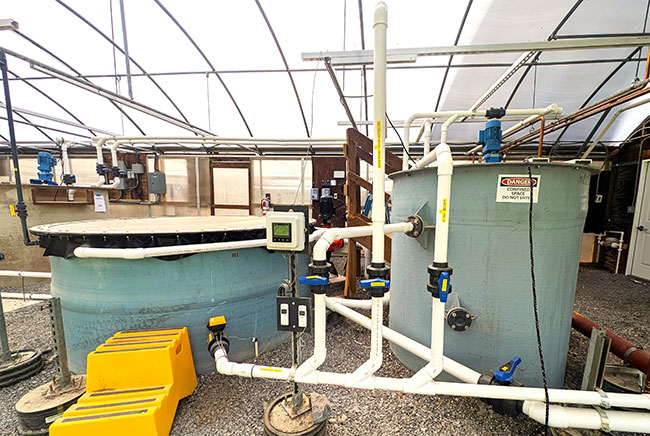
In addition to benefits such as more intensive production, highly controlled environments, enhanced biosecurity, and efficient water reuse, recirculating aquaculture systems (RAS) is also highly effective at rapid waste removal, capture, and concentration. The collection of these wastes unlocks the potential for farmers to utilize the biosolids for alternative revenue streams, from aquaponics to anaerobic digestion.
Utilizing biosolids can increase revenue and reduce environmental impacts for RAS farms. The carbon and nutrients in the raw sludge can be upcycled into valuable products, potentially lowering the disposal cost for farmers.
Anaerobic digestion (AD) recovers energy (via biogas production) from the waste and produces a liquid fertilizer rich in dissolved nitrogen and phosphorus. However, the feed composition and digestibility dictate RAS waste characteristics, such as the ratio of carbohydrates, proteins, and fats (Letelier Gordo et al., 2020). These characteristics also affect the AD process and may enhance or inhibit the quantity of methane in the biogas, determining its energy content.
A recent study, conducted at The Conservation Fund’s Freshwater Institute, quantified these differences and highlighted the impacts on the energy recovery potential. The study examined sludge (FA from Diet A and FB from Diet B) produced from two Atlantic salmon diets. Both diets were similar and contained a minimum of 24 per cent crude fat and 45 per cent crude protein; however, the source of ingredients in each diet varied.
The sludges used in this study were collected from the bottom drain of a radial flow settler linked to a 150 sq. m. growout tank. They were characterized for total solids, volatile solids, chemical oxygen demand, total Kjeldahl nitrogen, total ammonia nitrogen, total phosphorus, volatile fatty acids, crude fat, crude protein, pH, and trace metals (Ca, Mg, K, Na, Fe, Mn, Zn, Cu). This detailed waste analysis was necessary to help correlate the variations in methane production to the waste characteristics. The two sludges were then anaerobically digested using biochemical methane potential (BMP) protocols to evaluate the differences in the volume of methane produced.
Despite a similar concentration of crude fat in the feed, substantial differences in its concentration were observed in the waste. Sludge FB had a higher crude fat content than FA (27.4 per cent versus 12.2 per cent of the sludge dry matter, respectively). However, both sludges’ dry matter content (9-9.3 per cent) and crude protein concentration (32-33.5 per cent of the sludge dry matter) were similar. This observation indicated that the digestibility of the fats in both feeds may have been different, with more fat being excreted from diet FB than FA.
The amount of fat in FB was crucial because of how fats impact methane production. Typically, fats contain more energy than carbohydrates and proteins and have the potential to enhance methane production significantly.
The methane production data reflected the effect of the higher fat content of FB. Sludge FB performed better in the BMP tests, with a methane yield of 346 ± 5 mL CH4/g VS, 24 per cent higher than FA (279 ± 4 mL CH4/g VS) (Figure 2). The methane concentration in the biogas also exceeded 70 per cent, which is typical when fat-rich organic waste is subjected to AD.
While the overall methane production was higher for FB, its production rate during the first half of the study was higher for FA. The FA sludge contained more organic acids, which are easily consumed by microorganisms commonly present in an AD system. Additionally, fats also take longer to break down, accounting for the lower initial rate of methane production from FB.
For those interested in exploring an AD system for their farm, another critical factor to consider is the use of the effluent (digestate) produced during the AD process. Digestate is generally more stable than raw sludge and contains high concentrations of dissolved nutrients, potentially making it a good fertilizer. However, fish feed is often fortified with zinc for fish health, with a large fraction ending up in the waste sludge.
As the waste sludge is condensed into digestate, zinc concentrations or those of other heavy metals may exceed safe levels for land application, depending on local regulations. The heavy metal issue is exacerbated, especially when the sludge is dried, as it concentrates the heavy metals, often exceeding local limits, especially for zinc (Brod et al., 2017). Co-digesting RAS sludge with other substrates with low heavy metal content may alleviate these issues.
In conclusion, the macronutrient concentrations in the fish feed may not be as impactful as the origin of the ingredients in determining impacts on end-of-pipe treatment processes like AD. As such, it is essential to characterize the waste sludge if diet changes occur to prevent inhibitory effects on waste treatment processes. The Freshwater Institute will continue this research at pilot-scale to further increase the viability of energy recovery from RAS sludge.
References
- Letelier-Gordo, C. O., Mancini, E., Pedersen, P. B., Angelidaki, I., & Fotidis, I. A. (2020). Saline fish wastewater in biogas plants-biomethanation toxicity and safe use. Journal of Environmental Management, 275, 111233.
- Brod, E., Oppen, J., Kristoffersen, A. Ø., Haraldsen, T. K., & Krogstad, T. (2017). Drying or anaerobic digestion of fish sludge: Nitrogen fertilisation effects and logistics. Ambio, 46(8), 852-864.
Abhinav Choudhury is the environmental research engineer at The Conservation Fund’s Freshwater Institute in Shepherdstown, W. Va., USA.