The old adage, “If it ain’t broke, don’t fix it,” certainly applies to manufacturing.
Legacy systems, including older PLCs (Programmable Logic Controllers), SCADA (Supervisory Control and Data Acquisition) systems, and non-networked machinery have long been the backbone of industrial operations. However, as manufacturing continues to evolve, and as companies see the benefits of leveraging data, legacy systems start to show their shortcomings.
“These legacy systems have been in place forever and typically, they were meant to be closed systems,” says Tyler Burke, product manager of industry management and automation with Phoenix Contact Canada. “Now, because of digitization, people are slowly accepting the idea that we can pull more data out and then use that data to make better decisions.”
In a perfect world, “pulling data” out of legacy systems would be as simple as plugging them in and flipping a switch. In the real world, the process is much more complicated.
“You can’t simply connect it to your IT [Information Technology] system,” says Burke. “You need a level of security and all the protocols in place. So in general, you need to isolate your control system from everything else, and then you need to have a device that can talk to the control system and relay it to higher-level systems.”
Even if you could connect legacy systems directly to the Internet, Burke says it would not be advisable to do so. “Despite the fact that PLCs today have a lot more security and more functions, it’s still not a good idea to connect them directly to the Internet. You need a middleman,” he says.’’
This middleman is where edge computing comes into play. “It makes a lot of sense because it helps you shore up your security gaps,” Burke says. “So when you have legacy systems that were never meant to be connected, with edge computing, you can do so without exposing yourself to cybersecurity risks.”
When it comes to cybersecurity, Burke says that IT should be your first line of defence. The problem, however, is that some try to make a direct connection, wherein they essentially run a single cable from their machine to their IT system. “The problem here is that anytime you have an outage, you have to call IT, and IT prioritizes security over everything else, whereas with operations, we prioritize availability. We just want to make sure the system is still running.”
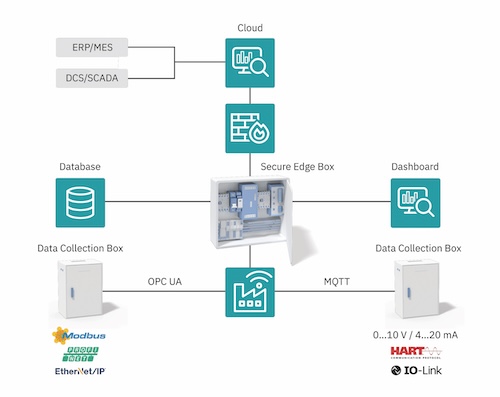
So rather than make this direct connection, with edge computing you have an edge device sitting between two firewalls – an IT firewall and an OT firewall. “So, an edge device is essentially a data aggregator or data concentrator that takes all the data from the machine level, and feeds it up into the IT level,” Burke says.
The result is a system with three network levels: machine, edge and the cloud. However, the machine never talks to the cloud, and IT never talks directly to the machine. Instead, the machine talks to the edge device, and the edge device sends data up the chain.
Cost savings
While edge computing is a must for cybersecurity reasons, it can also help an organization save money in the long run. “Your network is a triangle,” says Burke. “You’re always trying to push data from lots of individual devices up to some higher level, and then you hit the Internet, which then goes out to the world. While you could have devices, like PLCs, that directly push data into a cloud system, doing so would be very expensive.”
Burke explains that when it comes to the cloud, your cost is based on how many tags you have. So in this case, an edge computing device acts as a data concentrator, which helps reduce the number of tags, and in turn, the cost.
“You can basically use similar tags to make a decision,” Burke says. “So if the health of 10 machines is good, maybe you’re just sending one tag saying ‘Health is all good.’ And now you’re only paying for one tag instead of 10. This means you’ll want to make some local decisions, because every time you push data into a cloud server, you’re going to be paying some type of service fee. So, if you can limit how much you’re doing, that would save you a lot of money.”
Burke says that there’s another compelling reason to invest in edge computing: network latency. “Let’s say you have 10 machines with numerous sensors collecting data,” he says. “You might have to push large volumes of data up, and if you’re doing that constantly, your IT department is not going to be very happy with you, because there are a lot of connections that they don’t have control over.”
The flow of this data becomes much more manageable with an edge device as the middleman.
“When you have an edge device,” Burke says, “you can collect the data in a local database and then push that data up to the cloud. So you’re going to have a local copy of the data, with the added benefit that if your internet connection were to ever go down, the edge device would still have all your data stored locally.”
Compelling reasons to upgrade
Upgrading legacy systems so that they can collect and share data doesn’t have to be expensive, and it doesn’t have to take place in one big jump. It can be done on a step-by-step basis, Burke explains. Before you can upgrade, however, you’ll need to identify the reasons why you want to do so, and how edge and cloud computing will benefit your facility. Once you understand your goals, you’ll be better able to decide which machines should be connected first.
Burke says that his customers typically want to start by improving or controlling one of four major areas of concern. The first is energy efficiency. By automating when certain machines are powered up or powered down within a manufacturing facility, you can cut energy costs. If you don’t need your equipment running 24/7, then it makes sense to plan accordingly and power up only when you have to.
Another compelling reason to upgrade is remote monitoring of machine cycles. If you know how many times a particular piece of equipment usually runs before it typically breaks down or needs maintenance, you can harness that data and preemptively schedule maintenance right before it’s needed, thus limiting downtime.
Custom manufacturing is the third compelling reason to upgrade. “We’re getting into this day and age where people want things customized for different purposes,” says Burke. “For example, we just had a customer who needed a cable in a very specific length. So the more data you have, the more control you have, which means you can change a set point on a machine dynamically, and then have it revert afterwards.”
Finally, there’s smart networking. “Although our networks are getting bigger and bigger, we want to make sure things are automated so that we don’t have to constantly manage everything,” says Burke. “You don’t want to double the amount of data that’s coming out of your machines and then have to hire more people to support it. The goal is to use data to make better decisions while limiting the need for a person to have to constantly monitor and interact with that data.”
Despite their longevity and reliability, legacy systems have their inherent shortcomings. Properly implemented, edge devices and cloud computing can benefit manufacturers in many ways, bringing older equipment into the modern manufacturing world.