You can’t stop an extreme heat wave as it slams into your region, but you might be able to reduce the harm to your potato crop.
That’s the idea behind an Agriculture and Agri-Food Canada (AAFC) project to develop tools to help Alberta potato growers minimize heat stress impacts on tuber yields and quality.
Heat stress is a concern among global potato growers, and although it is not a constant source of pain for growers in Alberta, that doesn’t mean growers should not be aware of strategies, especially if warming trends persist.
Temperature has been cited by some as the single-most crucial uncontrollable factor when it comes to both the growth and yield of potatoes. Temperature plays a critical role in all stages of potato development, but the most critical stages for temperature have been identified as tuber initiation and bulking. The growth stage at which heat stress occurs can have implications not only on the potato’s overall development but also on the cultivar’s response to high temperatures.
For example, some research shows effects are more pronounced early stages of tuber formation (which can prompt drastic tuber yield reductions, according to 2013 research from Serock, Poland) than in later stages, which can lead to quality deterioration (as found in 2017 research from South Korea).
While developing heat-resistant varieties is also a major focus for researchers and breeders around the world, helping all potatoes stand up to the heat through management strategies is the key goal of this new AAFC project.
Jonathan Neilson, a research scientist with AAFC-Lethbridge, says although heat stress is not an annual issue for Alberta potato production, it is a recurring problem.
“Some years, we have really stressful heat conditions, and then other years we go into a cooler, wetter cycle. There have been a few heat dome events in recent years, with prolonged periods of around 35°C and sometimes even reaching 40°C,” says Nielson, who is leading the project.
So, while heat stress is not a constant source of problems on an annual basis, from a sustainability perspective, it’s something Alberta potato growers nevertheless must deal with.
Growers must learn to address the impacts on yields and quality – especially crucial if such head events become more frequent in the future, which many argue is a distinct possibility. The good news is, there appear to be strategies.
Heat stress basics
The impacts of heat events on potato crops depend on such factors as the potato variety, the crop growth stage when the event occurs, and the event’s duration and intensity.
Neilson notes that the optimal temperature for tuber production depends on a few factors like the potato variety, but it is usually somewhere in the range of 15 to 20°C.
Above 20°C, the tuber growth rate tends to decline. Once the temperature climbs even higher, results can be even more stark.
“Once the temperature gets over about 30°C, overall growth stops. And when temperatures oscillate between going over and then under that maximum temperature, you have photosynthesis and plant growth stopping and starting.”
How heat stress manifests in tubers
That stopping-and-starting can affect overall tuber yields – the tonnage, the average tuber size, and so on. It can also affect tuber quality, causing various types of deformities and other problems.
“For example, you can get heat runners after a pause in tuber development. That’s where [instead of resuming an increase in tuber size when growth restarts], the tuber starts producing knobs because the eyes break dormancy and start growing out,” he says.
“Another possibility is secondary tuber sets. The plant sets the first set of tubers and then gets stressed out. But when growth restarts, instead of continuing to grow the first set, it will start producing a second set.
“As a result, you get tubers of different physiological age going into storage, so you get differences in the size profile.”
This means, for instance, you might get a mix of a lot of big tubers with a lot of small tubers.
“That is obviously not ideal because you want all your tubers to be within a certain size range that meets your contract.”
Another key impact of heat stress is the effect on fry colour. “If the tubers are immature or physiologically stressed, the sugar dynamics can change,” says Neilson.
That can result in a dark colour when the potatoes are fried, for a lower quality end-product – especially bad news for Alberta’s wildly successful processing sector.
“You can get overall dark French fries or dark chips. But you can also get different patterns; a more common one is sugar end, where the french fry is very dark at one end and light at the other.”
A suite of stress-related studies
Neilson’s heat stress project is one of a collection of weather-stress-related potato projects in his research program.
“Our goal is to develop the tools and methodologies to find stress-related problems, recommend a solution, and verify that the solution is actually working,” he continues. “Then once we’ve got all of those pieces in place, we want to give that to growers and have them use it,” he says.
So, one overall program objective is to develop methods to rapidly assess large amounts of field data to identify weather-stress problems in crops.
The idea is to be able to get the relevant stress information to growers in a timely enough manner so growers have an opportunity to deal with the stress problem in their fields before it becomes irreversible.
And the other key program objective is to work with methods shown to reduce stress impacts in a greenhouse, a laboratory, a different growing region or a different agricultural system, and adapt those methods for real-world potato production under Alberta conditions.
Neilson’s heat stress project is funded by the Potato Growers of Alberta (PGA).
He is also leading a nearly completed hail stress project, which received funding from Results Driven Agriculture Research and in-kind support from the PGA.
Additionally, Nielson has some AAFC-funded projects looking at how field operations can be managed to reduce general weather/climate stress in potatoes.
His program is designed to have these individual projects build on each other, with tools, methods, equipment and learnings from one project being applied to the other projects.
Addressing heat stress
The heat stress project’s first full field season was in 2024, and it will run for two more years. The field work is taking place at AAFC’s Vauxhall Research Farm.
The experimental setup includes methods to ensure high temperatures in the plots. For instance, Neilson and his research group are using greenhouse tunnels to simulate short-term heat stress.
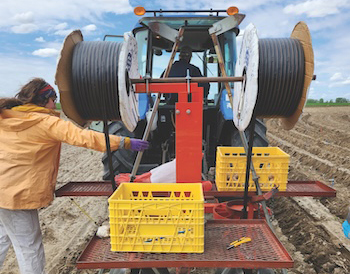
The team is also planting drip lines along with the potatoes so they can circulate water that has been heated to different temperatures, in turn increasing the root zone temperature. After, the team is planning to use these lines to apply the products that they are testing to see if root zone placement boosts product effectiveness.
In the trials, they are measuring yields, temperatures and many other factors.
These data collection activities include flying drones over the plots weekly to take spectral measurements (measurements of different wavelengths of light to assess things like the crop and soil conditions), as well as taking spectral and physical measurements on the ground.
The goal of the project is to evaluate some commercially available products that are shown to help with heat stress impacts in other parts of the world or other agricultural systems.
“We’re trying to work out the technicalities of making them work for Alberta growers, given the differences in our growing systems [from the rest of the world],” says Nielson.
By focusing on addressing some of the technical barriers for growers when it comes to adoptiong a product, their efficacies can be better understood in the context of Alberta.
Key barriers and questions include: “When do you apply it [the product]? How is it applied [spraying versus fertigation]? How much do you apply? Do you apply it once or multiple times?”
And that work also leads back to an important research question for Neilson: How are the products or practices altering the physiology of the potato plant to make the production system more resilient to the stresses it is experiencing?
Evaluating products and methods
Two products the team is currently testing are glycine betaine and algal extract. Glycine betaine is naturally produced in some plants, but it can also be commercially manufactured; Neilson’s group is testing the commercial, purified form. The algal extract product that they are testing contains glycine betaine as well as some other compounds shown to help with plant stress.
Neilson and his group are also looking at the effects of applying calcium as a soil additive to reduce heat stress impacts in potatoes. “Calcium is a really important chemical for every biological organism. It plays a lot of roles in keeping cells active and dividing,” he notes. “Mostly in controlled settings, calcium applications have been shown to help plants maintain metabolism under stressful conditions, for instance, by allowing the plants to keep growing leaves and keep photosynthesis going.”
Another component of the project’s field trials builds on an earlier project led by Neilson about the use of cover cropping and/or intercropping in potato production for building soil organic carbon.
He explains, “We know soil organic carbon is a big contributor towards soil health, and better soil health tends to improve stress resistance in plants. But exactly how that works is what we’re looking at.”
In that earlier project, Neilson and his group observed a decrease in canopy temperature and soil temperature in the potato plots that had cover crops or intercrops.
Now, in the heat stress project, they are digging a little deeper into the cooling effects of these practices.
They hope to answer such questions as:
- Do the specific placements of the potato crop and the other crops matter to the temperature effects?;
- Are the temperature effects significant enough to make the practices worth doing?; and
- Is the cover crop or intercrop competing against or working with the potato crop?
Hail stress: initial findings
A master’s student in Neilson’s group is currently analyzing the data from the aforementioned hail stress project. One of the main outcomes so far from the nearly completed project is that the amount of impact from hail stress depends not only on the hail’s intensity but also on the timing of the hail event.
“When the potato plants are hit by hail in the bulking period, which is late July to August in Alberta, they tend to suffer a more negative impact than if the plants are hit later or earlier in the season,” says Neilson.
“That makes sense because if the hail hits later in the season, then the crop is already grown so there’s not as much yield impact, although we’re still delving into the quality issues.
“And if the hail hits before tuber set, then the plant has a chance to regenerate; it will be delayed by a couple of weeks, but it will still be able to complete tuber set.”
Another main finding relates to the effects of glycine betaine and algal extract in helping plants to recover from hail stress.
“We found that if we apply glycine betaine or algal extract products, and we have a hailstorm in the early bulk period when the plants are particularly susceptible, then the crop is able to recover back to close to what it would have been without hail damage,”
notes Nielson.
“Since these two products promote cell division and cell growth, we suspect that their application is allowing the plant to resume growth more quickly after a stress event.”
Tools for growers
Neilson is also looking into how to deliver timely, relevant, easy-to use, stress-related information to Alberta potato growers.
“Currently, we can really well describe a potato crop, so we can tell you two weeks later what the crop looked like two weeks ago. But we want to be able to say within 24 hours, ‘Here is what we’re seeing,’ and maybe provide a risk assessment that says, ‘You’re at risk of this problem, and here are some potential things that you can try to address the problem.’”
Neilson and his group are already working on a tool for hail stress. They have pulled together published data from past studies by other researchers and used it to build a preliminary model. The model would, for example, allow growers to enter their own data about a recent hail event, such as the event’s timing, amount of hail damage, and so on. Then the model would estimate the expected decline in the marketable yield based on the available data.
Right now, the model is using data from other places and many years ago. However, the idea is that Alberta growers could add their own current and historical data to the model’s dataset, so the model could be trained for an Alberta context.
Neilson has also started talking with the PGA about considerations like what type of information would be most useful to growers and how would growers like to receive that information. He expects this effort will involve talking with many individual growers, processors and others about their information needs and preferences.
Ultimately, Neilson would like to be able to give growers tools to not only identify weather-stress problems in their own potato fields but also tools to evaluate the effects of different products on reducing weather-stress impacts.
That, he says, would allow growers to make timely, cost-effective management decisions based on their own specific situation.
“In my view, my role as a government scientist is not necessarily to tell growers something like ‘This is the best way to grow potatoes’ because every field is different and every potato operation is different, with its own particular production system, equipment, and so on,” he says.
“We can’t be in the business of testing every product on the market because there are many, many products and new ones are coming out every year,” says Nelson.
“Providing growers with the tools to make the evaluations themselves is where I think we’ll have the biggest impact.”