For potato growers across Canada – but especially in P.E.I. – the most dreaded four-letter word is “wart.”
Potato wart, a soil-borne fungus that causes warty growths on potatoes, can have a major financial impact on growers – not only because it renders potatoes unmarketable, but also by limiting the use of affected fields. No province knows this better than Prince Edward Island, where several discoveries of potato wart in the early 2020s led to limits on exports.
As such, tackling potato wart is a major priority for the whole country – and a team effort. Research on multiple fronts – not only agronomy but also on genomics and even data science – is required to help develop potato wart strategies. For example, Agriculture and Agri-Food Canada’s David De Koeyer is working the breeding angle, hoping to develop potato varieties resistant to potato wart with his team at AAFC’s Fredericton Research and Development Centre.
That research is being complemented by a small team in St. John’s, where a team is testing the potentially resistant varieties developed by De Koeyer. They’re also testing new fungicides and biologicals for their control efforts.
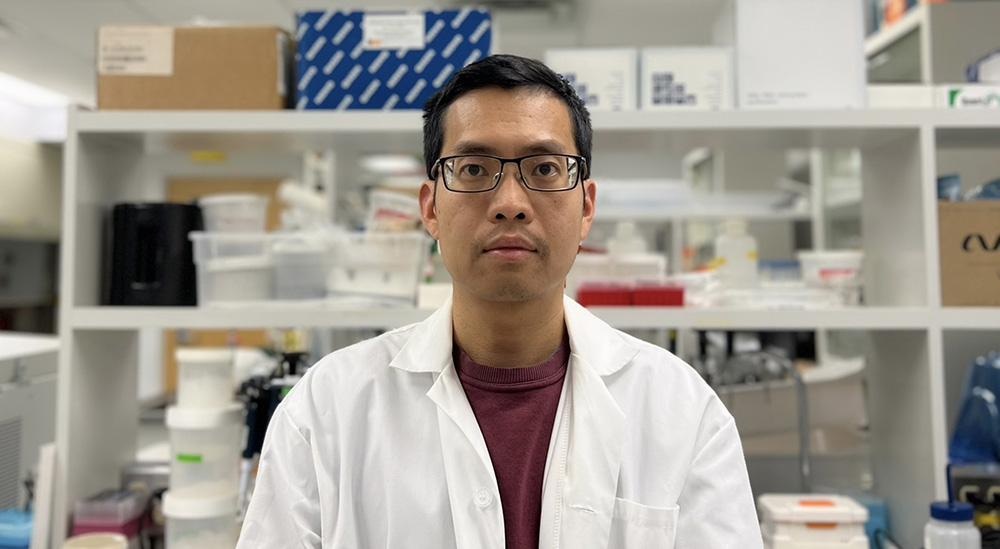
Several provinces west in Ottawa, Dr. Hai Nguyen is working a different angle – studying the potato wart genome to develop better tools to detect the more-than-40 different types (pathotypes) of potato wart in a potato.
Nguyen’s work is proof that not all of the most important research for potatoes is done in the field – Nguyen’s lab work involves a lot of analysis on computers. But it’s crucial, he says – and quite cool.
The fungus is an especially complex being, says Nguyen. “Is an obligate pathogen – it really needs the potato to propagate and complete its life cycle. If a compatible host wasn’t there, then over time, the spores will eventually lose viability and just die off. It needs a host to propagate, and potato is one of those hosts.” He says “one of the hosts” because the fungus itself can affect several different plants including tomatoes, but it does not produce the same symptoms as seen on tubers.
It can also reproduce either asexually or sexually – and that makes its genetics especially unique and challenging. The many different pathotypes are almost like different races. “It’s like having European descendants or Asian descendants.” You can’t tell them apart visually, he says, but you would use the spores to infect different varieties of potatoes. “If they are able to infect, depending on the level of infection, you could score it, and you would get different reactions – a certain pattern, basically,” he explains. That particular pattern will match to a different pathotype, which is how technicians and researchers can identify the type of fungus. “Once you have enough data, you can sequence its DNA, and you could know what its pathotype is without doing that intensive work of infecting a bunch of hosts and waiting to score it.”
The cliché goes that knowing is half the battle – and this applies to Nguyen’s side of the research. “If you get a quick scan of what [the fungus’s] race is, the you could potentially know, ‘Well, I know that this race is what I have in my field around me, so perhaps I can grow varieties that are more resistant.’”
That’s just one of the strategies, he says. And he acknowledges that the main goal when it comes to potato wart – which is prevention, not treatment – isn’t entirely met with his work. But it’s all part of a bigger picture, he says, and much like a virus needs a host, you can’t have one without the other. “Studying the genetics of the fungus is not going to directly lead to [preventative] solutions, but it is complementary to the research on the potato host resistance side. The infection needs to have both sides. It needs to have the pathogen side, and something in the host that makes it [either] susceptible or resistant. So you can’t just study the host.”
He receives DNA from his Atlantic colleagues, which is sequenced in the lab and presented like a text file – a “very long” text file that wouldn’t be especially clear to a layperson, but for data scientists or geneticists, it’s music to their ears.
AAFC is moving increasingly toward finding solutions – whether that’s applications of soil amendments, safe and approved chemicals or even combinations, “not just to suppress but to eliminate it.” The fungus can even be suppressed with some other viruses and microbes. The various different approaches are crucial, and Nguyen says the genetics approach is a small piece of a very important puzzle – but he wants growers and civilians to understand how important it is.
“The study of potato wart genetics is not something that people often think about, but genetics give you a big advantage,” he says. “You might know its potential weaknesses – maybe something about its life cycle, maybe it needs a certain enzyme or a certain nutrient in order to facilitate its growth.”