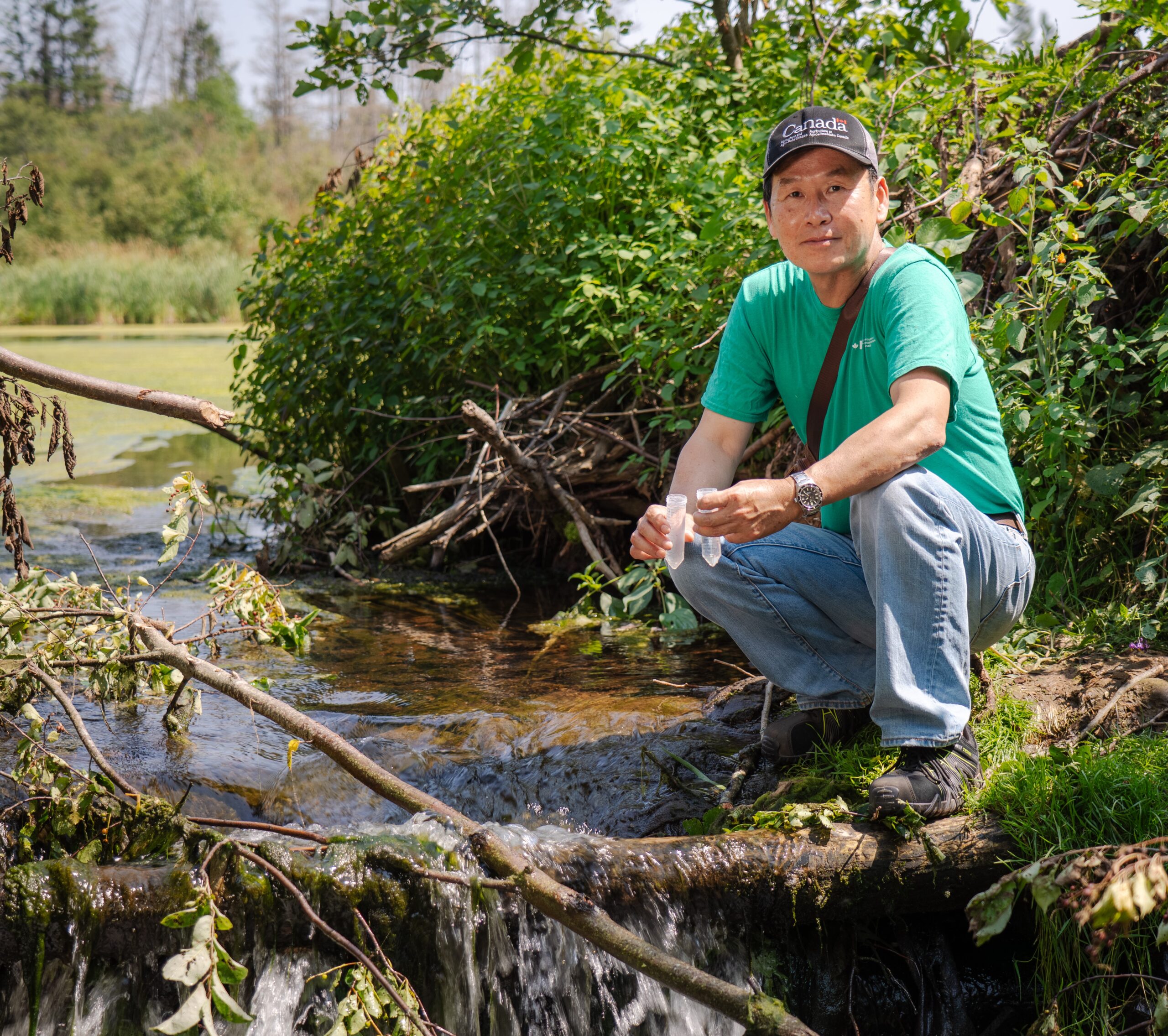
It’s likely no longer controversial or novel to say that farming practices have an impact on water quality. How much, and how direct that impact is, can vary by practice, location and many other factors. For P.E.I., which is surrounded by ocean and thus is made up of sandier soils, farming practices can have a direct impact on the water quality of the limited freshwater streams and rivers that feed into brackish estuaries and eventually the ocean.
Progressive farmers already have plenty of practices to choose from to help mitigate effects on soil and water, and research continues on proactive practices. Now, AAFC research scientist Dr. Yefang Jiang, based at the Charlottetown Research and Development Centre, has added another new layer of understanding to in-field BMPs to reduce nitrogen from entering groundwater and also improving surface water quality in local water bodies.
“[Nutrient leaching] does contribute to climate change,” Jiang tells Potatoes in Canada. “Here in P.E.I., after crops are harvested, some of the nitrogen left in the soil can leach down into groundwater – this will affect our drinking water and the health of our [water bodies].”
It comes as no shock that potato production is contributing to such issues, if only because it’s a predominant commodity in P.E.I. But with potato farms making up about 66 per cent of the drainage area, Jiang says they are responsible for about 90 per cent of the nitrogen load. The main sources of nitrogen are fertilizer, as well as nitrogen fixed by legumes like red clover.
With the model being tested, full-scale testing would be too expensive, so a virtual model – the Soil and Water Assessment Tool, or SWAT – was used, looking at nitrogen loading dating back to 2011. Jiang says this found nitrogen levels in water increased from three to five milligrams per litre – about 360 tonnes per year.
Jiang and team focused on farms in the Dunk River watershed in central Prince Edward Island as this region holds much of the province’s farmland. Where water sampling typically occurs in summer months, the team used a model to simulate the sampling data from the fall, winter and spring to determine the annual effects of nitrogen on waterways.
The SWAT model helped the team create a “virtual watershed” to test the effects various on-farm BMPs would have on water quality. It included studying the various crops used in farmers’ three-year rotation with potatoes such as red clover, soybean, timothy (a perennial grass) and buckwheat.
As previously mentioned, red clover and other forage legume crops can result in excess nitrogen in soils entering groundwater – if it’s not utilized by the next crop. “Red clover can fix over 100 KG of nitrogen per hectare per year,” Jiang says, adding that it is often underestimated because it can vary so much from field to field or year to year.
Forage legumes, such as red clover and alfalfa, are commonly planted as rotation crops to improve soil organic matter, break pest cycles, control weeds, and provide nitrogen for future cash crops, and red clover is commonly used on P.E.I. in potato-cereal-clover rotations. Because of this, applying fertilizer without properly accounting for this natural nitrogen source can provide more nitrogen than the following crop, in this case, potatoes, needs.
The promising alternative could be substituting red clover with soybeans in the rotation. Soybeans recycle less nitrogen into the soil, which in turn reduces the risk of it entering waterways. “It can make a real difference,” Jiang says. In one test, nitrogen loading was reduced by about 17 per cent – and the soybean provided an additional cash crop. “Another positive thing is that our collaborators found this 17 per cent reduction in nitrogen loading could translate into a 17 per cent drop in sea-level biomass.”